

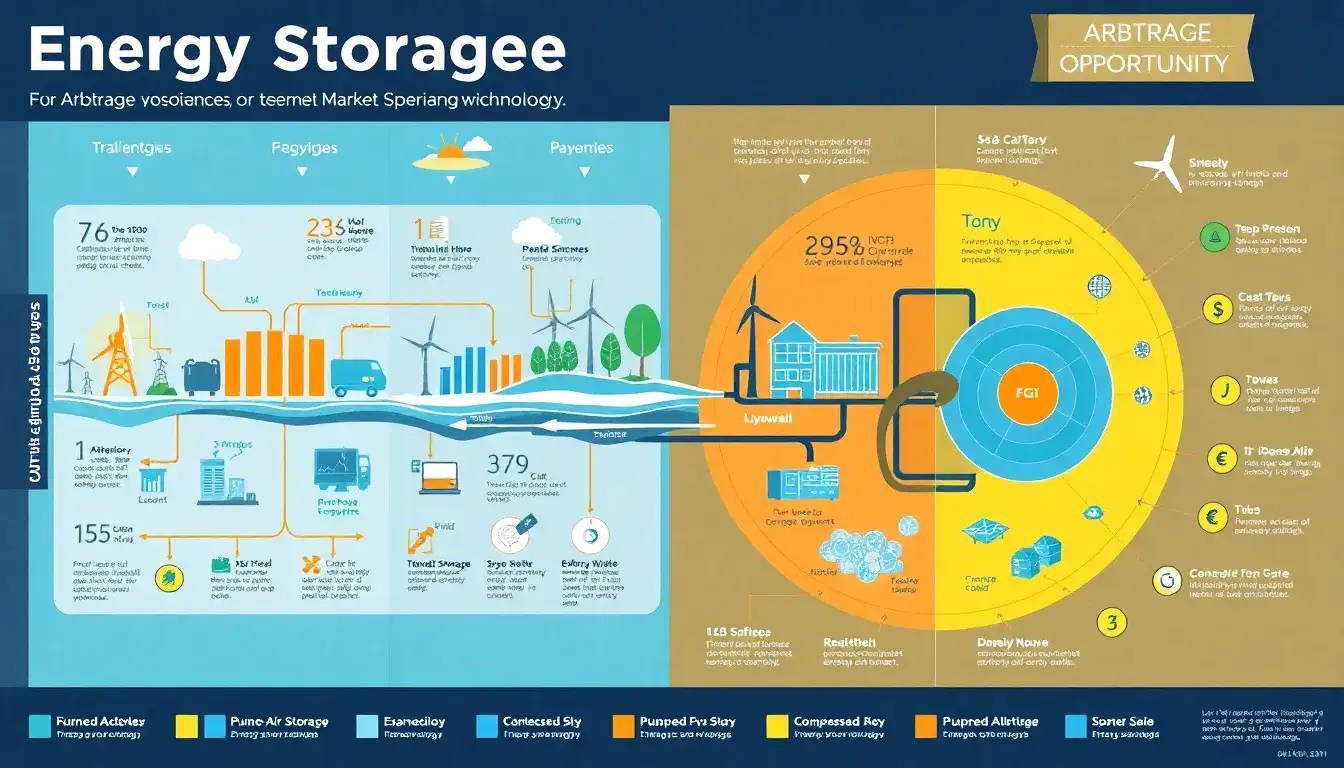
Different types of energy storage technologies offer varying opportunities for energy arbitrage, which exploits price differences by storing electricity when prices are low and dispatching it when prices are high. The comparison involves factors such as duration, efficiency, capital costs, and market participation.
Key Energy Storage Technologies in Arbitrage
1. Battery Energy Storage Systems (BESS) – Lithium-Ion Batteries
- Lithium-ion batteries are the predominant technology currently used for energy arbitrage due to their fast response times and ability to cycle daily.
- They capitalize on predictable daily price patterns via Time-of-Use (TOU) strategies: charging during off-peak hours (low prices) and discharging during peak hours (high prices).
- Batteries provide high round-trip efficiency (typically around 85-95%) which maximizes profitability in arbitrage.
- They are particularly effective in intraday or day-ahead markets where electricity price volatility is significant.
- Examples include utilities deploying Tesla batteries for peak demand management and grid reliability.
2. Pumped Storage Hydropower
- Pumped hydro is the largest and longest-established form of grid-scale storage.
- It typically supports arbitrage over longer durations (hours), relying on geographic elevation differences to store energy.
- While it has high capacity, the capital intensity and geographic limitations reduce flexibility.
- Efficiency ranges from 70-80%, lower than batteries, which impacts arbitrage margins.
- It is often used for bulk energy shifting rather than quick daily cycling.
3. Other Technologies (e.g., Flow Batteries, Compressed Air, Thermal Storage)
- Flow batteries and thermal storage technologies provide different duration and cycling characteristics but are less common in arbitrage due to cost or efficiency constraints.
- These can be suitable for longer-duration arbitrage or seasonal applications but lack the fast response needed for short-term price spikes.
- Cost and technology maturity are still barriers for widespread arbitrage participation.
Comparison of Arbitrage Opportunities
| Technology | Charge/Discharge Speed | Cycle Life & Duration | Efficiency (%) | Capital Cost | Market Suitability | Arbitrage Opportunity |
|---|---|---|---|---|---|---|
| Lithium-ion Batteries | Very fast (seconds) | Daily cycling (hours) | 85-95 | Moderate to High | Intraday, Day-ahead markets, TOU | High opportunity due to fast cycling & efficiency |
| Pumped Storage Hydropower | Moderate (minutes to hours) | Long duration (hours) | 70-80 | Very High | Bulk energy shifting, peak demand | Moderate, best for long-duration arbitrage |
| Flow Batteries | Moderate | Medium to long duration | ~70-80 | High | Longer duration arbitrage and backup | Limited, due to cost and efficiency |
| Thermal Storage | Slow | Seasonal to daily | Variable | Moderate | Niche applications, often co-located with generation | Limited, for seasonal arbitrage |
Summary
- Lithium-ion batteries dominate short-term arbitrage with fast response, high efficiency, and suitable capital costs for frequent cycling, making them ideal for daily or intraday price fluctuations.
- Pumped hydro is effective for longer duration and bulk arbitrage but limited by geography and lower efficiency.
- Other storage technologies have niche roles for longer-term or seasonal arbitrage but generally do not compete with batteries for short-term market participation.
Thus, arbitrage opportunities are highest for battery energy storage systems due to their flexibility and efficiency, while pumped storage serves as a bulk energy arbitrage option. Emerging technologies are still developing to optimize arbitrage profitability in various market segments.
Original article by NenPower, If reposted, please credit the source: https://nenpower.com/blog/how-do-different-types-of-energy-storage-technologies-compare-in-terms-of-arbitrage-opportunities/

