

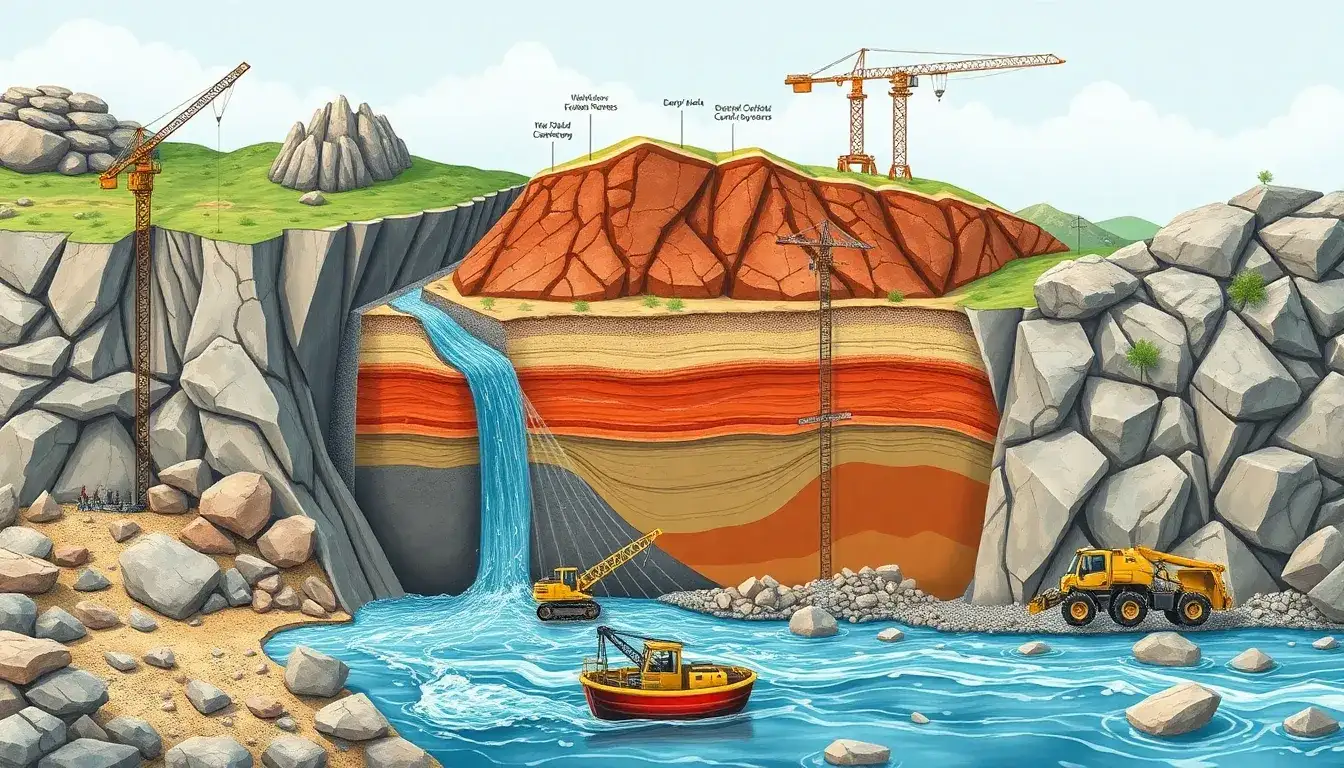
Different rock formations can have a notable impact on the construction costs of pumped hydro storage (PHS) facilities, primarily through their influence on excavation, tunneling, and civil engineering requirements. Although the publicly available detailed cost models for PHS, such as those developed by the National Renewable Energy Laboratory (NREL), focus on parameters like head, reservoir volume, and penstock type more explicitly, the geological conditions—including rock type and formation stability—play an important underlying role in cost determination.
Influence of Rock Formations on PHS Construction Costs
- Excavation and Tunneling Costs: Harder and more fractured rock formations can increase excavation difficulty and duration, requiring more advanced drilling and blasting techniques and potentially specialized equipment. Softer or more homogeneous formations may reduce excavation time and costs. For example, deeper or more complex tunnels through challenging rock increase civil construction costs significantly.
- Geotechnical Stability and Support Requirements: Some rock formations require extensive rock support systems (such as rock bolts, shotcrete, or concrete lining) to ensure tunnel and cavern stability, further increasing capital costs. Stable rock formations reduce the need for such reinforcements, thus lowering construction expenditures.
- Site-Specific Design Adaptations: The geological context may influence the layout of upper and lower reservoirs, penstocks, and penstock alignments. Sites with favorable rock formations allow more straightforward construction methods and designs, reducing costs relative to more complex geological settings.
Cost Model Sensitivity to Geology
According to NREL’s bottom-up cost model for pumped storage hydropower, while total project costs are highly sensitive to parameters such as hydraulic head and storage duration, they are comparatively less sensitive to geology type or penstock type at the screening-level estimate stage. This suggests that although geology influences costs, other factors dominate the cost structure at higher-level estimations.
Summary
| Aspect | Impact of Rock Formations |
|---|---|
| Excavation & Tunneling | Hard rock increases costs due to drilling/blasting complexity |
| Rock Support & Stability | Unstable formations require costly reinforcements |
| Reservoir & Facility Layout | Geological conditions influence design complexity and costs |
| Overall Cost Sensitivity | Geology affects costs but less than factors like head or storage |
In conclusion, different rock formations influence construction costs of pumped hydro storage facilities mainly through their impact on excavation difficulty and civil works complexity. However, current publicly available cost models indicate that geology plays a secondary role in cost sensitivity compared to fundamental design parameters like head and reservoir size. This underscores the importance of thorough geotechnical investigations early in project development to optimize design and budgeting.
Original article by NenPower, If reposted, please credit the source: https://nenpower.com/blog/how-do-different-rock-formations-influence-the-construction-costs-of-pumped-hydro-storage-facilities/

