

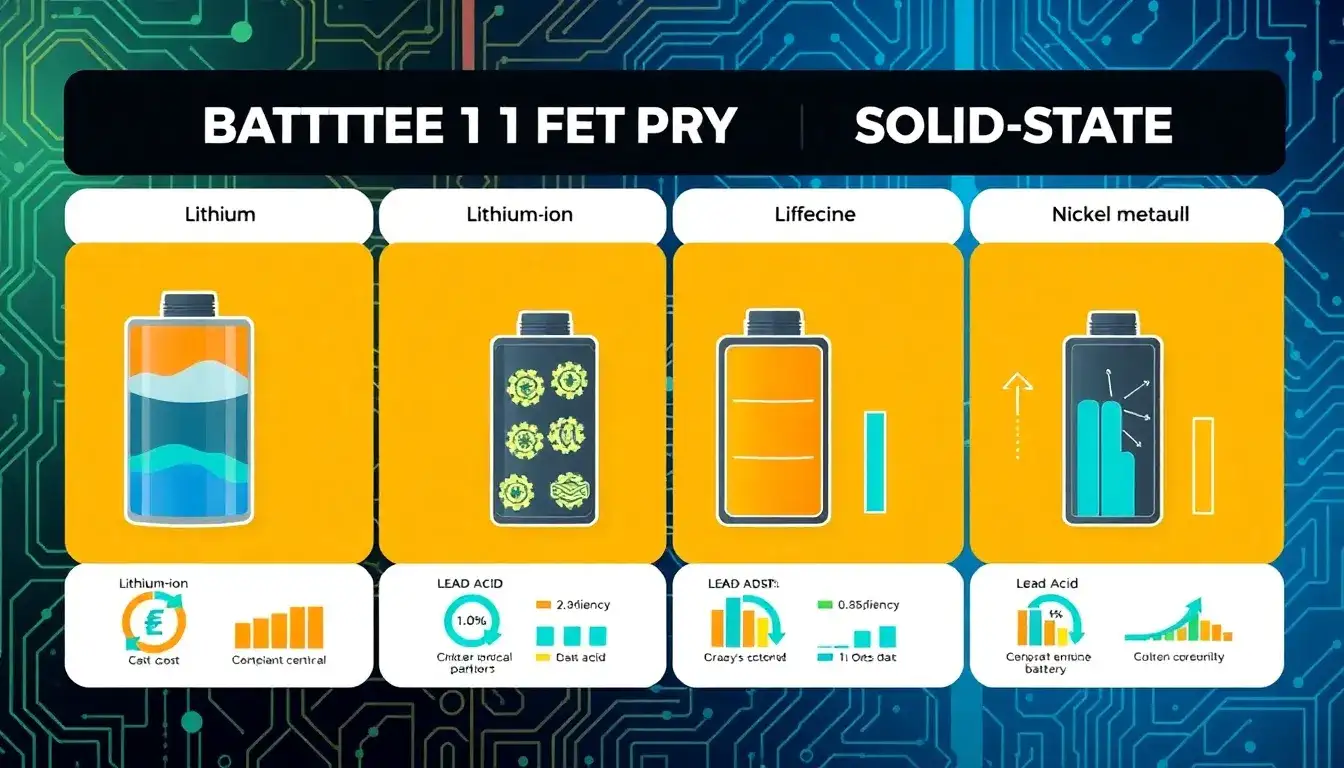
Different battery technologies vary significantly in terms of cost and efficiency, influenced by factors such as upfront price, energy density, cycle life, efficiency, and total cost of ownership over their lifespan.
Cost Comparison
Lead-Acid Batteries:
- Lead-acid batteries have the lowest upfront cost among common battery technologies, with initial investments often ranging from $50 to $200 per kWh depending on the system scale and specifics.
- They are cost-effective for applications with less frequent cycling and shorter lifespan needs.
- Despite low initial costs, lead-acid batteries require more frequent replacements due to shorter cycle life and lower efficiency, which raises long-term costs.
- Total cost of ownership tends to be higher over time because lead-acid batteries typically last 5 to 10 years with about 500 to 1000 cycles and efficiency at 70-80%.
Lithium-Ion Batteries:
- Lithium-ion batteries have significantly higher initial costs, approximately up to three times the cost of lead-acid batteries per kWh at installation.
- However, lithium-ion batteries have much higher energy density (3 to 3.5 times lead-acid), longer cycle life (2000 to 3000+ cycles or more), and higher efficiency (~85-90%).
- Their longer life and higher efficiency reduce replacement frequency and operational energy losses.
- When calculating total cost of ownership including installation, replacement, and maintenance over the battery’s lifetime, lithium-ion batteries actually incur lower costs per usable kWh than lead-acid—about 2.8 times cheaper per usable kWh per cycle in one study.
Flow Batteries:
- Flow batteries have high initial costs ($200 to $500 per kWh) due to complex components and electrolytes but offer very long cycle life (10,000+ cycles) and good efficiency (75-85%).
- Their lifespan can exceed 20 years, making them suitable for long-duration storage despite the upfront cost.
- Over a long period, flow batteries may have a comparable or lower total cost of ownership compared to lithium-ion batteries, particularly in stationary, large-scale applications.
Sodium-Ion Batteries:
- Sodium-ion batteries are emerging with costs currently estimated between $150 to $250 per kWh, positioned below lithium-ion costs but above lead-acid.
- They have comparable efficiency and cycle life to lithium-ion (around 85-90% efficiency and 1000 to 3000 cycles) with a lifespan of 10 to 15 years.
- Costs are expected to decrease as the technology matures, potentially making sodium-ion a competitive alternative in the future.
Efficiency and Performance
- Lead-Acid: Lower energy efficiency (70-80%) and shorter cycle life, requiring partial depth of discharge to extend battery life, which reduces usable capacity.
- Lithium-Ion: High efficiency (~85-90%), better performance at deeper discharge levels (up to 100% DoD), and longer cycle life resulting in more usable energy over time.
- Flow Batteries: Moderate to high efficiency (75-85%), excellent cycle life allowing for very long-term use with minimal degradation.
- Sodium-Ion: Efficiency and cycle life comparable to lithium-ion, but technology is less mature and evolving rapidly.
Summary Table
| Battery Technology | Initial Cost ($/kWh) | Efficiency (%) | Cycle Life (cycles) | Lifespan (years) | Total Cost of Ownership | Notes |
|---|---|---|---|---|---|---|
| Lead-Acid | 50 – 200 | 70 – 80 | 500 – 1000 | 5 – 10 | Higher due to replacements | Lowest upfront cost, large size and weight |
| Lithium-Ion | 150 – 400+ | 85 – 90 | 2000 – 3000+ | 8 – 15 | Lower per usable kWh over life | Higher upfront, better efficiency and cycle life |
| Flow Batteries | 200 – 500 | 75 – 85 | 10,000+ | 20+ | Potentially competitive over long term | Large-scale, long duration storage |
| Sodium-Ion | 150 – 250 (developing) | 85 – 90 | ~1000 – 3000 | 10 – 15 | Expected to decrease with maturity | Emerging tech, alternative to lithium |
In conclusion, lead-acid batteries remain the most cost-effective upfront but have lower efficiency and shorter life, leading to higher long-term costs. Lithium-ion batteries, despite higher initial cost, offer superior efficiency, energy density, and cycle life, resulting in a lower total cost of ownership per usable kWh. Flow batteries excel in durability and long-term applications but require significant upfront expenditure. Sodium-ion batteries are an emerging option, promising cost and performance improvements in the future.
Original article by NenPower, If reposted, please credit the source: https://nenpower.com/blog/how-do-different-battery-technologies-compare-in-terms-of-cost-and-efficiency/

