

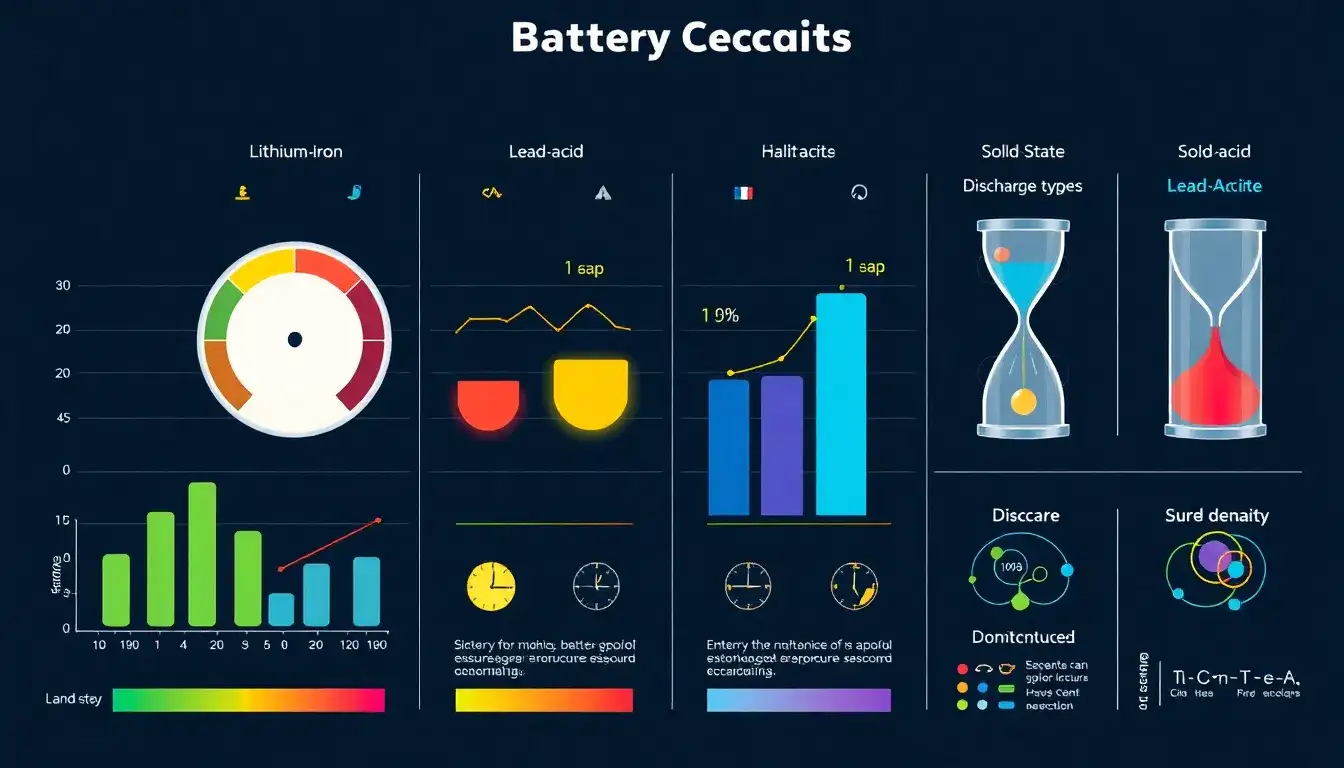
When comparing different battery chemistries, two key factors are their depth of discharge (DoD) and lifespan. Here’s how various types of batteries stack up:
Depth of Discharge (DoD)
- Lead-Acid Batteries: These batteries are not suitable for deep discharges, as doing so can significantly reduce their lifespan. They usually should not be discharged below 50% to ensure longevity.
- Nickel-Cadmium (NiCd): NiCd batteries can handle deep discharges (80%) but may require periodic reconditioning.
- Nickel-Metal Hydride (NiMH): They can also handle deep discharges but might have mild memory effects if not fully discharged regularly.
- Lithium-Ion (Li-ion): Li-ion batteries, including various chemistries like LCO, NMC, LFP, and LTO, generally support deeper discharges (up to 80%) without significant degradation. However, their lifespan can decrease with frequent deep discharges.
Lifespan
- Lead-Acid Batteries: Have a relatively short lifespan of about 200-300 cycles at 80% DoD.
- Nickel-Cadmium (NiCd): Can last up to 1,000 cycles, though they’re less commonly used due to toxicity and environmental concerns.
- Nickel-Metal Hydride (NiMH): Typically last between 300 to 500 cycles.
- Lithium-Ion (Li-ion)
- LCO (Lithium Cobalt Oxide): Offers around 500-1,000 cycles.
- NMC (Lithium Nickel Manganese Cobalt Oxide): Similar to LCO, around 500-1,000 cycles.
- LFP (Lithium Iron Phosphate): Lasts 2,500-12,000 cycles, making them very durable for energy storage applications.
- LTO (Lithium Titanate): Known for an extremely long lifespan of up to 20,000 cycles.
Summary
| Chemistry | Depth of Discharge | Lifespan (Cycles) |
|---|---|---|
| Lead-Acid | Limited, avoid below 50% | 200-300 |
| NiCd | High, but periodic reconditioning needed | Up to 1,000 |
| NiMH | High, but may have memory effect | 300-500 |
| Li-ion (LCO) | High, up to 80% | 500-1,000 |
| Li-ion (NMC) | High, up to 80% | 500-1,000 |
| Li-ion (LFP) | High, up to 80% | 2,500-12,000 |
| Li-ion (LTO) | High, up to 80% | Up to 20,000 |
In summary, lithium-ion batteries, particularly LFP and LTO, offer superior depth of discharge and lifespan compared to other chemistries, making them ideal for applications where these factors are crucial.
Original article by NenPower, If reposted, please credit the source: https://nenpower.com/blog/how-do-different-battery-chemistries-compare-in-terms-of-depth-of-discharge-and-lifespan/

