

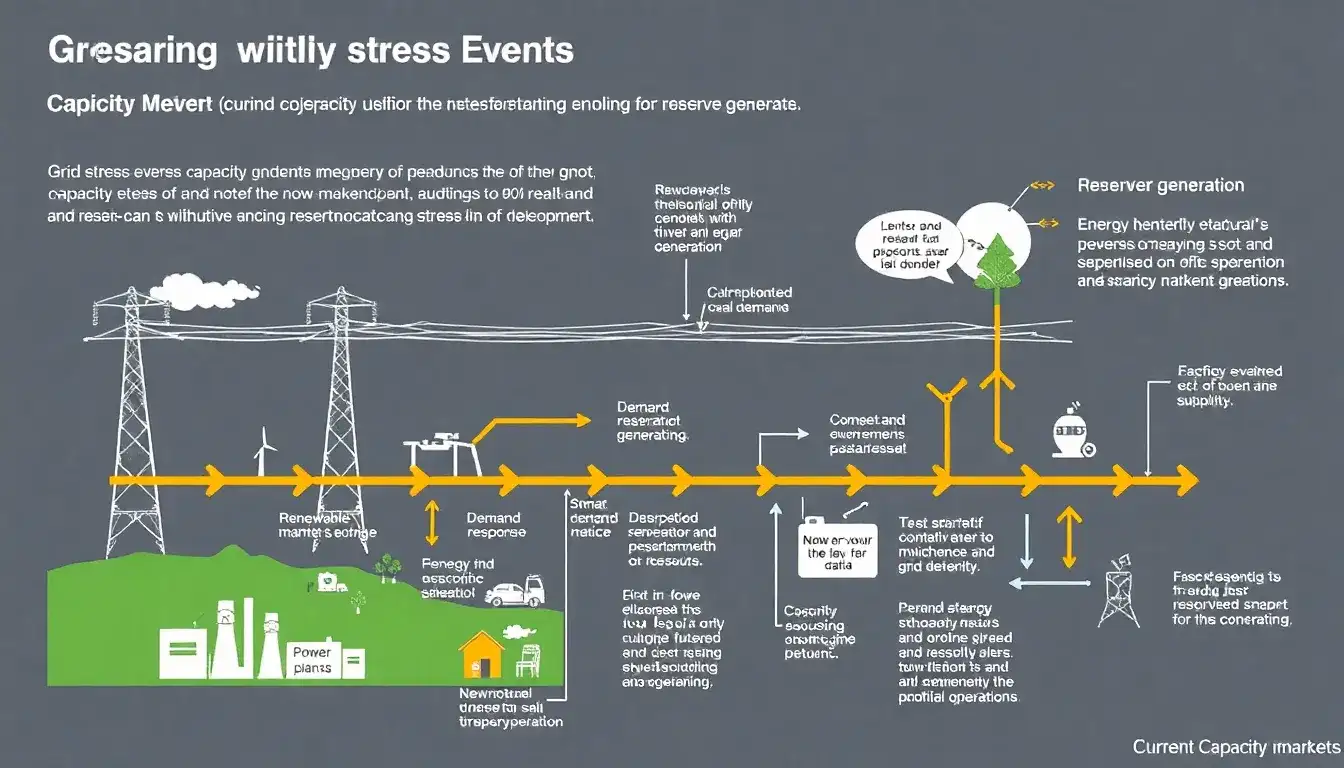
Current capacity markets define “grid stress events” (also called “stress events” or “system stress events”) primarily as extreme shortages of electricity supply relative to demand, typically occurring during periods of very high demand or limited generation availability. These events are formally recognized only when a demand control event has actually occurred and then confirmed after post-event analysis. For example, in the UK, a system stress event is declared when demand control measures are enacted and verified afterward.
How Capacity Markets Address Grid Stress Events:
- Notification and Activation: Capacity providers are notified several hours (e.g., four hours) before a potential stress event that they may need to deliver their contracted capacity. If the stress event proceeds (i.e., demand control is instigated and not cancelled), providers must fulfill their obligations.
- Payment Based on Availability: Capacity markets pay providers mainly for being available and on standby to respond during stress events rather than for actual energy delivered. This ensures capacity resources remain ready even if not ultimately called upon during such events.
- Ensuring Sufficient Capacity: By contracting and compensating capacity ahead of time, these markets incentivize power resources (generation and sometimes storage) to be available to meet peak demand and avoid blackouts or shortages.
Evolving Challenges and Limitations:
- Traditional capacity markets define grid stress events narrowly as short-term peaks in demand that outstrip available generation, but with increasing renewable penetration, stress events can also be prolonged periods of under-generation (e.g., low wind or solar output).
- Current capacity market designs, which focus on availability rather than continuous energy delivery over extended periods, do not adequately incentivize resources like long-duration energy storage that can sustain supply during such extended stress events.
- As a result, capacity markets are being called on to evolve their definitions and mechanisms to better capture the value of resources that provide sustained reliability, especially in renewables-heavy grids, and to support regulatory reforms that enable long-duration storage and other flexible, firm capacity solutions.
In summary, current capacity markets define grid stress events as times of extreme supply shortages requiring demand control measures, and address them by ensuring and compensating the availability of capacity to meet peak demands. However, they face growing challenges in adapting to changing grid conditions driven by renewable integration, necessitating updates to better handle sustained or new types of stress events beyond short-term peaks.
Original article by NenPower, If reposted, please credit the source: https://nenpower.com/blog/how-do-current-capacity-markets-define-and-address-grid-stress-events/

