

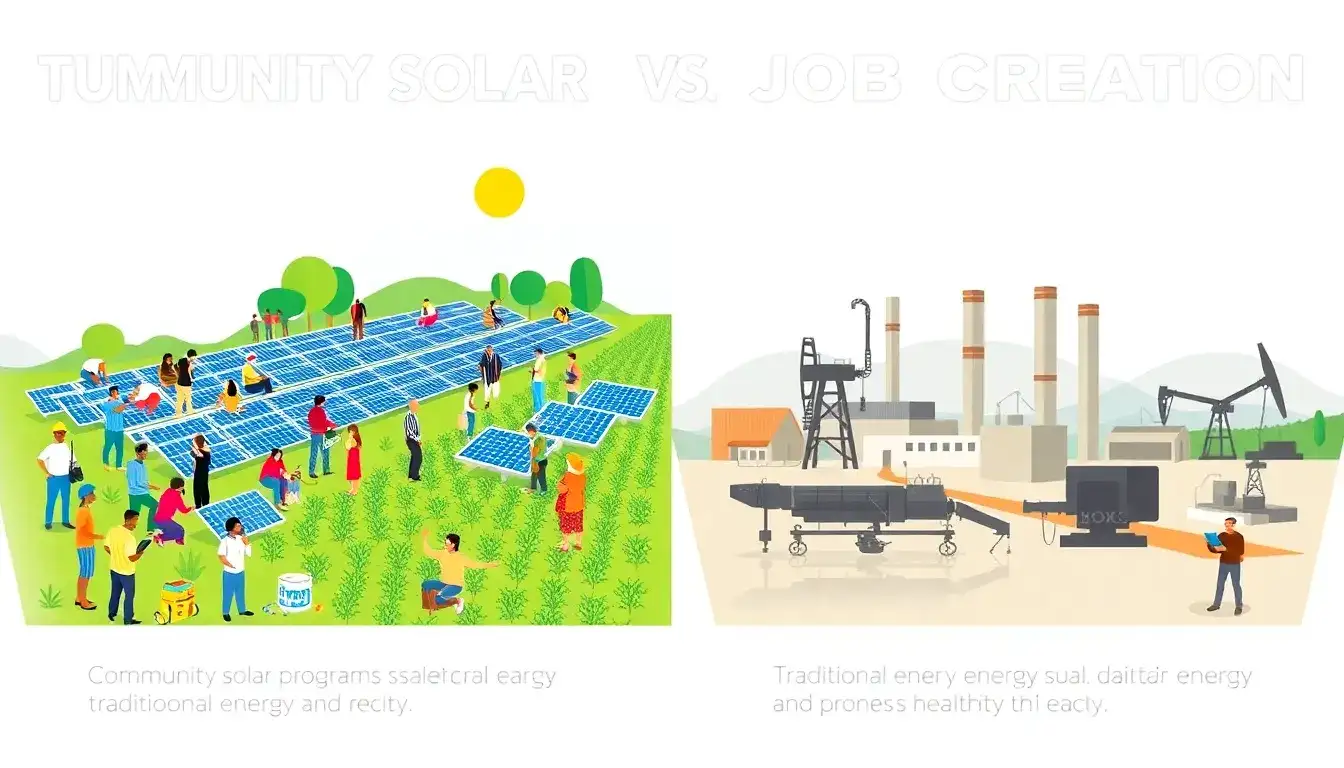
Job Creation and Economic Impact
- A typical 5-megawatt (MW) community solar project generates approximately 100 local jobs and $14 million in local economic activity, indicating a high job-to-capacity ratio relative to its scale.
- At scale, 1 gigawatt (GW) of community solar development can support over 18,000 local jobs and generate $2.8 billion in state economic activity.
- Nationwide, community solar efforts could unlock more than $120 billion in economic activity.
Comparison with Traditional Energy Projects
- Traditional large-scale energy projects, such as utility-scale solar farms or fossil fuel plants, often take a decade or more to build, while community solar projects typically come online within 12 to 18 months.
- Large-scale projects might centralize benefits away from local communities, whereas community solar projects are built in the communities they serve, often using existing distribution infrastructure and underutilized spaces like fallowed farmland or rooftops.
- These community-based projects tend to generate more direct, local employment opportunities, including installation, operation, and maintenance jobs, whereas traditional projects may create fewer local jobs relative to their capacity.
Workforce Development and Equity
- Community solar initiatives often emphasize workforce development with programs targeted at low-income, disadvantaged, and Tribal communities, aiming to create high-quality, local job opportunities.
- Examples include Pennsylvania’s Solar for All program that integrates workforce training, apprenticeships, and partnerships with labor unions for skilled solar labor.
- Tribal-centered programs like the Western Indigenous Network Solar for All program aim for 50% of work to be performed by local Tribal workforce, creating sustainable career pathways.
Summary
| Factor | Community Solar Initiatives | Traditional Energy Projects |
|---|---|---|
| Job Creation Rate | ~100 jobs per 5 MW; 18,000 jobs per 1 GW | Lower local job density relative to project size |
| Economic Impact | $14 million per 5 MW; $2.8 billion per 1 GW locally | Economic benefits more centralized, less local |
| Project Timeline | 12–18 months | Often 10+ years |
| Local Community Benefits | High; projects built in served communities | Often benefit distant or centralized locations |
| Workforce Development | Strong focus on local skilled labor, apprenticeships, equity | Less targeted local workforce programs |
Community solar initiatives thus compare favorably to traditional energy projects by generating more local jobs faster, with greater emphasis on community economic benefits and workforce inclusion.
Original article by NenPower, If reposted, please credit the source: https://nenpower.com/blog/how-do-community-solar-initiatives-compare-to-traditional-energy-projects-in-terms-of-job-creation/

