

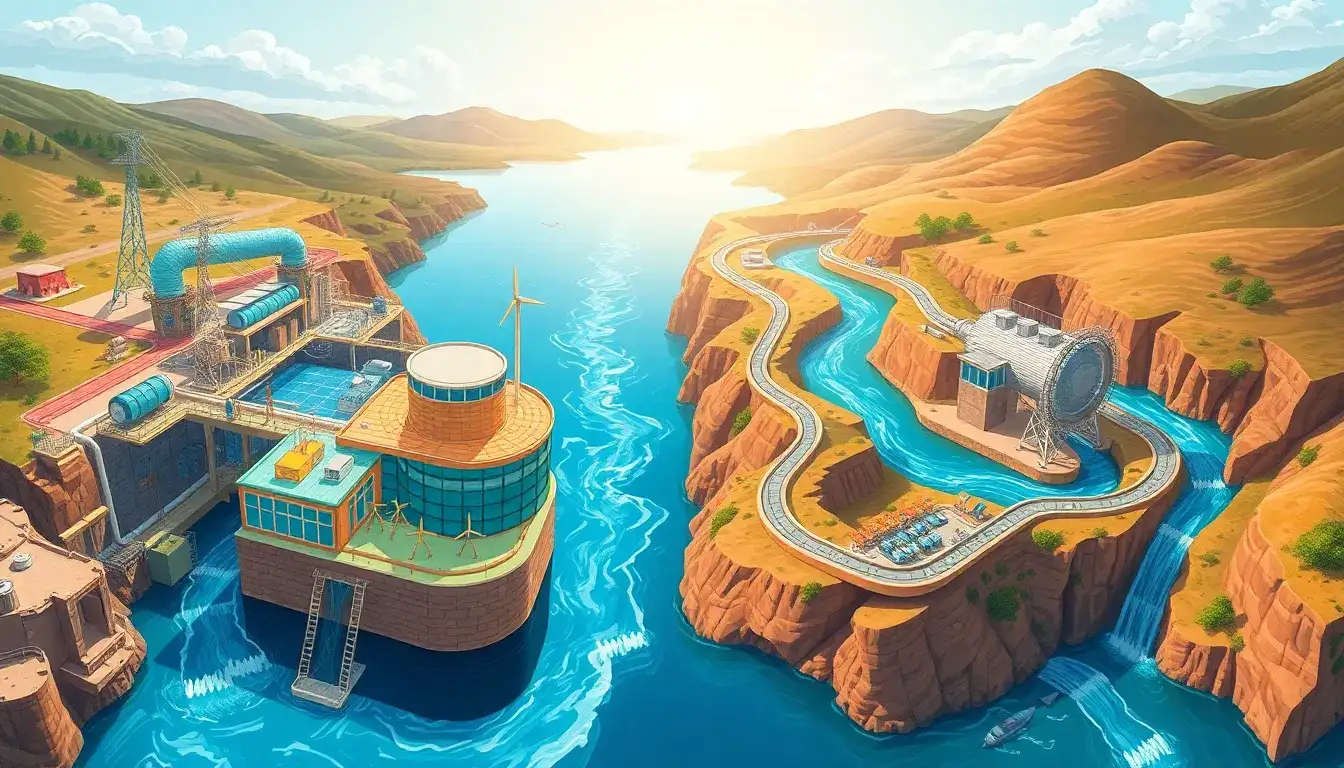
Closed-loop pumped storage systems differ from traditional (open-loop) pumped storage systems primarily in their configuration, environmental impact, and siting flexibility.
Traditional (Open-Loop) Pumped Storage
- These systems are directly connected to a natural water source such as a river, lake, or reservoir, which serves as either the upper or lower reservoir.
- Water is pumped from the natural lower reservoir to an upper reservoir during low electricity demand and released back to generate power during high demand.
- The open connection to natural water bodies means potential impacts on aquatic and terrestrial ecosystems due to water level fluctuations, water quality changes, and habitat disruption.
- Their siting depends on proximity to suitable natural water bodies, limiting location options.
Closed-Loop Pumped Storage
- Closed-loop systems operate with two artificial reservoirs that are not directly connected to natural water bodies. Both reservoirs are isolated from natural surface water, creating a contained system.
- Water circulates only between these closed reservoirs, pumped up during low demand and released down to generate electricity during peak demand.
- This isolation greatly reduces environmental impacts such as disruption to riverine or lake ecosystems, water quality degradation, and aquatic habitat disturbances. It provides opportunities to minimize environmental effects on aquatic and terrestrial habitats.
- Because they do not rely on natural water bodies, closed-loop projects offer more flexibility in siting, often allowing development in locations unsuitable for open-loop systems.
- They are gaining increased interest and acceptance due to these environmental and siting advantages as renewable energy integration grows.
Summary Table
| Feature | Open-Loop Pumped Storage | Closed-Loop Pumped Storage |
|---|---|---|
| Connection to natural water | Direct connection (river, lake) | No direct connection, isolated reservoirs |
| Environmental impact | Higher potential impact on aquatic and terrestrial habitats due to hydrologic connection | Reduced environmental impacts; containment limits ecosystem disruption |
| Site selection flexibility | Limited to locations near suitable natural water bodies | Greater flexibility, can be sited away from natural water bodies |
| Adoption trend | Traditional and more common | Increasing interest for environmental benefits and flexibility |
In essence, closed-loop systems function similarly to traditional pumped storage in terms of energy storage mechanics but distinguish themselves by their enclosed design that reduces environmental impact and expands potential development sites.
Original article by NenPower, If reposted, please credit the source: https://nenpower.com/blog/how-do-closed-loop-systems-differ-from-traditional-pumped-storage-systems/

