

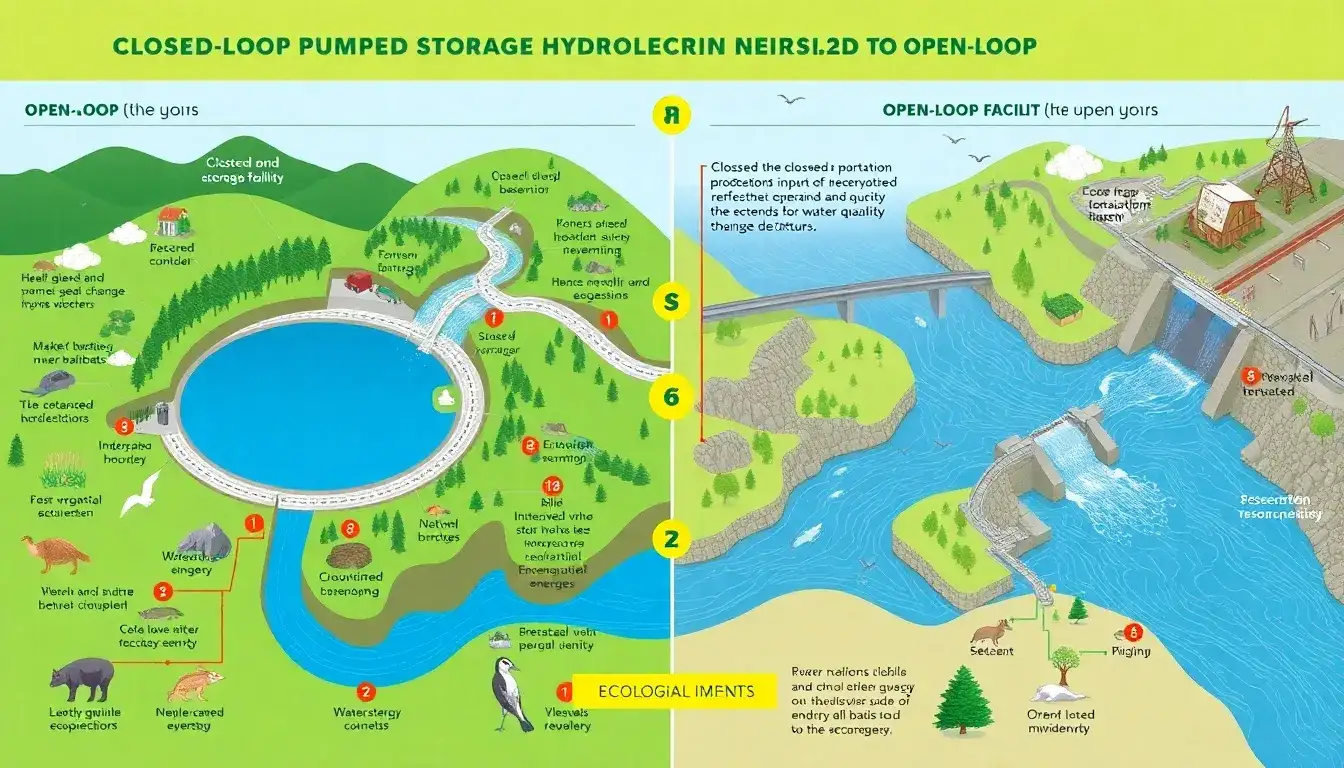
Closed-loop pumped storage hydropower (PSH) facilities generally have a different and often reduced environmental impact on local ecosystems compared to open-loop PSH systems due to their distinct operational and structural characteristics.
Key Differences in Environmental Impacts
Water Interaction and Aquatic Ecosystems:
- Closed-loop PSH systems are not continuously connected to natural flowing water bodies, unlike open-loop systems that directly interact with rivers or lakes. This isolation limits their impacts on aquatic ecosystems, such as disruption of fish habitats and water quality changes, which are more common in open-loop systems.
- Because closed-loop systems operate off-stream, they minimize the alteration of natural waterways and reduce the risk of affecting aquatic biodiversity.
Local vs. Broader Environmental Effects:
- Closed-loop PSH tends to have more localized and shorter-duration environmental effects since their reservoirs and operation are self-contained, whereas open-loop systems can have broader impacts through continuous interaction with natural water flows.
- However, closed-loop systems may impact geology, soils, and groundwater more significantly, especially if they rely on groundwater for filling or refilling reservoirs, potentially leading to issues like groundwater depletion or land subsidence.
Flexibility and Siting Impacts:
- Closed-loop facilities provide greater flexibility in siting because they do not require connection to a natural water body, allowing developers to avoid sensitive ecological zones and reduce impacts on protected aquatic habitats.
Greenhouse Gas Emissions and Lifecycle Impacts:
- While not directly about ecosystems, closed-loop PSH facilities tend to have lower lifecycle greenhouse gas emissions compared to alternative energy storage technologies, partly due to less environmental disruption and more efficient operation, especially when powered by grids rich in renewable energy.
- Both closed- and open-loop PSH share some environmental impacts related to construction activities and material use, but these impacts are similar across types.
Summary Table Comparing Closed-Loop and Open-Loop PSH Impacts
| Environmental Aspect | Closed-Loop PSH | Open-Loop PSH |
|---|---|---|
| Connection to Natural Water | No continuous connection (off-stream) | Continuous connection to rivers/lakes |
| Impact on Aquatic Ecosystems | Limited aquatic disruption | Potentially significant aquatic impacts |
| Localized vs. Broad Effects | More localized, shorter duration impacts | Broader and longer-term aquatic impacts |
| Groundwater and Soil Impact | Potentially higher impact due to groundwater use | Generally lower groundwater impact |
| Siting Flexibility | High, can avoid sensitive ecological zones | Limited, must be near natural water body |
| Greenhouse Gas Emissions | Lower lifecycle emissions with renewable grid | Similar emissions, dependent on grid mix |
In summary, closed-loop PSH facilities tend to reduce negative impacts on aquatic ecosystems and offer greater flexibility for environmentally sensitive siting compared to open-loop PSH. However, they may increase impacts on groundwater and soils locally due to their reliance on contained reservoirs and potential groundwater sources. This makes closed-loop PSH a promising option for minimizing ecological disruption while providing grid-scale energy storage.
Original article by NenPower, If reposted, please credit the source: https://nenpower.com/blog/how-do-closed-loop-psh-facilities-impact-local-ecosystems-compared-to-open-loop-ones/

