

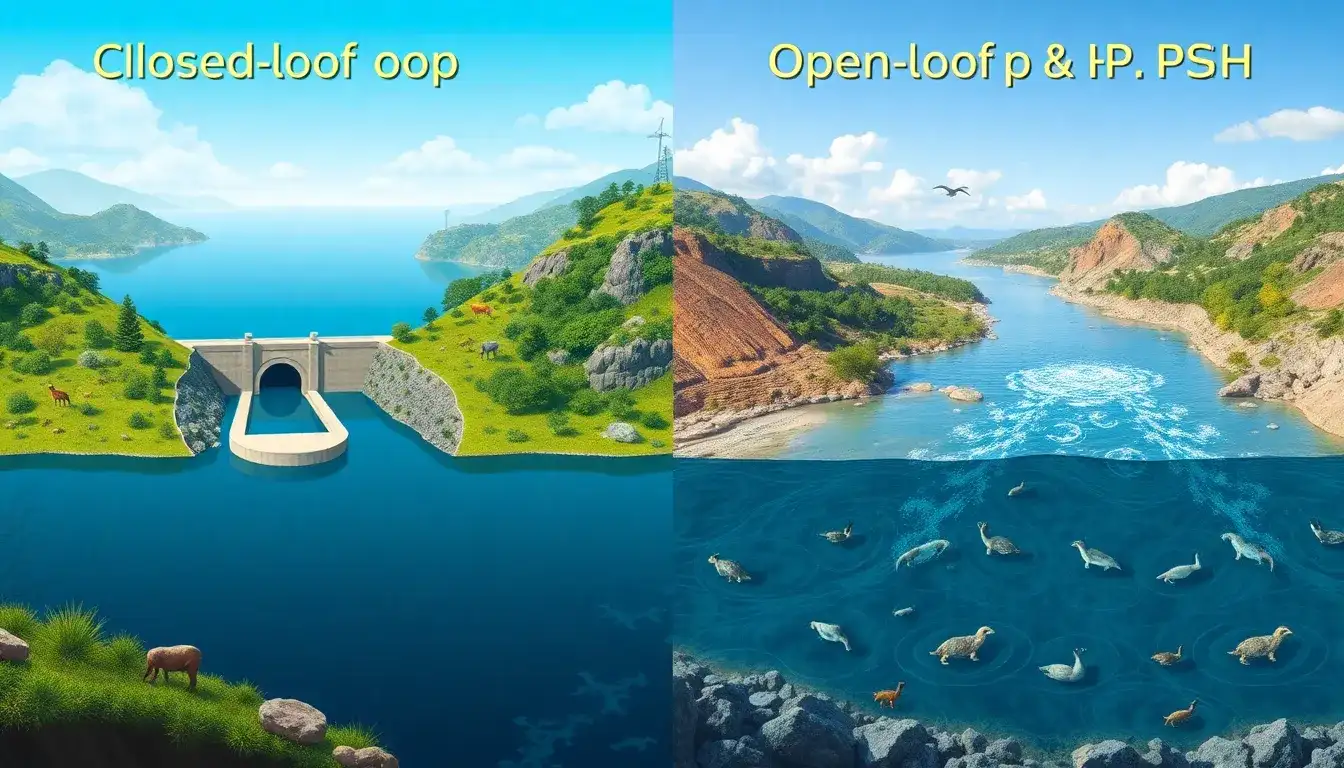
Closed-loop pumped storage hydropower (PSH) facilities generally have a lower and more localized environmental impact compared to traditional open-loop PSH facilities, mainly due to differences in water source connection and site characteristics.
Key Environmental Impact Differences Between Closed-Loop and Open-Loop PSH:
- Water Connection and Aquatic Impact:
Open-loop PSH facilities are continuously connected to natural flowing water bodies, such as rivers or lakes, which can lead to significant impacts on aquatic ecosystems through water diversion, habitat alteration, and potential changes in water quality. In contrast, closed-loop PSH systems are “off-stream” and not continuously linked to naturally flowing water, minimizing their direct effects on aquatic resources. This results in generally lower aquatic impacts for closed-loop systems. - Terrestrial and Localized Effects:
Closed-loop PSH projects tend to have more localized and shorter-duration environmental impacts since they are often sited away from natural streams and rivers. This “off-stream” siting also gives closed-loop projects greater flexibility in location, potentially avoiding sensitive terrestrial habitats affected by open-loop projects. However, closed-loop projects, especially those using groundwater or underground reservoirs, may have higher impacts on geology, soils, and groundwater compared to open-loop projects, which is a trade-off that needs consideration. - Water Sourcing and Rights:
Because closed-loop systems are not connected to a natural water body, water sourcing can present challenges related to rights, timing, and quantities, potentially causing delays or contention during project development. Open-loop systems draw water directly from natural sources, which can be easier to manage hydrologically but with greater ecological disturbance. - Greenhouse Gas Emissions and Life Cycle Considerations:
Life cycle assessments indicate that most greenhouse gas (GHG) emissions associated with closed-loop PSH arise from the energy used to pump water, often linked to the grid’s energy mix rather than the storage method itself. Overall, PSH technologies, including closed-loop, have relatively low GHG emissions compared to other energy storage technologies. Closed-loop PSH’s siting and operational flexibility can further reduce environmental footprints, especially when paired with renewable energy sources.
Summary Table:
| Environmental Aspect | Closed-Loop PSH | Open-Loop PSH |
|---|---|---|
| Connection to natural water | Not continuously connected (off-stream) | Continuously connected to natural water |
| Aquatic ecosystem impact | Generally lower, localized | Higher, continuous aquatic disturbance |
| Terrestrial and geological impact | Potentially higher impacts on soils, geology, groundwater (especially underground) | Potentially broader terrestrial impacts due to location |
| Water sourcing | Complex water rights, potential delays | Easier direct sourcing, but more ecological disturbance |
| Greenhouse gas emissions (life cycle) | Primarily from energy grid mix, generally low GHG overall | Similar GHG profile but depends on grid mix and operations |
| Site flexibility | Greater flexibility due to off-stream location | More limited due to dependence on river/lake location |
In conclusion, closed-loop PSH offers environmental advantages by reducing impacts on aquatic ecosystems and providing greater siting flexibility, which can allow for better avoidance and mitigation of environmental risks. However, they may have higher localized impacts on groundwater and soils, and water rights complexities must be managed carefully. Overall, closed-loop PSH may present a more environmentally sustainable option compared to open-loop PSH, particularly when integrated with renewable energy grids.
Original article by NenPower, If reposted, please credit the source: https://nenpower.com/blog/how-do-closed-loop-psh-facilities-compare-to-open-loop-facilities-in-terms-of-environmental-impact/

