

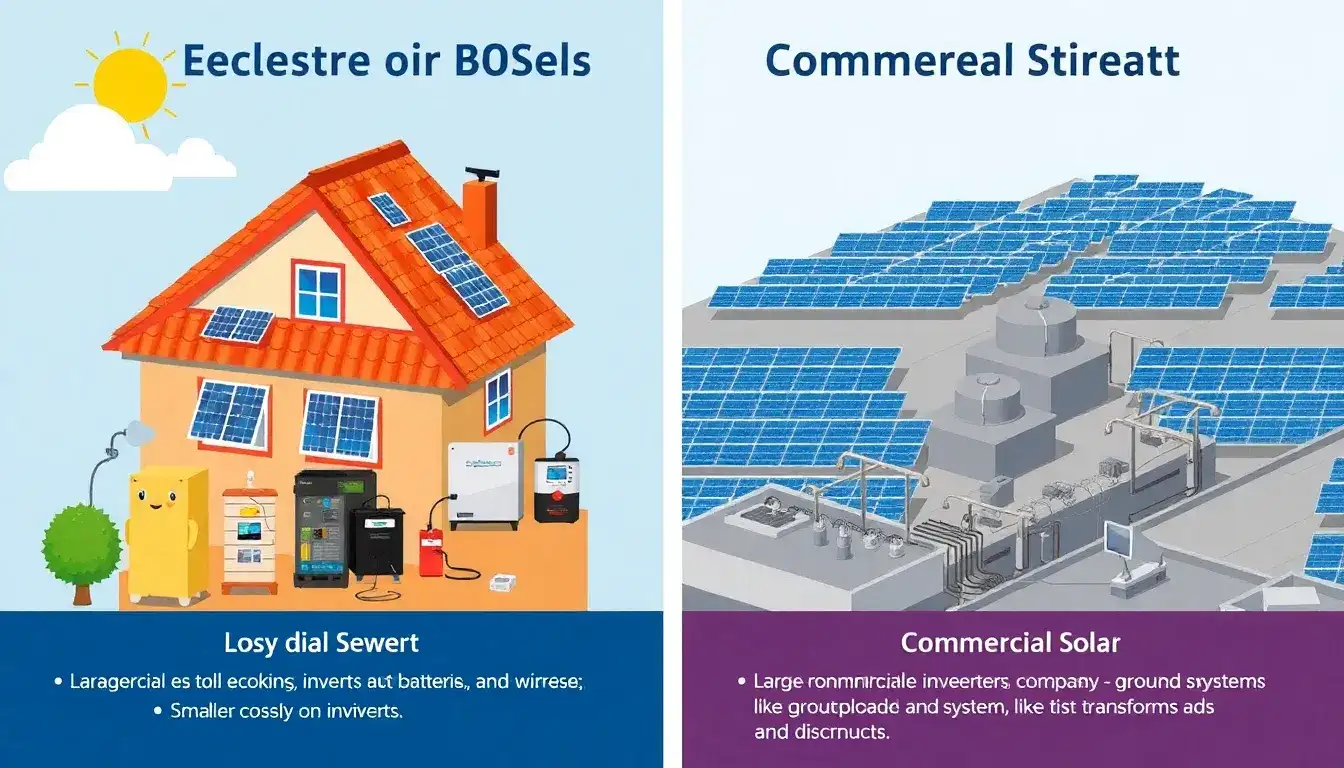
Balance of System (BOS) costs in solar systems include all the expenses associated with components other than solar panels. These components are crucial for the system’s operation, efficiency, and reliability. The variation in BOS costs between residential and commercial solar systems is influenced by several factors.
Factors Influencing BOS Costs
- Scale and Complexity: Commercial solar systems are generally larger and more complex than residential systems. This complexity often requires more sophisticated BOS components, such as larger inverters and more extensive wiring systems, leading to higher costs.
- Inverter Costs: Commercial systems typically use larger inverters capable of handling higher power outputs. These inverters are more expensive than those used in residential systems.
- Mounting Hardware: While residential systems often use rooftop mounting, commercial systems may use ground-mounted racking systems, which can involve more substantial foundation work and materials.
- Installation Labor: Labor costs for installation are generally higher for commercial systems due to their size and complexity.
- Grid Connection Requirements: Commercial systems often require more elaborate electrical connections to handle higher voltages and currents, which can increase costs.
Comparison of BOS Costs
| Component | Residential Systems | Commercial Systems |
|---|---|---|
| Inverters | Smaller capacity, less expensive | Larger capacity, more expensive |
| Mounting Hardware | Rooftop mounting, simpler | Ground-mounted or rooftop with more substantial racking |
| Installation Labor | Lower labor costs due to smaller scale | Higher labor costs due to complexity and size |
| Grid Connection | Simpler connection requirements | More complex, often requiring medium voltage connections |
| Battery Systems | Optional, typically smaller capacity | Often larger capacity for greater energy storage needs |
Percentage of Total Costs
BOS costs typically account for 10% to 50% of total solar system costs, depending on system size and complexity. For residential systems, these costs might be on the lower end of this range, while commercial systems might approach the higher end due to their larger scale and complexity.
In summary, while both residential and commercial solar systems require similar types of BOS components, commercial systems generally incur higher costs due to their larger size and complexity.
Original article by NenPower, If reposted, please credit the source: https://nenpower.com/blog/how-do-bos-costs-vary-between-residential-and-commercial-solar-systems/

