

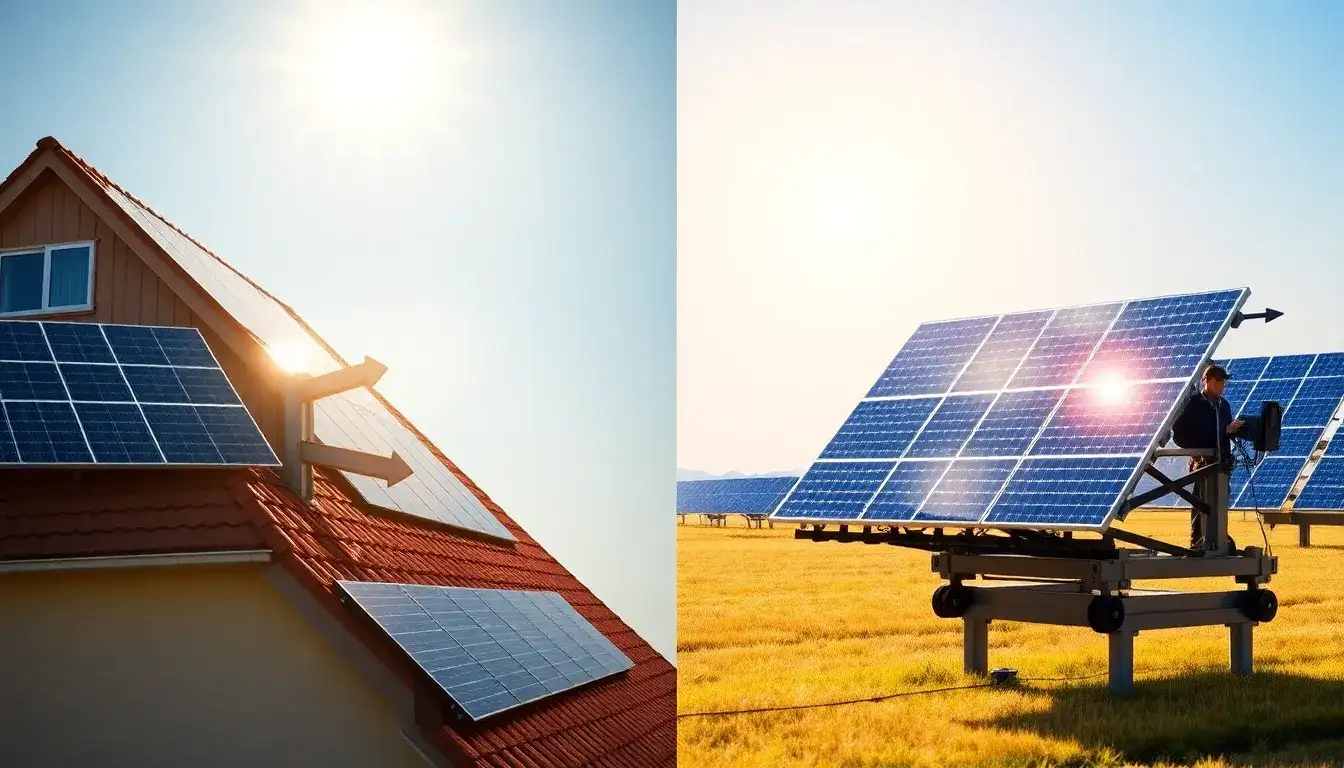
Bifacial solar panels generally produce more energy than traditional monofacial solar panels due to their ability to capture sunlight from both their front and rear sides. This dual-sided light absorption allows them to generate electricity not only from direct sunlight but also from reflected light off the ground or surrounding surfaces, which traditional panels cannot utilize.
Energy Production Comparison
-
Increased Energy Output:
Bifacial panels can achieve energy gains typically ranging from about 9% to 27% more than monofacial panels, depending on the installation environment and setup. For example, a study from LONGi found bifacial panels produced 11% more energy than standard panels in ground-mounted systems, and pairing bifacial panels with solar trackers boosted this advantage to about 27%. Data from the National Renewable Energy Laboratory (NREL) showed up to a 9% increase compared to monofacial panels under monitored conditions. -
Effect of Installation Environment:
The energy advantage of bifacial panels is highly influenced by the reflectivity (albedo) of the surfaces beneath and around the installation. Light-colored or reflective surfaces such as sand, snow, or white concrete significantly enhance bifacial gains, with energy output improvements of 3% to 30% reported based on albedo, panel height, and arrangement. -
Geographical and Structural Factors:
Bifacial panels show greater relative energy production increases in high-latitude (±60°) regions and when mounted on fixed-tilt systems or trackers designed to maximize rear side irradiance. In some cases, bifacial modules on dual-axis trackers have yielded up to 35-40% higher energy output compared to monofacial setups.
Additional Benefits
-
Durability:
Bifacial panels typically have glass on both sides, increasing their resistance to environmental factors like hail and wind, potentially extending panel life and consistent energy production over time. -
Better Use of Space and Hardware:
With higher production per panel, bifacial arrays may require fewer panels for the same output capacity, optimizing use of inverters and mounting hardware, potentially reducing balance-of-system costs in large installations.
Economic Considerations
-
Cost vs. Benefit:
Bifacial panels have a higher upfront cost, roughly less than 10% more than monofacial panels, mainly due to their dual glass or transparent backsheet design. However, the increased energy production can offset these costs over the system’s lifetime, especially in suitable environments with reflective ground surfaces and proper mounting systems. -
Best Use Cases:
Bifacial technology is best suited for commercial or utility-scale installations where panels can be elevated and installed with sufficient clearance to capture rear-side light. They are less practical for typical residential rooftop installations, where the rear side is shaded by the roof and receives minimal reflected light.
Summary Table: Bifacial vs. Traditional (Monofacial) Solar Panels
| Feature | Monofacial Solar Panels | Bifacial Solar Panels |
|---|---|---|
| Light Absorption | Front side only | Both front and rear sides |
| Energy Production Increase | Baseline | Typically 9-27% more, up to 30% in ideal conditions |
| Efficiency | Standard efficiency | Up to 30% higher with reflected light and optimal setup |
| Durability | Standard (single glass) | More durable (glass on both sides) |
| Cost | Lower upfront cost | Approx. 5-10% higher upfront cost |
| Ideal Installation | Rooftops, limited reflective surfaces | Open spaces with reflective surfaces, ground-mounted arrays |
| Suitability for Trackers | Commonly used | Enhanced energy gains with trackers |
In conclusion, bifacial solar panels outperform traditional monofacial panels in energy production primarily by utilizing reflected sunlight via their rear side. Their effectiveness depends significantly on site conditions such as ground reflectivity and mounting design. Though more expensive initially, bifacial panels can offer better long-term energy yields and return on investment in appropriate applications, particularly in large-scale or ground-mounted systems.
Original article by NenPower, If reposted, please credit the source: https://nenpower.com/blog/how-do-bifacial-solar-panels-compare-to-traditional-solar-panels-in-terms-of-energy-production/

