

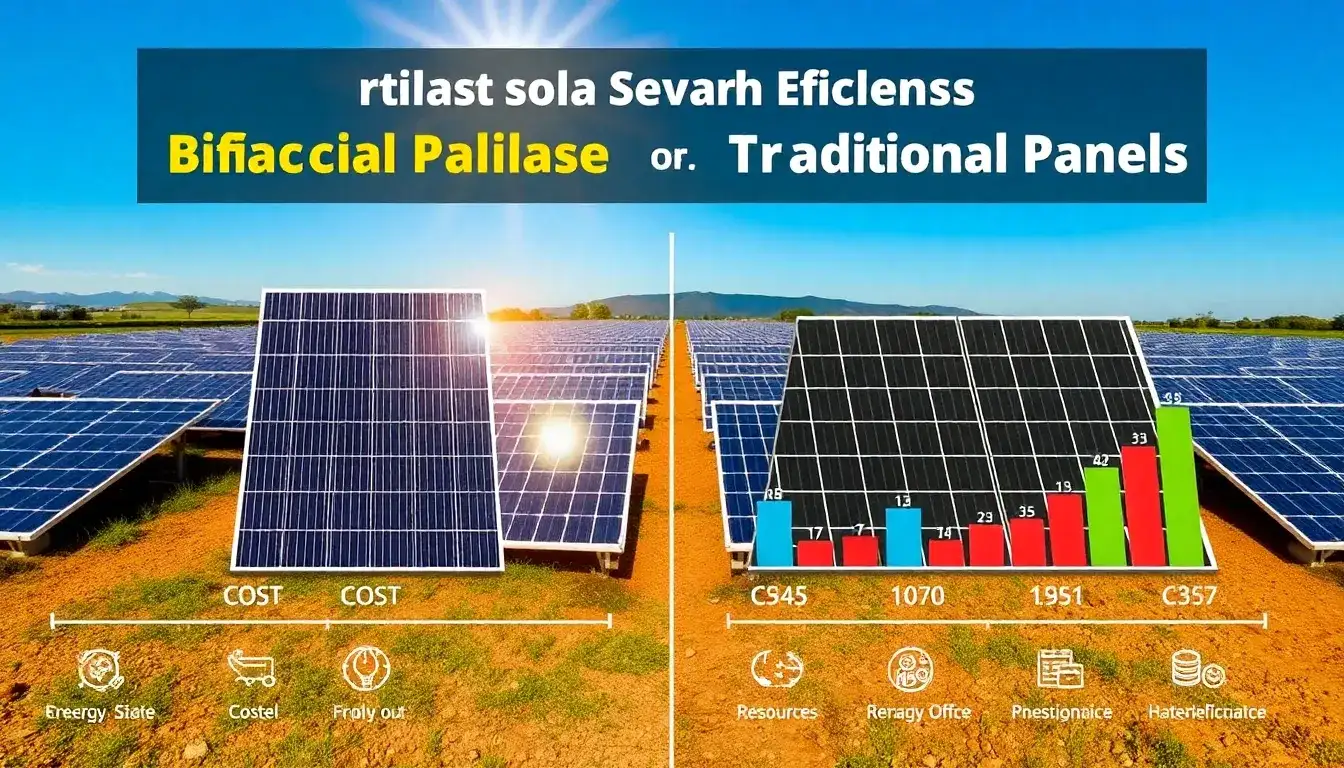
Bifacial solar panels generally have a higher upfront cost compared to traditional monofacial solar panels, but this cost premium can be justified by their increased energy production and economic returns over time.
Cost Comparison
- Upfront Cost Difference:
- Bifacial panels cost approximately 1 to 20 cents more per watt than monofacial panels depending on the scale and installation type. For a typical residential 6 kW system, this translates to about $600 to $1,200 extra in total system cost for bifacial panels due to panel price and additional equipment like trackers or specialized mounts.
- For utility-scale projects, bifacial panels may cost roughly $10,000 more per MW (megawatt) capacity than monofacial panels, representing a moderate incremental investment.
- Residential Systems Example (UK):
- Bifacial solar panel systems for a 2-3 bedroom home cost around £5,500 to £6,600 all-in, while monofacial systems are generally cheaper, ranging from £4,000 to £5,000 including installation.
Performance and Economic Benefits
- Bifacial panels capture sunlight on both sides, leading to increased efficiency and energy yield, often in the range of 6% to 16% more electricity generated compared to monofacial panels, depending on installation conditions and location.
- Utility-scale cases show bifacial systems producing around 5.5% more energy over several months, with improved capacity factor and demand value, translating to financial gains that can offset the higher initial cost in about 2.5 years or less.
- Techno-economic analyses indicate that bifacial solar farms can yield 11–13% higher net present value (NPV) and offer higher internal rates of return (IRR) than monofacial farms, making them more profitable investments despite higher upfront expenses.
Additional Costs Beyond Panels
- The increase in cost for bifacial systems often also includes balance of system (BOS) components and installation complexity, such as trackers or specialized ground mounts designed to optimize backside light capture. These additional components can raise costs but help maximize the energy gains that bifacial panels offer.
Summary Table
| Aspect | Bifacial Solar Panels | Monofacial Solar Panels |
|---|---|---|
| Initial Cost | Higher (10-20 cents/watt more, ~$600-$1,200 extra for 6 kW system; ~$10k/MW utility-scale) | Lower (baseline cost) |
| Energy Production | 6%-16% higher yield | Standard single-side production |
| Efficiency | Up to ~30% (depends on conditions) | Typically 15-20% |
| Economic Payback | Higher upfront cost but payback in 2.5 years or less in some utility-scale cases | Lower upfront cost, longer payback if less energy generated |
| Installation | Requires specialized mounts or trackers to maximize gain | Simpler installation |
| Financial Returns | Higher NPV and IRR | Lower NPV and IRR |
Conclusion
Bifacial solar panels cost more upfront than traditional monofacial panels, with additional expenses related to installation and system components. However, their ability to generate significantly more energy—especially in favorable conditions with reflective surfaces—leads to higher long-term savings and improved financial returns. For utility-scale projects and some residential systems where conditions support strong backside irradiance, bifacial panels can be worth the higher initial investment. For installations with limited space or less reflective ground, monofacial panels may remain the more cost-effective choice.
Original article by NenPower, If reposted, please credit the source: https://nenpower.com/blog/how-do-bifacial-solar-panels-compare-to-traditional-solar-panels-in-terms-of-cost/

