

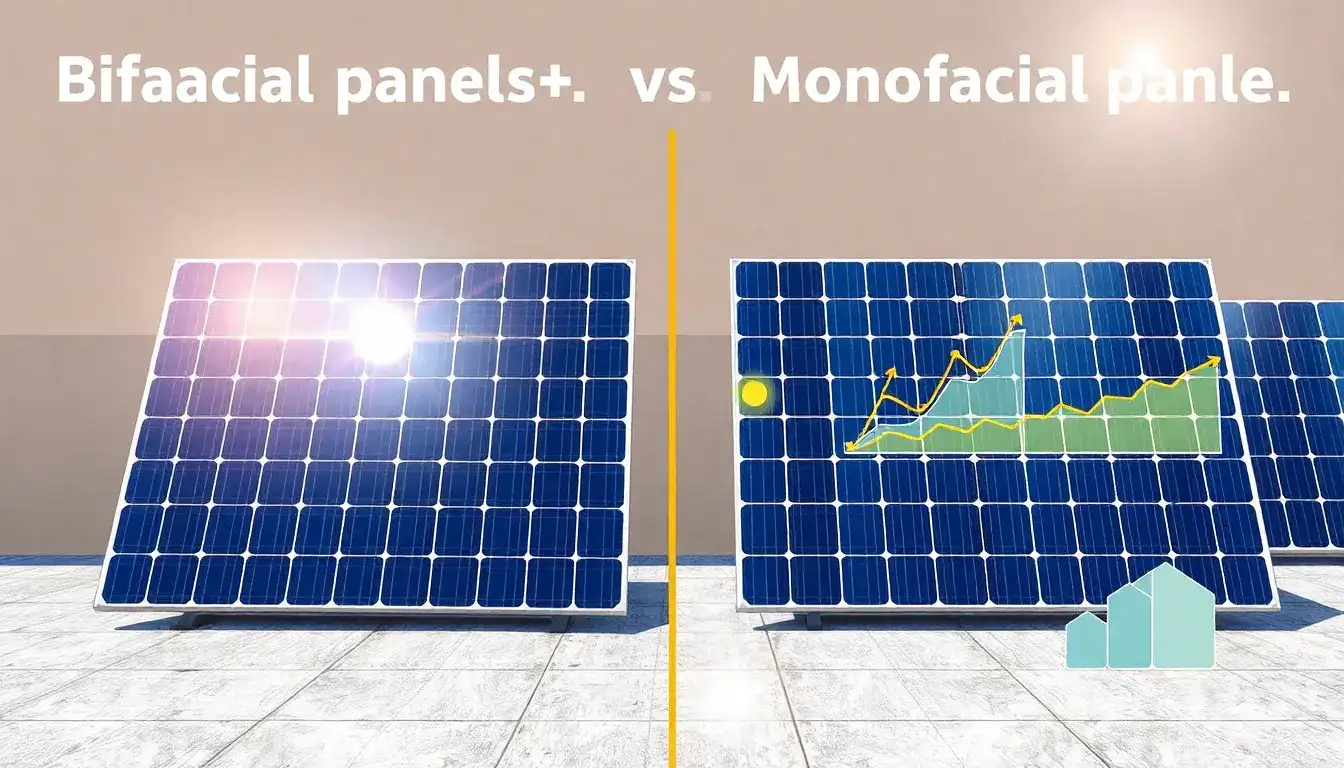
Bifacial solar panels generally outperform traditional monofacial panels in terms of energy output due to their ability to capture sunlight on both the front and rear sides, whereas monofacial panels only generate electricity from the front side.
Energy Output Comparison
- Increased Energy Production:
Bifacial panels can produce 5% to 30% more electricity than monofacial panels. This range depends largely on environmental conditions such as the reflectivity (albedo) of the surface beneath the panels and installation height and angle. For example, reflective surfaces like white roofs, snow, or water can significantly boost bifacial panel output by increasing rear-side irradiation. - Real-World Case Study:
A utility-scale comparison over seven months between two nearly identical solar projects (one with monofacial modules and the other with bifacial modules) showed the bifacial project generated 5.5% more kilowatt-hours than the monofacial project. The bifacial installation also had a higher capacity factor, indicating more effective use of the panel capacity. - Mechanism:
Bifacial panels use a transparent or semi-transparent backsheet (often double glass) that allows sunlight reflected from the ground or surrounding surfaces to reach the rear solar cells, thereby converting additional light into electricity. Monofacial panels, by contrast, have an opaque backing and can only convert light incident on their front face.
Efficiency and Optimal Conditions
- Efficiency Gains:
Bifacial panels can achieve up to approximately 30% higher efficiency in environments that provide ample rear-side reflected light, effectively yielding a higher power output per panel. - Installation Considerations:
To maximize energy gains, bifacial panels should be installed with sufficient clearance from reflective surfaces to capture reflected light effectively, such as elevated mounting systems above white or reflective ground surfaces. In contrast, monofacial panels are often more practical and cost-effective for rooftop installations on darker, less reflective surfaces.
Cost and ROI
- Cost Trade-offs:
Bifacial solar panels tend to have a higher upfront cost (around 10% more) and are heavier due to their glass-on-glass structure, leading to potentially higher installation costs. However, the increased energy output can offset these costs over time. In utility-scale projects, the additional capital cost for bifacial modules has been estimated to pay back within 2.5 years due to higher energy yield.
Summary Table
| Feature | Monofacial Solar Panels | Bifacial Solar Panels |
|---|---|---|
| Energy generation | Front side only | Both front and rear sides |
| Typical energy gain | Baseline (100%) | 5% to 30% higher energy output |
| Efficiency | Standard efficiency | Up to ~30% higher efficiency |
| Optimal installation | Rooftops, non-reflective surfaces | Open spaces, reflective surfaces, elevated mounting |
| Upfront cost | Lower | Higher (10%+ more) |
| Weight | Lighter | Heavier (double glass) |
| Installation ease | Easier | More complex due to weight and design |
Conclusion
Bifacial solar panels offer a clear advantage in energy output compared to traditional monofacial panels by utilizing reflected light on their rear side to boost total power generation. Their benefits are most pronounced in installations with high ground reflectivity and sufficient spacing or elevation to capture rear-side irradiance. Although bifacial panels come with higher upfront and installation costs, the increased energy production can provide a better long-term return on investment, especially in utility-scale and commercial solar installations. For typical residential rooftop setups with less reflective surfaces, monofacial panels may still be the more cost-effective option.
Original article by NenPower, If reposted, please credit the source: https://nenpower.com/blog/how-do-bifacial-solar-panels-compare-to-traditional-monofacial-panels-in-terms-of-energy-output/

