

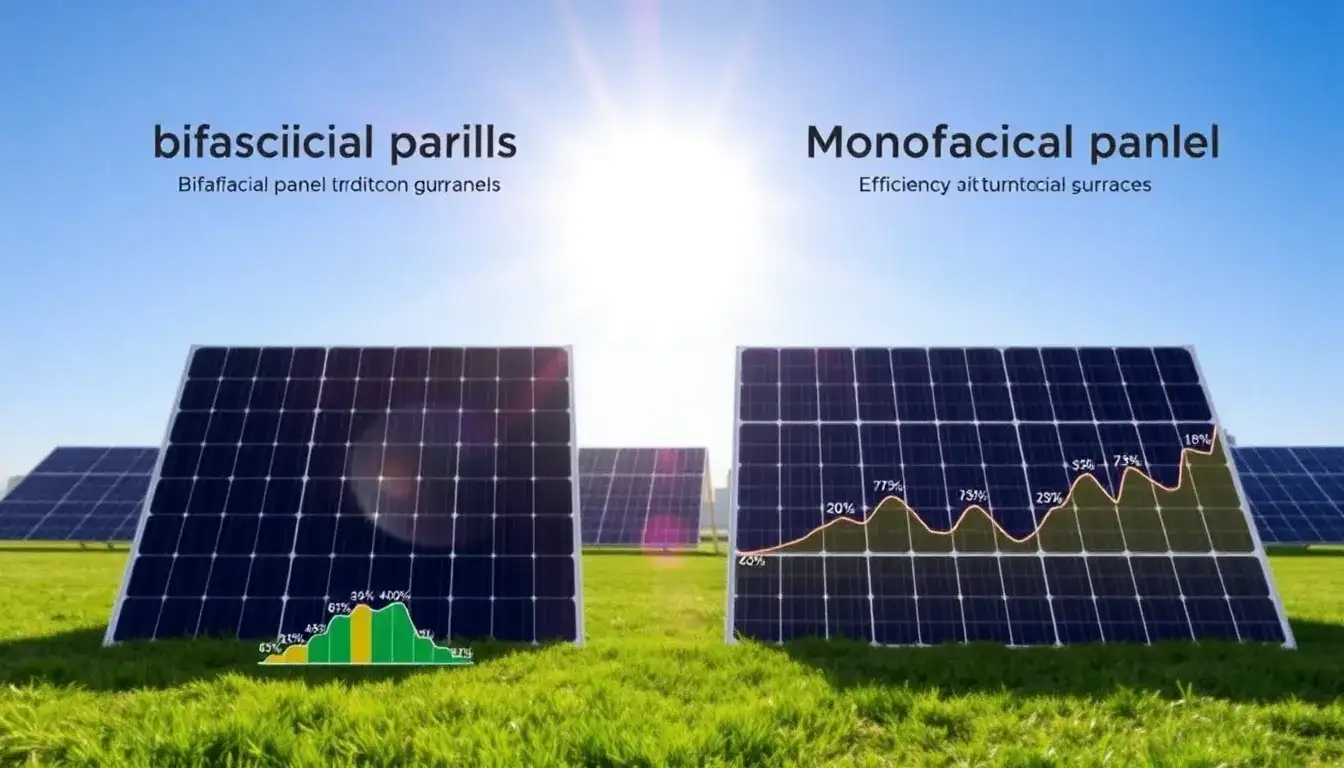
Bifacial solar panels outperform traditional monofacial panels in terms of efficiency primarily because they capture sunlight from both their front and rear sides, whereas monofacial panels only absorb light on the front side. This dual-sided absorption allows bifacial panels to utilize reflected and diffused light from the surroundings to generate additional electricity.
Efficiency and Energy Output:
- Bifacial panels can achieve up to 30% higher efficiency and energy output compared to monofacial panels under optimal conditions due to their ability to convert sunlight on both sides into electricity.
- The electricity generated by bifacial modules is typically 5% to 30% higher than that of monofacial panels, with the actual gain depending on environmental factors such as ground reflectivity (albedo), installation height, and spacing between panels.
- A utility-scale comparative study found bifacial solar projects produced about 5.5% more kilowatt-hours (kWh) than monofacial projects, with a higher capacity factor and demand value, translating into better utilization of capacity and increased revenue potential.
Design Differences Affecting Efficiency:
- Bifacial panels have a transparent or semi-transparent backing and are often double-glass, enabling light to penetrate and be absorbed from both sides. This design also tends to enhance durability and extend the panels’ operational lifespan.
- Monofacial panels have an opaque backing, capturing sunlight only on the front, which limits their efficiency to direct sunlight exposure.
Performance in Different Conditions:
- Bifacial panels perform better in environments with high albedo surfaces such as snow, sand, or reflective roofing because they capture reflected light on the rear side, enhancing energy production.
- They also have superior low-light performance, being more effective in diffused lighting conditions due to their ability to absorb scattered light from both sides.
Trade-offs:
- While bifacial panels offer higher efficiency and energy yields, they come with higher upfront costs (about 10% more) and can be heavier and more complex to install due to specialized mounting requirements to avoid shading on the rear side.
- Monofacial panels remain cost-effective, easier to install, and sufficient for typical residential applications where space or reflective surfaces are limited.
Summary Table:
| Feature | Monofacial Solar Panels | Bifacial Solar Panels |
|---|---|---|
| Light Absorption | Front side only | Both front and rear sides |
| Efficiency Gain | Standard | Up to 30% higher under optimal conditions |
| Energy Output | Limited to direct sunlight | Higher due to additional rear-side capture |
| Design | Opaque backing | Transparent/semi-transparent double glass |
| Performance in Diffuse Light | Standard | Better due to rear side absorption |
| Installation Complexity | Lower | Higher, requires special mounting |
| Upfront Cost | Lower | Approximately 10% higher |
| Durability | Standard | More durable, double glass design |
In conclusion, bifacial solar panels offer significant efficiency advantages over traditional monofacial panels by capturing sunlight on both sides, making them especially beneficial in installations with reflective surfaces and open spaces. Although they have higher initial costs and installation complexity, their increased energy production can provide superior long-term returns.
Original article by NenPower, If reposted, please credit the source: https://nenpower.com/blog/how-do-bifacial-solar-panels-compare-to-traditional-monofacial-panels-in-terms-of-efficiency/

