

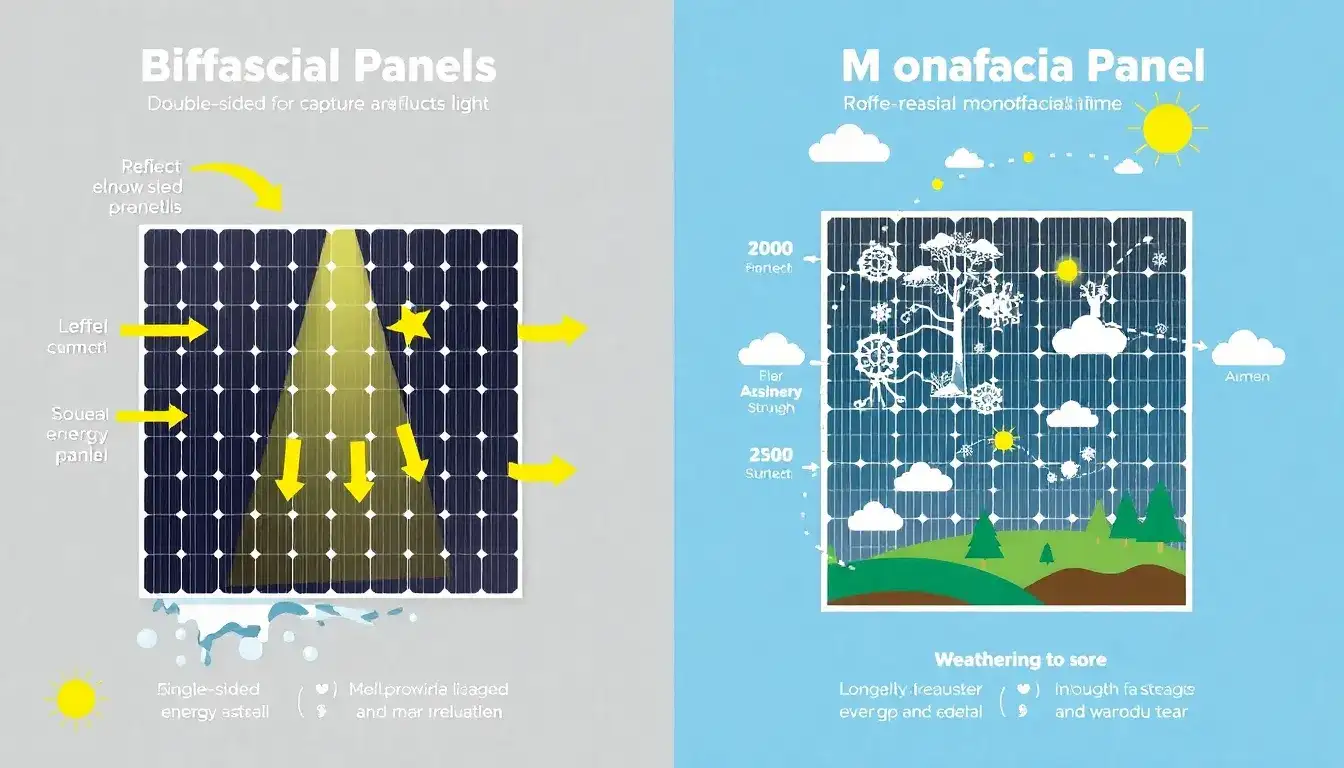
Bifacial solar panels generally offer superior durability compared to traditional monofacial panels, owing primarily to their construction and design features:
- Double Glass Construction: Bifacial panels are typically made with tempered glass on both the front and back sides, unlike monofacial panels which usually have a glass front and a polymer backsheet. This glass/glass design provides enhanced resistance to weather elements such as UV rays, high temperatures, strong winds, hail, and other environmental stresses.
- Frameless or Minimal Frame Design: Many bifacial panels use a frameless design or minimal framing, reducing potential weaknesses or points of corrosion seen in metal frames common in monofacial panels. The absence of a metal frame also reduces potential-induced degradation (PID), improving long-term reliability.
- Extended Lifespan and Warranties: The robust construction of bifacial panels translates into longer operational lifespans and manufacturers often provide longer performance warranties—up to 30 years in some cases—highlighting the confidence in their durability.
- Better Resistance to Environmental Wear: The glass-on-glass structure makes bifacial panels more resistant to moisture ingress and mechanical impact, contributing to less wear over time compared to monofacial panels that use polymer backsheets which can degrade faster under harsh conditions.
- Maintenance and Longevity: Bifacial panels require minimal maintenance, similar to monofacial panels, but the stronger build quality typically reduces the risk of damage or performance loss due to environmental exposure.
In contrast, traditional monofacial panels are usually constructed with a single glass front surface and a polymer backsheet, which, while effective and durable, are generally more vulnerable to UV degradation, moisture ingress, and frame corrosion over decades. Monocrystalline monofacial panels do have strong durability due to their uniform structure but still lack the physical robustness of the double-glass bifacial design.
Summary Comparison on Durability
| Aspect | Bifacial Solar Panels | Monofacial Solar Panels |
|---|---|---|
| Construction | Tempered glass front and back (glass/glass) | Tempered glass front + polymer backsheet |
| Frame | Frameless or minimal metal frame | Usually aluminum or steel frame |
| Resistance to Weather | Excellent resistance to UV, wind, hail, heat | Good, but backsheets can degrade faster |
| Potential-Induced Degradation | Reduced due to no metal frame | Higher risk due to metal frame grounding |
| Lifespan & Warranty | Longer warranties (up to 30 years) | Standard warranties (typically 25 years) |
| Maintenance | Low maintenance, robust build | Low maintenance, but backsheets more vulnerable |
Overall, bifacial solar panels are more durable than traditional monofacial panels because their double-glass construction and frameless design better protect against environmental damage and degradation, resulting in longer-lasting, more reliable solar energy generation.
Original article by NenPower, If reposted, please credit the source: https://nenpower.com/blog/how-do-bifacial-solar-panels-compare-to-traditional-monofacial-panels-in-terms-of-durability/

