

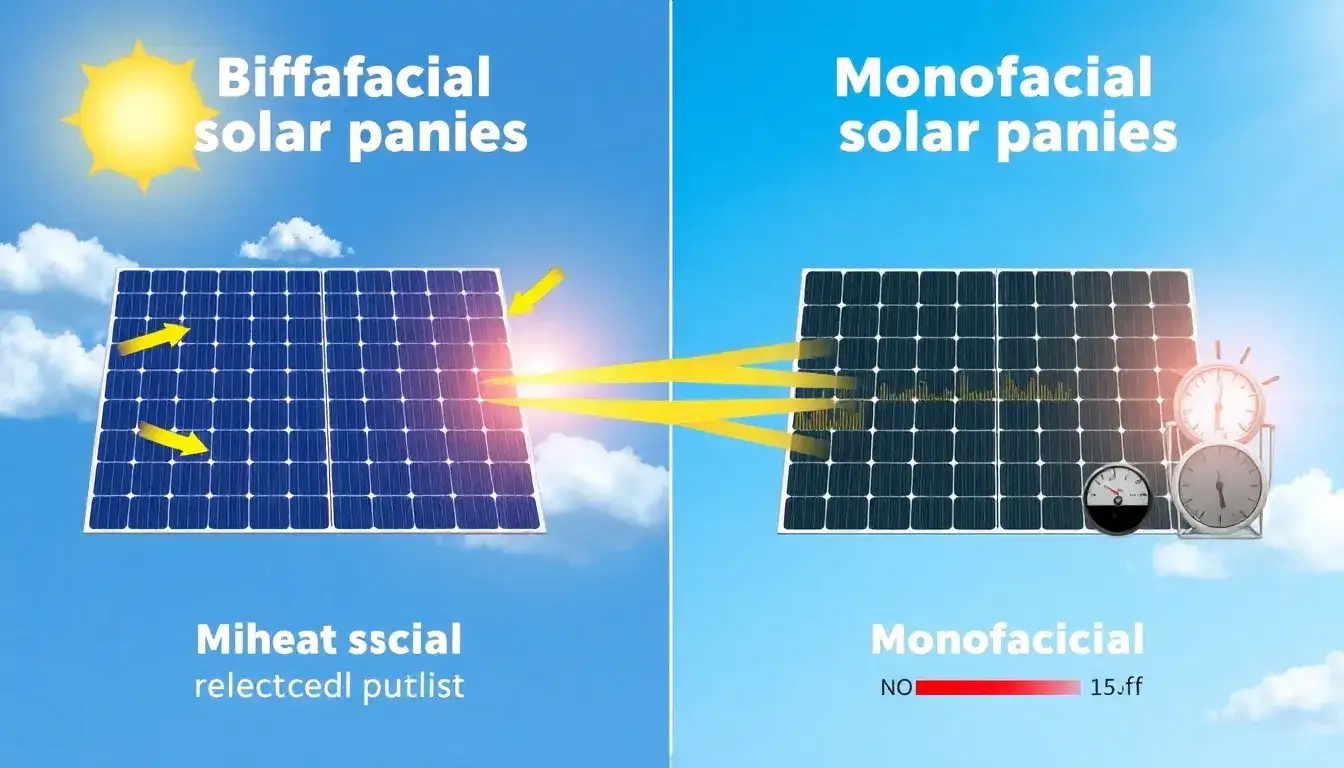
Bifacial solar panels generally outperform traditional monofacial panels in overall energy production due to their ability to capture sunlight on both their front and rear surfaces.
Energy Production Comparison
- Increased Efficiency and Output:
Bifacial panels can generate between 5% to 30% more energy than monofacial panels. This is because they harvest light not only from direct sunlight on the front but also from reflected and diffused light on the rear side. This dual-sided light absorption significantly boosts efficiency and energy yield. Studies show bifacial panels producing about 11% more energy in ground-mounted installations compared to monofacial panels, and up to 27% more when combined with solar trackers that optimize their orientation. - Influence of Installation Environment:
The gain in energy from the rear side depends heavily on the reflectivity of the surface beneath the panels. Light-colored or reflective surfaces, such as sand or white roofing, increase reflected light and thus enhance bifacial panel performance. Darker surfaces like asphalt reflect less light, reducing the advantage of bifacial designs. - Performance in Low-Light Conditions:
Bifacial panels also perform better in diffuse and low-light conditions due to their ability to capture scattered sunlight on both sides, extending their effective operational hours during the day.
Additional Advantages Related to Energy Production
- Durability and Lifespan:
Bifacial panels typically use a double-glass construction, improving their durability against weather, UV rays, and mechanical stress. This robust build often leads to longer warranties and operational lifespans, ensuring sustained energy production over time. - Versatility in Installation:
Their design allows for flexible mounting options such as rooftops, ground mounts, and carports, which can be optimized to maximize light capture on both sides.
Summary Table
| Feature | Bifacial Panels | Monofacial Panels |
|---|---|---|
| Energy Production Increase | 5-30% higher (up to 27% with trackers) | Baseline |
| Light Absorption | Front and rear (dual-sided) | Front side only |
| Efficiency Range | Approx. 19-23% (varies by manufacturer) | Typically lower by 5-30% relative to bifacial |
| Performance in Low Light | Superior | Lower |
| Durability | Double glass, more robust | Single glass typical |
| Dependency on Surface Reflectivity | Significant (better on reflective surfaces) | Not applicable |
In conclusion, bifacial panels offer a clear advantage over monofacial panels in terms of overall energy production due to their ability to utilize both direct and reflected sunlight, resulting in up to around 30% more electricity generation under optimal conditions. Their enhanced durability and versatility further support sustained higher output over time.
Original article by NenPower, If reposted, please credit the source: https://nenpower.com/blog/how-do-bifacial-panels-compare-to-monofacial-panels-in-terms-of-overall-energy-production/

