

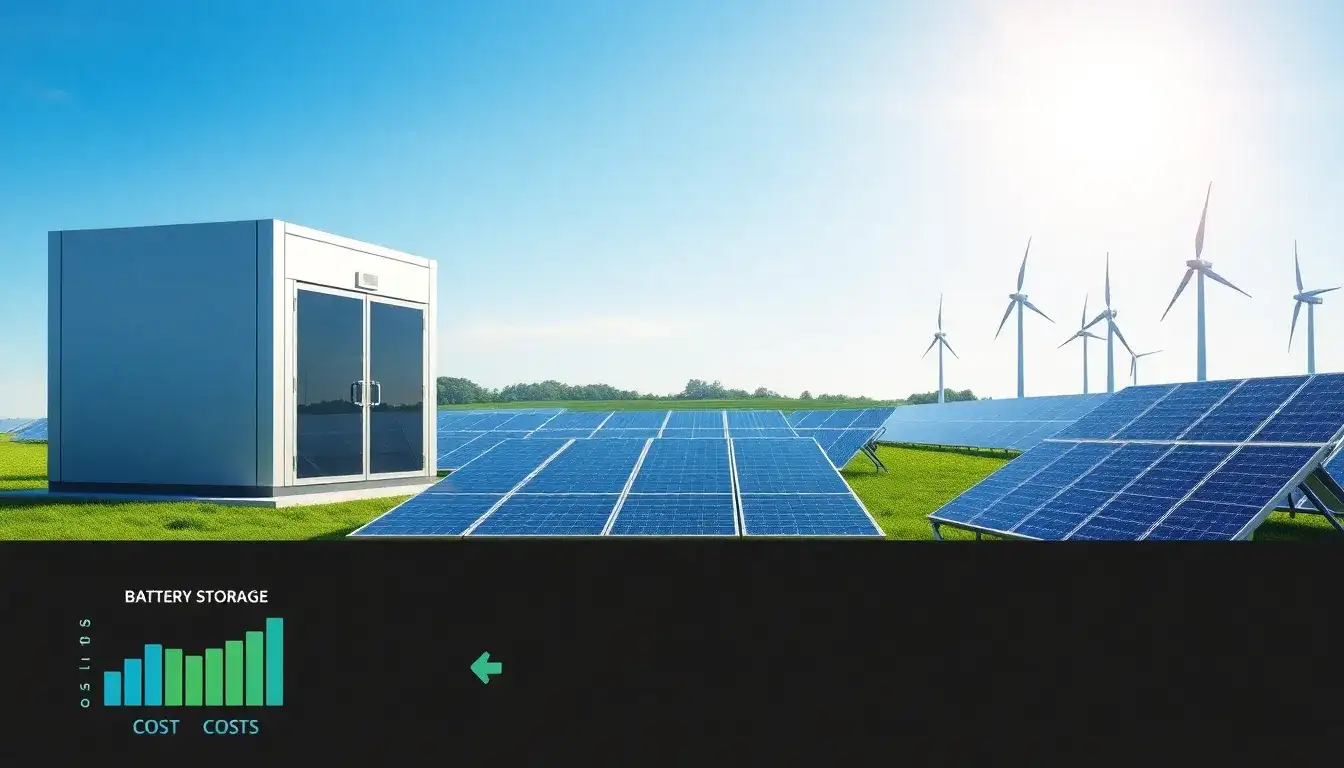
Battery storage costs have declined significantly over the past decade, but their cost competitiveness compared to other renewable energy technologies varies depending on the type of technology, duration, and region.
Battery Storage Cost Trends
- Utility-scale lithium-ion battery costs for 4-hour storage systems were about $482/kWh in 2022, with projections showing declines to a mid-range of approximately $326/kWh by 2030 and $237/kWh by 2050 according to NREL.
- Globally, battery storage project costs have dropped by about 89% between 2010 and 2023, reflecting rapid technology improvements and economies of scale driven in part by electric vehicle demand.
- Cost reductions are expected to continue, with scenarios from conservative (1.4% annual reduction) to advanced (4.0% annual reduction) between 2022 and 2035 for lithium-ion battery systems.
Comparison with Other Renewable Energy Technologies
- Solar photovoltaic (PV) and onshore wind have also seen steep cost reductions, with the levelised cost of electricity (LCOE) from solar PV falling 12% year-on-year in 2023 and onshore wind falling 3%. By 2023, solar PV costs were 56% lower than fossil fuel alternatives, and onshore wind was 67% lower.
- Battery storage costs remain higher than the generation costs of renewable power but provide critical services like energy shifting and grid stability, enabling higher shares of solar and wind.
Cost Comparison with Other Energy Storage Technologies
- For long-duration energy storage (LDES, discharge durations longer than 6-8 hours), alternatives to lithium-ion batteries such as thermal energy storage and compressed air storage are currently cheaper on a capital cost basis.
- According to BloombergNEF, thermal energy storage costs about $232/kWh and compressed air about $293/kWh globally, compared with about $304/kWh for 4-hour lithium-ion battery storage.
- Gravity storage and flow batteries have higher costs globally but may be more competitive in specific markets like China due to localized policies and industry maturity.
- Non-lithium technologies are less likely to see rapid cost declines this decade compared to lithium-ion batteries, which benefit from the scale of electric vehicle markets.
Summary Table of Approximate Capital Costs ($/kWh)
| Technology | Approximate Capital Cost | Notes |
|---|---|---|
| Lithium-ion batteries (4 hr) | $237-$326 (2030-2050) | Rapid cost decline due to EV-driven scale. |
| Solar PV generation | Lower LCOE than storage | 12% yearly decline; now well below fossil fuels. |
| Onshore wind | Lower LCOE than storage | 3% yearly decline; competitive vs fossil fuels. |
| Thermal energy storage | $232 | Cheapest LDES, especially in China. |
| Compressed air storage | $293 | Competitive LDES, advanced in China. |
| Gravity storage | $643 | Highest cost among LDES technologies. |
| Flow batteries | Higher than Li-ion | Emerging, regional differences. |
Conclusion
Lithium-ion battery storage costs have fallen dramatically and will continue to decline, making them increasingly competitive as a complement to renewable generation. However, for long-duration storage needs beyond about 6-8 hours, other technologies like thermal and compressed air storage currently offer lower capital costs. Meanwhile, renewable energy generation (solar PV, wind) has achieved even larger cost reductions and generally remains cheaper than battery storage when considering only generation costs without storage. Battery storage’s value lies in its ability to integrate renewable power effectively by managing variability and enhancing grid reliability.
Thus, while battery storage costs have improved vastly compared to a decade ago, they complement rather than replace renewable generation technologies and face competition from alternative long-duration storage solutions for specific applications.
Original article by NenPower, If reposted, please credit the source: https://nenpower.com/blog/how-do-battery-storage-costs-compare-to-other-renewable-energy-technologies/

