

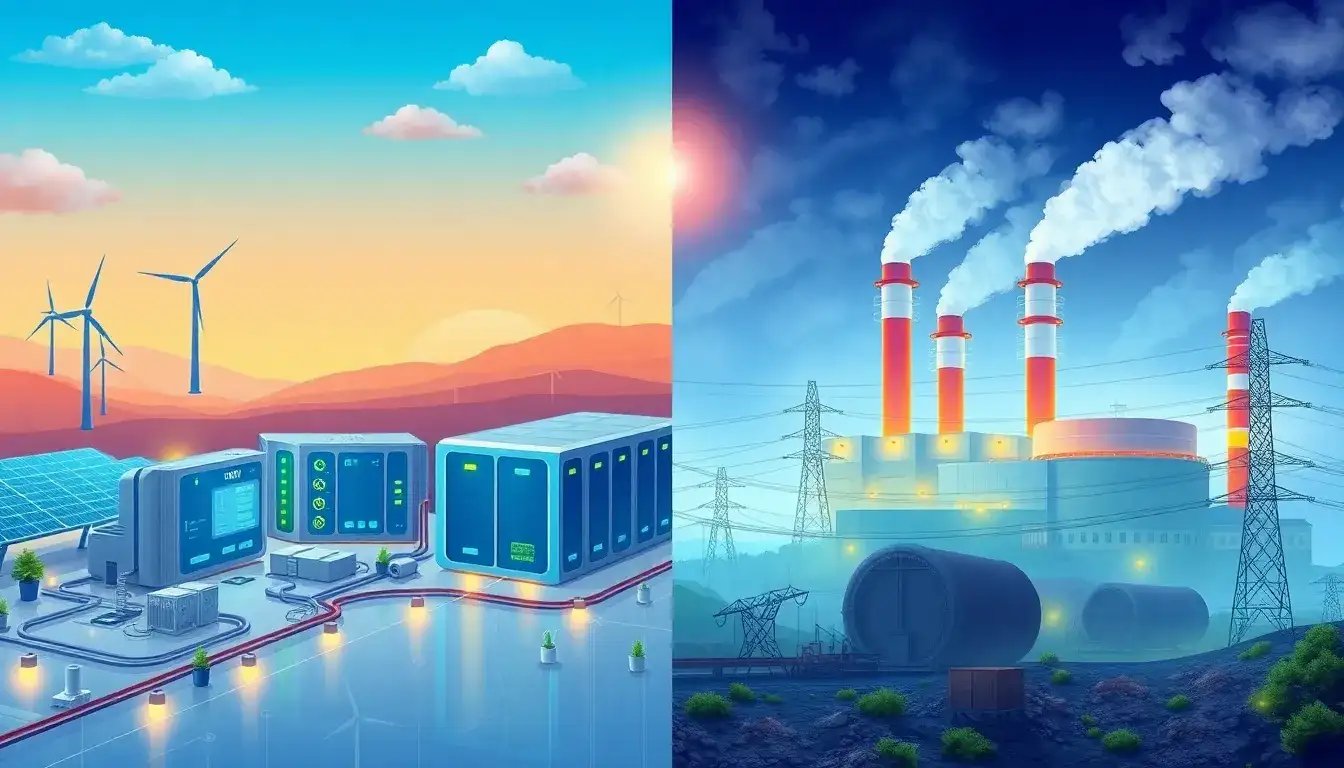
Reliability Considerations
Operational Flexibility
- BESS: Provide rapid response (milliseconds to seconds) for grid stabilization, frequency regulation, and load shifting.
- Traditional plants: Slower ramp rates (minutes to hours) but offer consistent baseload generation (e.g., coal, nuclear) or peaking capacity (e.g., gas).
Failure Modes
- BESS:
- Component failures: Inverters, battery management systems, and cooling infrastructure are frequent points of failure.
- Systemic risks: Poor commissioning, unbalanced currents, or unstable DC voltage can cause cascading outages.
- Thermal runaway: Lithium-ion batteries carry fire/explosion risks, though failure rates per GW have declined sharply (9+/GW in 2018 to <1/GW in 2023).
- Traditional plants:
- Mechanical failures: Turbine/boiler malfunctions or fuel supply issues dominate.
- Outages: Typically planned or weather-related (e.g., gas pipeline disruptions).
Data and Longevity
- BESS:
- Limited operational history (most data <5 years) and variability in chemistry/design complicate reliability assessments.
- EPRI notes higher unavailability rates than other inverter-based resources, driven by “plant trouble” (equipment failures) and metering/maintenance issues.
- Traditional plants:
- Decades of operational data provide predictable failure rates and maintenance protocols.
- Lifetime of 30-50 years, with well-understood degradation patterns.
Grid Integration Challenges
- BESS:
- Inverter dynamics can destabilize grids during faults, requiring updated protection schemes.
- CAISO data shows ~3× higher plant-trouble outages than solar/wind.
- Traditional plants:
- Synchronous generators inherently support grid voltage/frequency, reducing blackout risks.
Key Trade-offs
| Aspect | BESS | Traditional Plants |
|---|---|---|
| Response time | Milliseconds to seconds | Minutes to hours |
| Failure causes | Inverter/component faults, thermal runaway | Mechanical wear, fuel issues |
| Data maturity | Limited (1-5 years), fragmented ownership models | Extensive (30+ years), standardized reporting |
| Grid support | Requires advanced controls to mimic inertia | Natural inertia from rotating mass |
| Emission profile | Enables renewables, reduces peaker plant use | Fossil-dependent plants increase emissions |
Conclusion
BESS excel in flexibility and renewables integration but face higher component-level risks and immature reliability frameworks. Traditional plants offer predictability and grid inertia but lack adaptability to decarbonization goals. Hybrid systems combining both technologies may optimize reliability in transitioning grids.
Original article by NenPower, If reposted, please credit the source: https://nenpower.com/blog/how-do-battery-energy-storage-systems-compare-to-traditional-power-plants-in-terms-of-reliability/

