

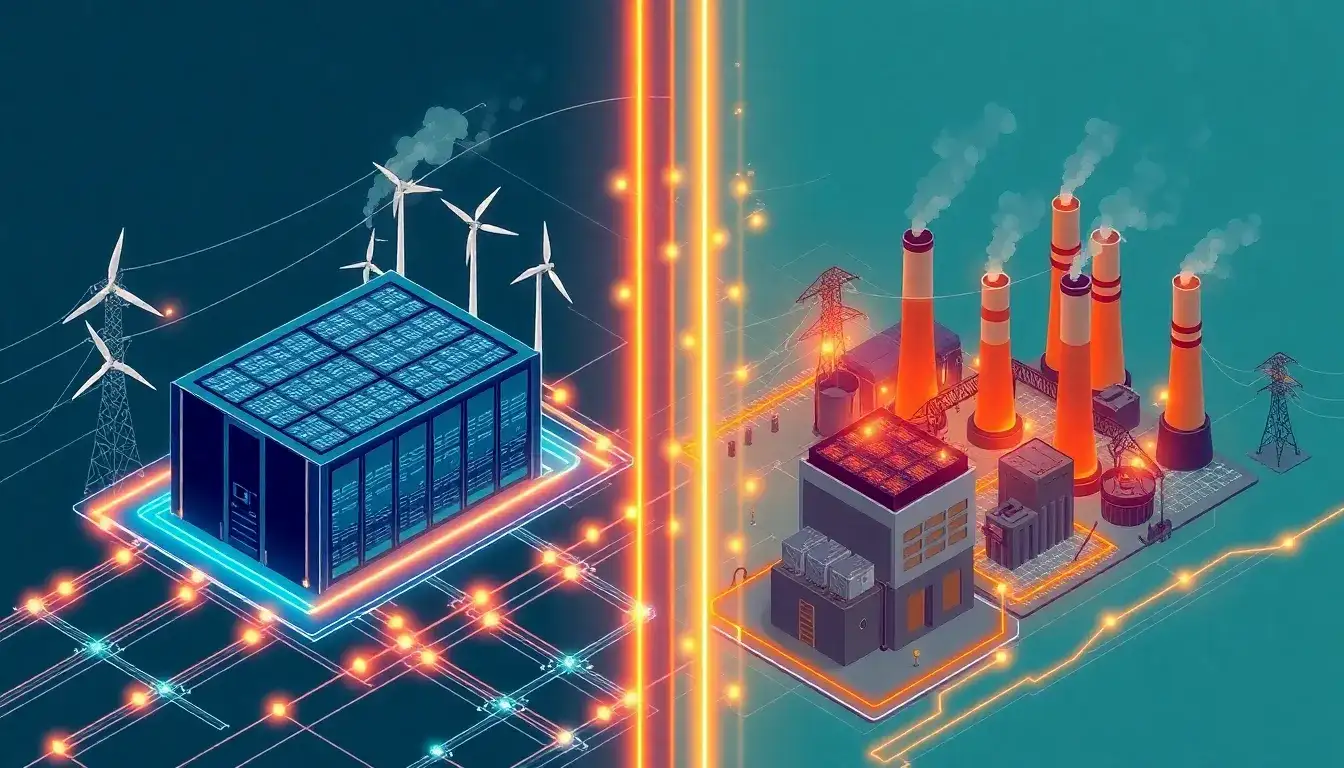
Battery energy storage systems (BESS) and traditional power plants both play important roles in maintaining grid stability, but they differ significantly in how they contribute and their capabilities.
Comparison of Battery Energy Storage Systems to Traditional Power Plants in Grid Stability
1. Response Time and Flexibility
- BESS have extremely fast response times, faster than traditional thermal power plants. They can rapidly charge or discharge energy, which allows them to provide immediate grid support services such as frequency regulation and voltage control. This rapid ramping capability is crucial as it helps balance supply and demand in real-time, especially given the variability introduced by renewable energy sources like solar and wind.
- Traditional power plants, especially thermal (coal, gas) and hydro, generally have slower response rates. They provide a steady, controllable output but cannot adjust output as quickly to address rapid fluctuations in grid demand or supply.
2. Grid Stability Services
- BESS provide several critical grid services:
- Frequency regulation: They help maintain the grid frequency within safe limits by quickly absorbing or injecting power as needed.
- Voltage support: Batteries help regulate voltage levels, ensuring equipment safety and operational reliability.
- Black start capability: Unlike many traditional generators, some grid-scale battery systems can restart the grid after a blackout without needing external power.
- Load following and ramping services: BESS can adapt to longer-term changes in demand and variable renewable energy supply, supporting grid balancing over minutes to hours.
- Traditional power plants provide essential base-load and peaking power and have historically managed these services. However, some grid reliability functions like black start have typically been limited to certain large generators and are now increasingly supported by batteries.
3. Integration of Renewable Energy
- The intermittent nature of renewables makes grid stability more challenging. BESS help integrate renewables by storing excess energy when production is high (e.g., sunny or windy periods) and releasing it during low production or peak demand, smoothing out variability and reducing the need for fossil-fueled peaking plants.
- Traditional power plants sometimes ramp up or down to compensate for renewable intermittency but often are less efficient and generate more emissions when doing so.
4. Scalability and Deployment
- Battery systems are modular and can be scaled up or relocated as grid needs change, providing flexibility in deployment and grid management.
- Traditional plants require significant infrastructure and longer lead times for construction or upgrades, which limits their adaptability.
5. Economic and Environmental Impact
- Batteries can reduce reliance on expensive and polluting peaking power plants by providing cleaner energy storage, supporting a greener and more sustainable grid transition.
- Traditional power plants generally have higher emissions, and some face increasing regulatory and economic challenges as the world moves towards decarbonization.
Summary Table
| Aspect | Battery Energy Storage Systems (BESS) | Traditional Power Plants |
|---|---|---|
| Response Time | Milliseconds to seconds — very fast response | Minutes to hours — slower response |
| Frequency & Voltage Control | Provides fast, precise regulation | Provides regulation but slower and less flexible |
| Black Start Capability | Available with proper hardware/software | Often available but limited to select plants |
| Renewable Integration | Smooths variability by storing excess & supplying energy | Compensates by ramping up/down; less clean |
| Scalability & Flexibility | Modular and relocatable | Fixed location and large infrastructure |
| Environmental Impact | Clean, reduces fossil fuel use | Typically fossil fuel-based with higher emissions |
| Cost & Lifespan | High upfront cost, improving technology, limited lifespan | Established technology, long lifespan, but operational costs & pollution |
Conclusion
Battery energy storage systems are emerging as critical assets for enhancing grid stability, particularly in power systems with high shares of variable renewable energy. They offer superior speed, flexibility, and multiple grid support services beyond the capabilities of traditional power plants. While traditional plants remain essential for base-load and certain grid functions, BESS complement and often outperform them in real-time stability, renewable integration, and resilience, making them a cornerstone for the future reliable and sustainable grid.
Original article by NenPower, If reposted, please credit the source: https://nenpower.com/blog/how-do-battery-energy-storage-systems-compare-to-traditional-power-plants-in-terms-of-grid-stability/

