

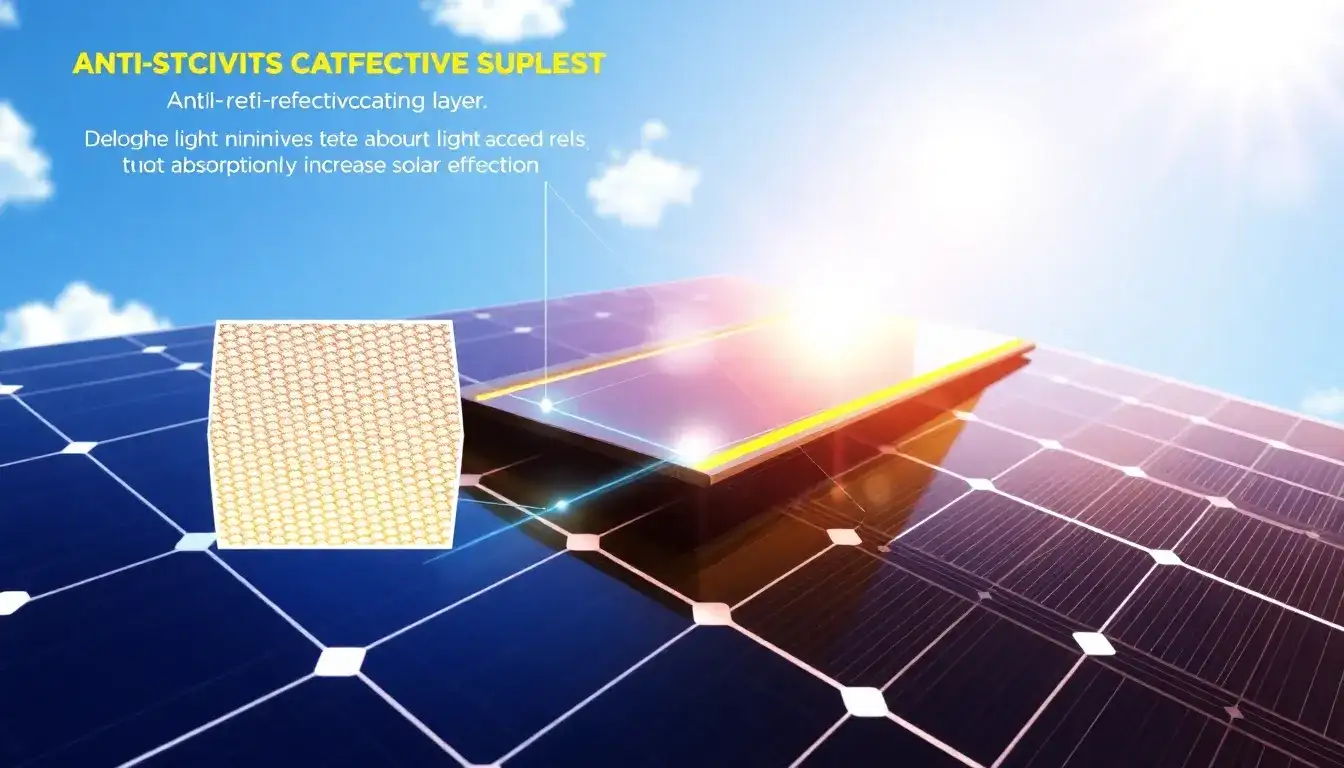
Anti-reflective coatings (ARCs) improve solar panel efficiency through multiple mechanisms:
1. Reduced Light Reflection
ARCs minimize light reflection from solar panels, allowing more photons to reach photovoltaic cells. Bare silicon reflects ~30% of sunlight, but ARCs made of silicon nitride or titanium oxide reduce this loss. By enhancing light absorption, ARCs directly boost energy output.
2. Increased Light Transmittance
When applied to glass surfaces, ARCs improve light transmittance through the panel’s protective layer, ensuring more sunlight reaches the cells. This is critical in harsh environments, where modules with ARCs demonstrated 5.5% higher annual energy output in a 40 MW plant study.
3. Enhanced Durability and Soiling Resistance
ARCs reduce dust adhesion and simplify cleaning. Field tests showed 3.7% lower soiling losses compared to uncoated panels. Abrasion tests simulating 29 years of cleaning revealed only a 2.6% decline in optical performance, making dry cleaning viable and reducing water use.
4. Improved Low-Light Performance
ARCs optimize light capture during cloudy conditions or low sun angles, maintaining efficiency even in suboptimal lighting.
5. Economic Benefits
In large-scale deployments, ARCs lower the levelized cost of energy (LCOE) by ~2.7%, as seen in a Moroccan study where LCOE dropped from 0.037€/kWh to 0.0368€/kWh. This results from higher energy yields and reduced maintenance costs.
Original article by NenPower, If reposted, please credit the source: https://nenpower.com/blog/how-do-anti-reflective-coatings-improve-solar-panel-efficiency/

