

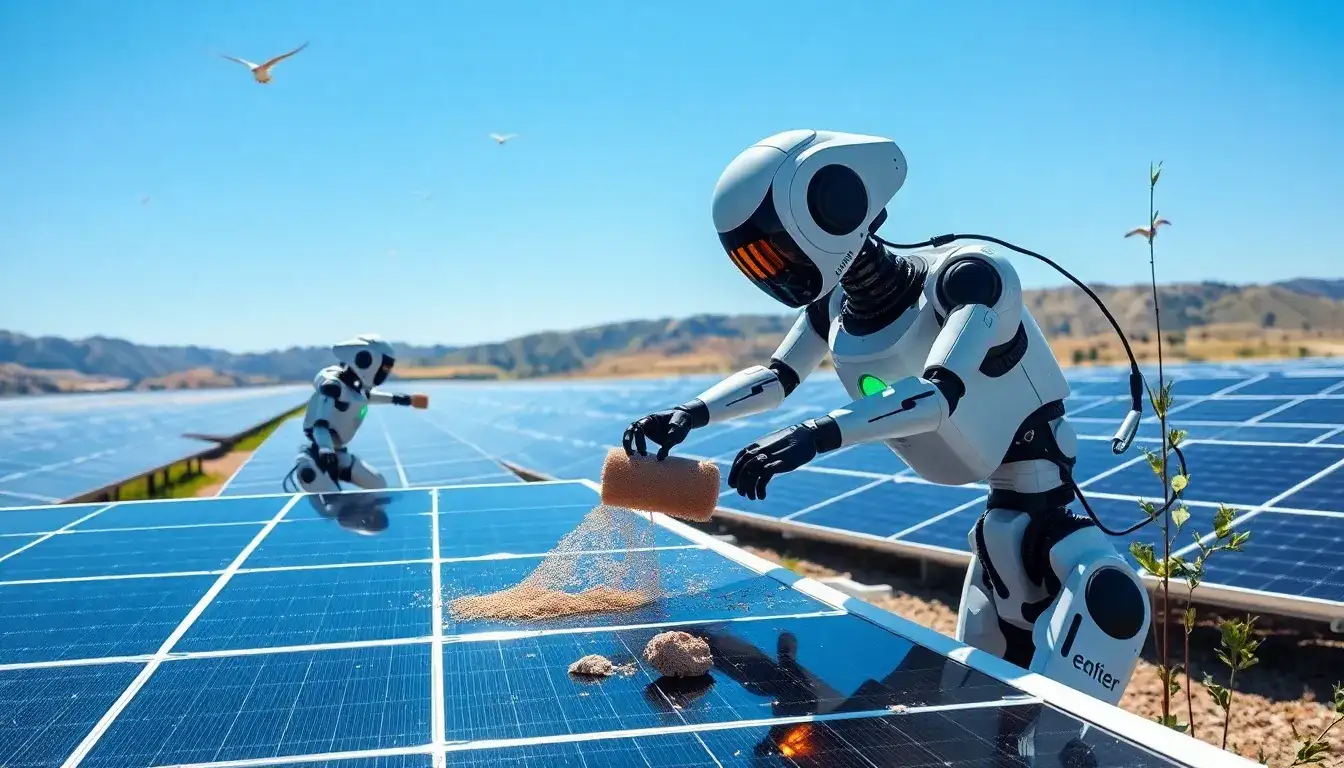
AI-powered robots clean solar panels through an integration of advanced imaging, machine learning, and autonomous robotic mechanisms that optimize cleaning efficiency, reduce water usage, and enable real-time monitoring.
How AI-Powered Robots Clean Solar Panels
- Dirt Detection Using AI Imaging
Robots employ AI-based vision systems, often using Convolutional Neural Networks (CNN) like the Visual Geometry Group 16 (VGG16) architecture, to detect and classify dirt types on solar panels—such as dust, bird droppings, or sand. This intelligent detection guides the robot on whether dry or wet cleaning is needed. AI-powered imaging precisely identifies the dirtiest areas, enabling targeted cleaning rather than uniform cleaning across the entire array, thus optimizing time and resources. - Autonomous Navigation and Cleaning Mechanisms
Equipped with sensors and AI algorithms, these robots autonomously navigate solar panel arrays, crossing gaps between panels (up to around 27.5 inches), adjusting cleaning paths, and avoiding obstacles to prevent damage. Cleaning tools include microfibre brushes or vertical brushes that sweep across panels, sometimes combined with water pumps for wet cleaning when necessary. Some robots feature waterless cleaning systems (e.g., NOMADD) suitable for arid areas where water resources are scarce. - Adaptive Cleaning Based on Dirt Type
Depending on the AI classification of the dirt, robots perform either dry cleaning using brushes or wet cleaning using water pumps, minimizing water usage while ensuring effective dirt removal. For instance, after sandstorms, robots can be programmed to clean dust accumulation immediately to prevent power losses. - Scheduling and Environmental Adaptation
AI systems integrate weather forecasts and environmental data to schedule cleaning at the most effective and least wasteful times. For example, cleaning can be planned to avoid rain or high winds, which might negate cleaning efforts or pose risks. Robots can clean day or night using onboard batteries and LED lighting, enhancing operational flexibility. - Performance Monitoring and Maintenance
AI algorithms continuously monitor the condition of panels during cleaning, detecting issues such as hotspots, microcracks, broken panels, or yellowing, which enables predictive maintenance and timely repairs. This capability improves panel longevity and overall solar farm efficiency. - Remote Control and Reporting
Cleaning robots can be remotely controlled or operate fully autonomously, with central management systems receiving alerts about faults or cleaning status, allowing operators to adjust cleaning schedules or routes dynamically.
Summary Table of AI-Powered Solar Panel Cleaning Robot Features
| Feature | Description | Benefits |
|---|---|---|
| AI Dirt Detection | Uses CNN-based imaging to identify dirt type and location | Targeted cleaning, reduced unnecessary cleaning |
| Autonomous Navigation | Sensors and AI enable self-driving on solar arrays | Minimizes human intervention, prevents damage |
| Dry & Wet Cleaning Modes | Brushes for dry cleaning and water pumps for wet cleaning | Efficient cleaning with water conservation |
| Environmental Scheduling | AI integrates weather data to optimize cleaning timing | Saves water, improves cleaning effectiveness |
| Nighttime Cleaning Capability | Batteries and LED lighting allow cleaning in darkness | Extends operation hours, ensures timely maintenance |
| Panel Condition Monitoring | Detects faults and damage during cleaning | Enables predictive maintenance and long-term panel health |
| Remote Operation & Monitoring | Central system for real-time tracking and alerts | Facilitates quick response and operational adjustments |
Overall, AI-powered solar panel cleaning robots combine intelligent detection, adaptive cleaning methods, and autonomous operation to maximize panel performance, reduce water consumption, and enhance maintenance safety and efficiency. This technology is increasingly adopted in large solar farms, especially in regions where water scarcity and labor costs challenge traditional manual cleaning.
Original article by NenPower, If reposted, please credit the source: https://nenpower.com/blog/how-do-ai-powered-robots-clean-solar-panels/

