

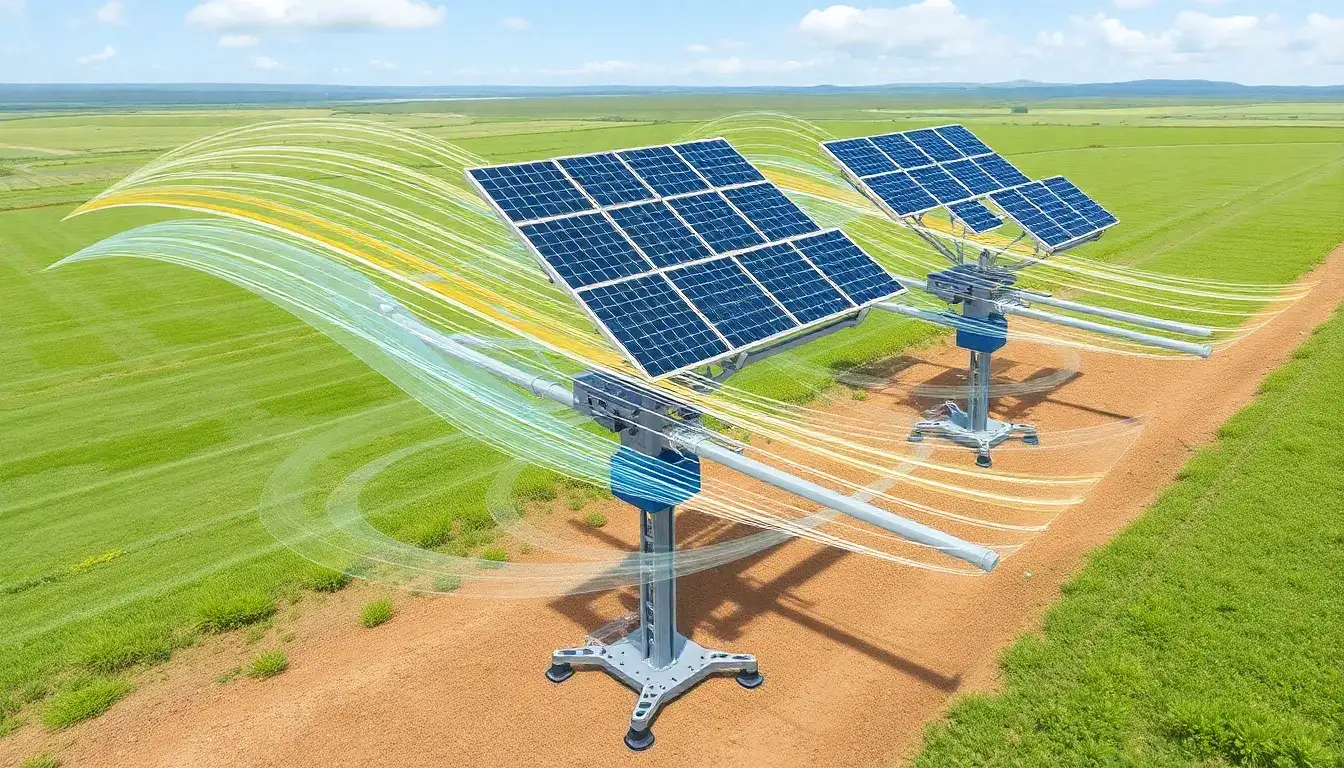
Aeroelastic forces significantly affect the stability of solar trackers, especially single-axis tracking systems that rotate or tilt to optimize sunlight exposure. These forces arise from the interaction between the solar tracker structure and the surrounding wind flow, which can induce dynamic effects such as resonant vibration, torsional flutter, and torsional galloping, collectively known as aeroelastic instability. Such instability can cause uncontrollable vibrations or oscillations in the solar tracker, leading to structural fatigue, misalignment, reduced tracking accuracy, and even component failure.
Because solar trackers are located close to the ground, they experience high turbulence in wind flow, which increases their susceptibility to such aeroelastic effects compared to static solar panel arrays. The movement and flexibility inherent to tracking systems amplify wind loads substantially, making them more vulnerable to aeroelastic excitation than fixed-tilt installations.
To maintain solar tracker stability under aeroelastic forces, several critical design and testing considerations are necessary:
- Dynamic wind testing and aeroelastic modeling: Wind tunnel testing and dynamic aeroelastic models assess how fluctuating wind loads induce vortex excitation and torsional galloping in the torque tube and frame. These tests measure torque, rotational displacement, and pressure to better understand dynamic response and structural limits.
- Critical damping: Achieving sufficient damping is crucial to mitigating resonant vibrations and preventing aeroelastic instability. Adequate damping reduces oscillations and enhances the system’s ability to withstand turbulent wind environments.
- Structural and aerodynamic optimization: Each component must be designed for optimized resistance against wind loads, balancing flexibility for tracking with robustness to aerodynamic forces. This includes evaluating potential failure modes and ensuring rigidity where necessary to minimize aeroelastic deformation.
In summary, aeroelastic forces impose complex dynamic challenges on solar trackers by causing unwanted vibrations and oscillations that compromise stability. Mitigating these forces requires a combination of thorough aeroelastic wind testing, optimized structural design, and adequate damping to ensure reliable and safe operation of solar tracking systems in real-world turbulent wind conditions.
Original article by NenPower, If reposted, please credit the source: https://nenpower.com/blog/how-do-aeroelastic-forces-affect-solar-tracker-stability/

