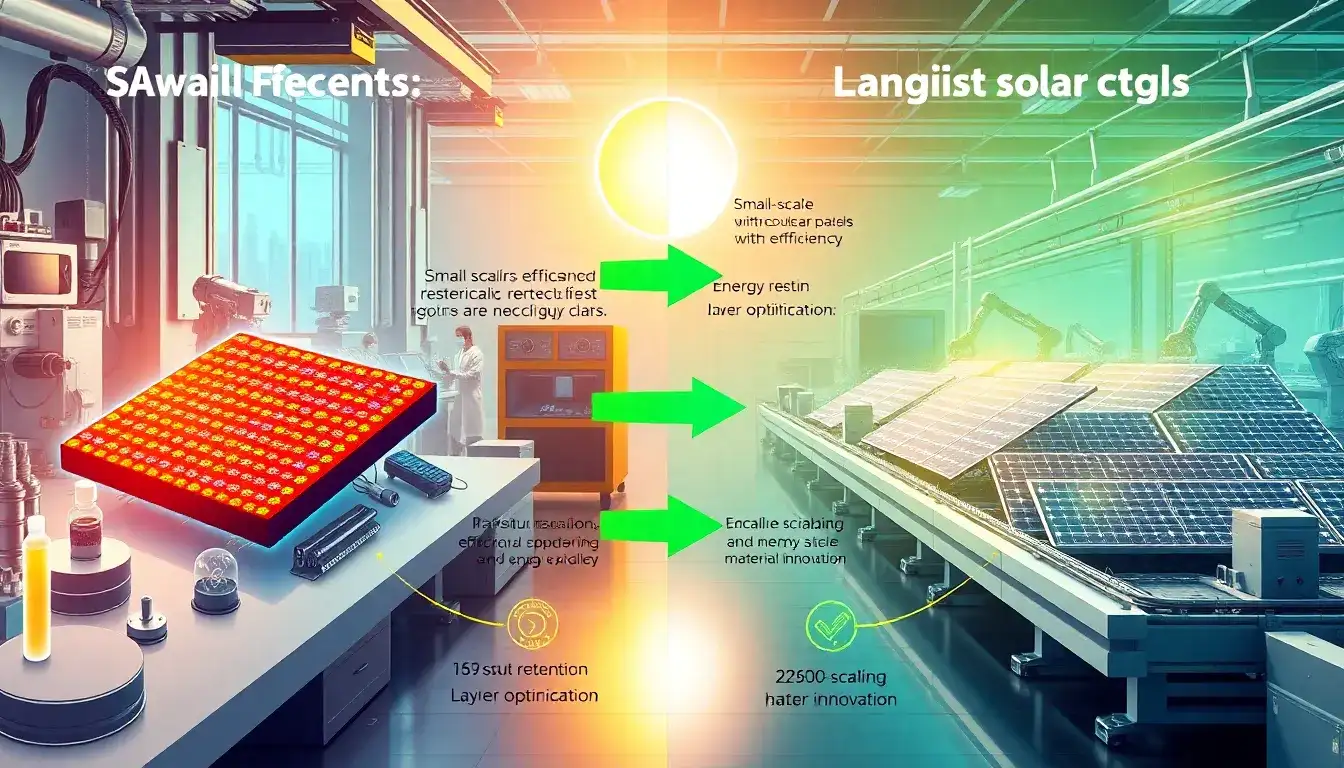
To minimize efficiency losses when scaling up perovskite solar cells from lab-scale to large-scale production, researchers focus on several key strategies:
1. Advanced Coating Techniques
Using ambient air-compatible deposition methods like slot-die/blade meniscus coating ensures homogeneous large-area films. A 320 cm² sub-module achieved 16.13% efficiency (7% loss vs. small cells) through optimized solvent additives and passivation. Such methods reduce defects and improve reproducibility during scale-up.
2. Defect Passivation and Material Engineering
- Liquid crystal additives like TFPCBP enable uniform defect passivation across large films, achieving 21.1% stabilized efficiency for 30 cm² modules. These additives avoid interfacial aggregation during solvent evaporation, preserving charge extraction.
- PEAI passivation suppresses non-radiative recombination in ambient-fabricated modules, enhancing carrier extraction.
3. Encapsulation and Stability Enhancements
Modules with liquid crystals retained 86% initial efficiency after 1,200 hours under damp-heat testing (85°C, 85% RH), surpassing control modules (51%). Heavy encapsulation, though costly, can be mitigated by advanced materials that balance protection and weight.
4. Industrial-Compatible Processes
- Vacuum processing combined with laser structuring achieved 18% efficiency for 4 cm² modules, reducing losses in monolithic series connections.
- Eco-efficient scale-up lowers costs by ~40% for sub-modules while maintaining performance through green solvents and ambient manufacturing.
5. Tandem Architectures and Novel Materials
Combining perovskites with silicon or using singlet fission materials (e.g., tetracene) improves light absorption and thermal stability, indirectly mitigating scaling losses.
Comparison of Scaling Approaches
| Method | Efficiency Achieved | Area | Key Innovation |
|---|---|---|---|
| Ambient slot-die | 16.13% | 320 cm² | PEAI passivation, green solvents |
| Liquid crystal TFPCBP | 21.1% (stabilized) | 30 cm² | Thermotropic phase uniformity |
| Vacuum processing | 18% | ~4 cm² | Laser structuring, reduced defects |
By prioritizing scalable deposition, defect control, and stability-focused designs, efficiency losses can be systematically minimized.
Original article by NenPower, If reposted, please credit the source: https://nenpower.com/blog/how-can-the-efficiency-losses-during-the-transition-from-lab-scale-to-large-scale-perovskite-solar-cells-be-minimized/