

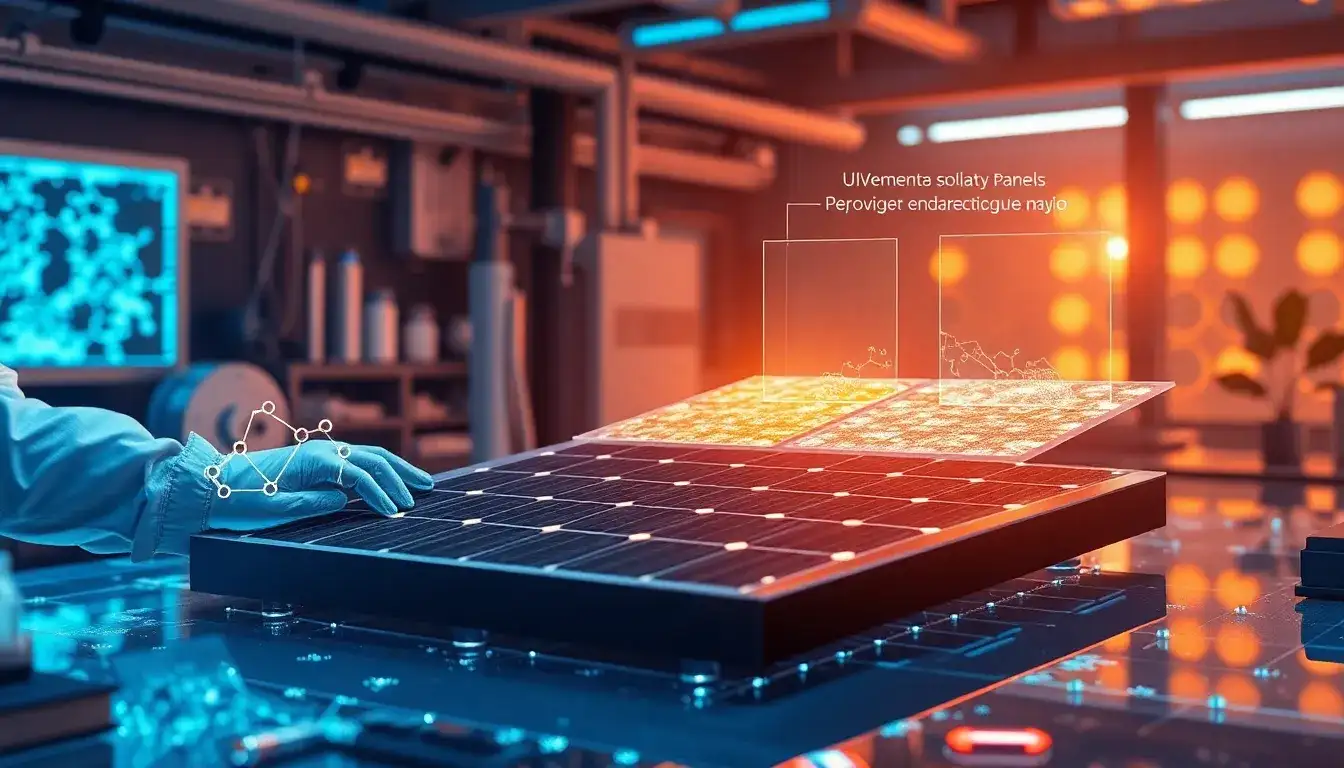
Degradation issues of perovskite solar panels arise primarily due to intrinsic material defects, environmental factors such as moisture and heat, ion migration, and photochemical reactions. To mitigate these problems, the following strategies have been identified and researched extensively:
Key Causes of Perovskite Solar Panel Degradation
- High Temperature Exposure: Temperatures during operation can reach up to 100 °C, which accelerates chemical decomposition in the perovskite layer.
- Intrinsic Defects and Ion Migration: Vacancies and pinholes within the perovskite structure enable ion migration, which disrupts performance by damaging transport layers and creating shunt pathways for electrons.
- Moisture Intrusion: Water penetrates the perovskite layer, causing deterioration of power conversion efficiency and other performance metrics.
- Ultraviolet (UV) Light Exposure: UV light triggers photochemical processes that can cause structural changes, such as phase segregation from the photoactive phase to a non-perovskite phase, degrading cell efficiency.
Strategies to Mitigate Degradation
1. Encapsulation
- Using polymers, glass, and specialized moisture-barrier coatings to protect the perovskite layer from environmental moisture and oxygen ingress.
- Application of hydrophobic coatings (e.g., fluorinated compounds, self-assembled monolayers) enhances moisture resistance and surface passivation to prevent direct exposure to moisture.
- Deposition of inorganic protective layers such as alumina (Al₂O₃) and titanium dioxide (TiO₂) acts as effective barriers against moisture and oxygen, improving long-term stability.
2. Material Engineering
- Incorporation of halide ions such as bromide or chloride can sometimes improve stability by altering the perovskite composition, although this may come with performance trade-offs.
- Engineering the perovskite film to reduce vacancies and defects during formation reduces ion migration, thus enhancing stability.
3. Thermal Management
- Designing solar modules and system components to minimize the exposure of perovskite layers to temperatures above 85-100 °C, or developing perovskite materials more resistant to heat-induced degradation.
4. Suppressing Ion Migration
- Stabilizing the interfaces and reducing chemical reactions between migrating ions and transport layers through chemical engineering and interface modification can prevent conductivity loss and device failure.
5. UV Light Management
- Applying UV-filtering layers or integrating UV-stable materials into the solar cell stack to prevent photochemical degradation and preserve the crystal structure of the perovskite layer.
6. Chemical Interaction Control
- Recent research uncovers the specific chemical interactions that cause instability, enabling targeted prevention approaches that may involve additives or altered chemical compositions to halt degradation pathways.
Summary Table of Mitigation Approaches
| Cause of Degradation | Mitigation Strategy | Description |
|---|---|---|
| Heat | Thermal management; heat-resistant materials | Limit operating temperature; engineer stable materials |
| Ion migration | Film quality improvement; interface engineering | Reduce vacancies; stabilize interfaces |
| Moisture | Encapsulation with hydrophobic coatings & inorganic layers | Prevent water ingress using barrier layers |
| UV light | UV-filtering layers; UV-stable materials | Prevent photochemical degradation by blocking UV |
| Chemical degradation | Chemical interaction control; additives | Modify chemistry to stop degradation reactions |
These combined approaches help slow down or prevent degradation, improving the operational lifespan and reliability of perovskite solar panels for practical applications.
Original article by NenPower, If reposted, please credit the source: https://nenpower.com/blog/how-can-the-degradation-issues-of-perovskite-solar-panels-be-mitigated/

