

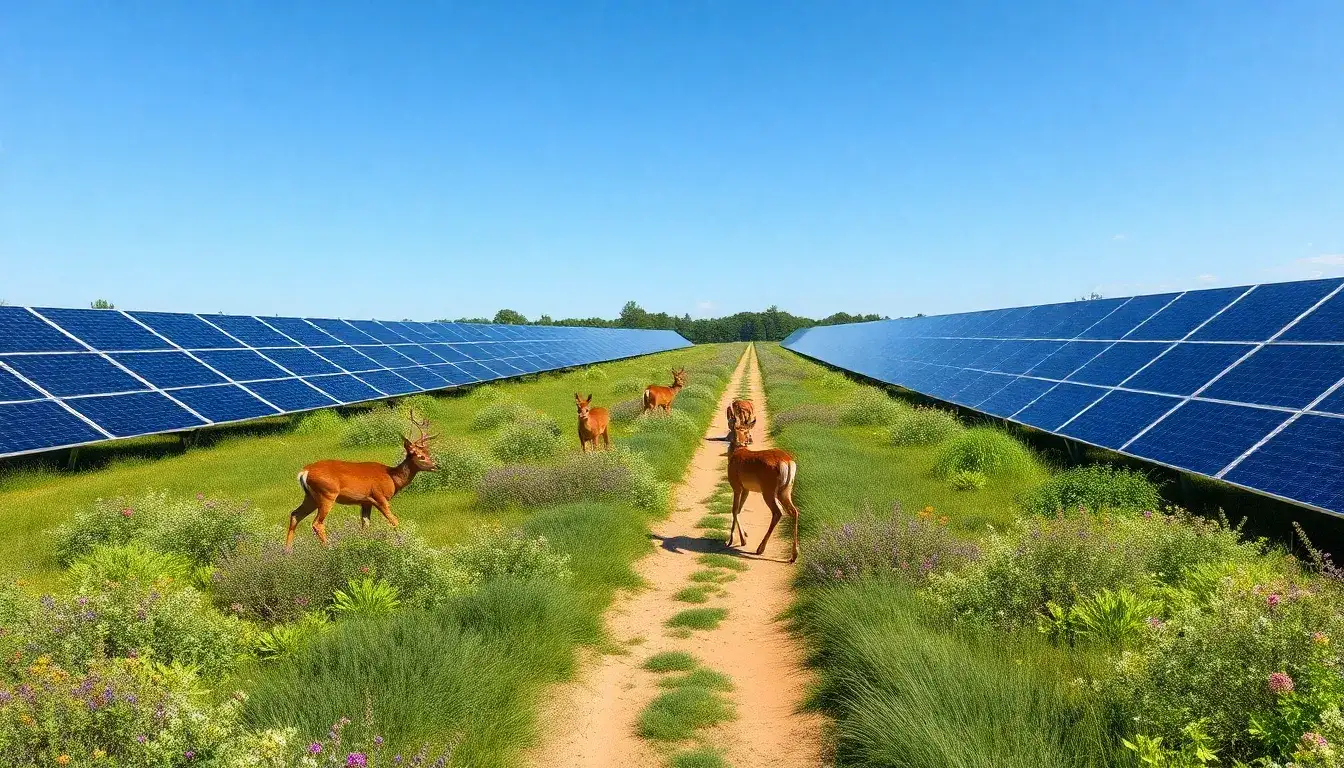
Solar farms can be designed to include wildlife corridors by integrating several key features that allow safe and functional movement of wildlife through or around the solar energy facilities, thereby reducing habitat fragmentation and preserving biodiversity.
Key Design Strategies for Wildlife Corridors in Solar Farms
1. Wildlife-Permeable Fencing
- Use fencing that allows smaller animals—such as raccoons, rabbits, and squirrels—to pass through by including holes or gaps large enough for these species while still protecting the solar infrastructure.
- Raise the bottom of the fence a few inches off the ground to create a passageway for small animals without allowing larger animals to enter.
- Employ mesh materials that balance security with permeability, ensuring smaller wildlife can move freely without compromising site protection.
2. Creating Openings for Larger Wildlife
- Incorporate deliberate openings or gaps in the perimeter fencing specifically for passage of larger mammals like deer, coyotes, and bears. For example, openings about 10 inches wide by 7 inches tall spaced every 260 feet can permit wildlife movement while maintaining security.
- Maintain unfenced “wildlife passageways” within large solar facilities to facilitate movement corridors that do not disrupt natural migration or range patterns.
3. Solar Panel Placement to Support Habitat and Connectivity
- Avoid complete clearing of vegetation; instead, maintain native plants and natural topography to provide habitat under and around solar arrays.
- Increase spacing between solar panels and raise panels higher than industry standard to allow sunlight to reach vegetation beneath and enable movement of animals underneath.
- Vary spatial arrangements of panels to avoid creating a uniform surface that might disrupt animal behavior, such as minimizing water-body illusions that can confuse some species.
4. Buffer Zones and Connectivity Conservation
- Establish buffer zones around the solar farm and between solar arrays that preserve natural habitats and allow wildlife to travel without disturbance.
- Plan wildlife corridors to maintain connectivity between ecosystems, enabling animals to move freely within and beyond the solar site without restricted ranges.
5. Seasonal and Adaptive Fence Management
- Adjust fencing heights and gaps seasonally to accommodate animal migration and breeding periods, allowing animals like amphibians and reptiles to move as needed during different times of the year.
- Implement temporary gaps or openings in fencing during migration seasons to support natural wildlife behavior.
6. Additional Measures to Reduce Impact on Wildlife
- Restrict vehicle speeds and use smaller maintenance vehicles to reduce disturbance and accidental harm to wildlife within solar farms.
- In sensitive habitats with endangered species (e.g., desert tortoise), consider temporary relocation and monitoring to ensure minimal impact during construction and operation phases.
By combining these strategies, solar farms can be designed as multifunctional landscapes that not only generate renewable energy but also sustain and promote wildlife movement and biodiversity. This approach balances infrastructure security with ecological preservation, creating “wildlife-friendly” solar energy projects.
Original article by NenPower, If reposted, please credit the source: https://nenpower.com/blog/how-can-solar-farms-be-designed-to-include-wildlife-corridors/

