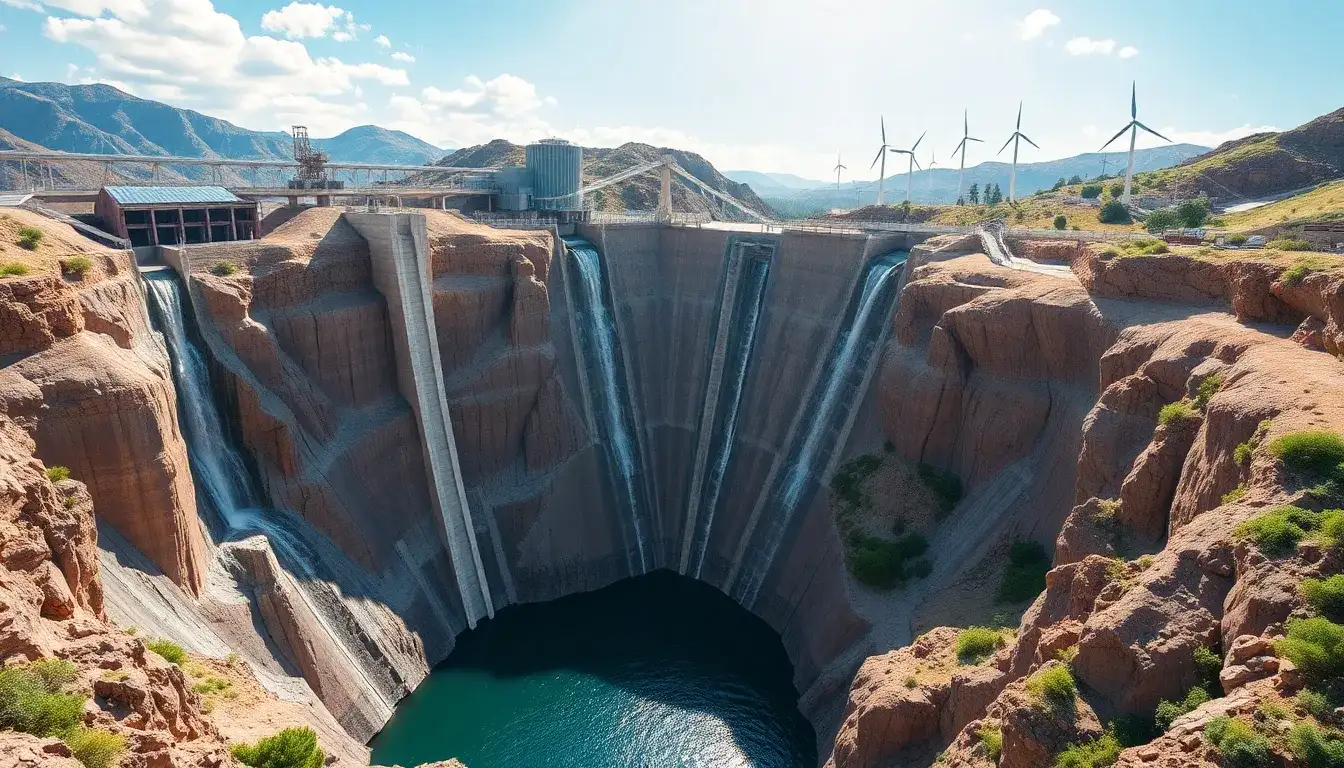
Open-pit mines can be repurposed for pumped storage hydropower (PSH) plants by leveraging their existing excavations as reservoirs and integrating renewable energy storage infrastructure. Here’s how this conversion works:
Key Components of Conversion
- Upper and Lower Reservoirs:
- Lower reservoir: The open-pit mine itself serves as the lower reservoir, with its naturally excavated basin providing ample water storage capacity.
- Upper reservoir: Adjacent elevated areas, such as natural lakes, waste dumps, or connected mining pits, are adapted or engineered to create the upper reservoir. In China’s Fushun West Open-Pit mine, a three-phase plan uses surrounding landforms for this purpose.
- Infrastructure Reuse:
- Transmission lines: Mines often have existing grid connections for operational equipment, reducing costs for linking to energy networks.
- Water rights: Many mines retain pumping rights to local water sources, simplifying water procurement.
- Energy Storage Mechanism: Excess renewable energy (e.g., solar/wind) pumps water to the upper reservoir. During peak demand, water flows downhill through turbines to generate electricity.
Benefits of Mine-Based PSH
- Cost Efficiency: Excavation costs are minimized since the pit already exists.
- Economic Revitalization: Provides jobs in regions facing mine closures, such as Fushun City, which employs 7,000 workers.
- Environmental Remediation: Mitigates long-term environmental hazards (e.g., acid drainage) while supporting renewable energy integration.
- Grid Stability: Offers large-scale, long-duration storage (8–12+ hours), outperforming batteries for sustained energy supply.
Challenges and Considerations
- Slope Stability: Hydrostatic pressure from reservoir filling requires rigorous geotechnical analysis, as demonstrated in Fushun using GeoStudio simulations.
- Regulatory Hurdles: Permitting for water use and land conversion, especially in regions without precedents for closed-loop PSH.
- Site Suitability: Head height (vertical distance between reservoirs) and topography must align with PSH requirements.
Global Implementation Status
- China: The Fushun project exemplifies how abandoned mines can achieve technical feasibility while supporting national carbon-neutrality goals.
- U.S.: No operational PSH on mine land yet, but DOE-funded initiatives aim to demonstrate viability at former coal sites.
- Australia: 37 mine sites identified for conversion, with off-river PSH minimizing ecological disruption.
By reusing mining infrastructure, these projects transform post-industrial landscapes into renewable energy hubs, balancing economic and environmental priorities.
Original article by NenPower, If reposted, please credit the source: https://nenpower.com/blog/how-can-open-pit-mines-be-utilized-for-new-pumped-storage-hydropower-plants/