

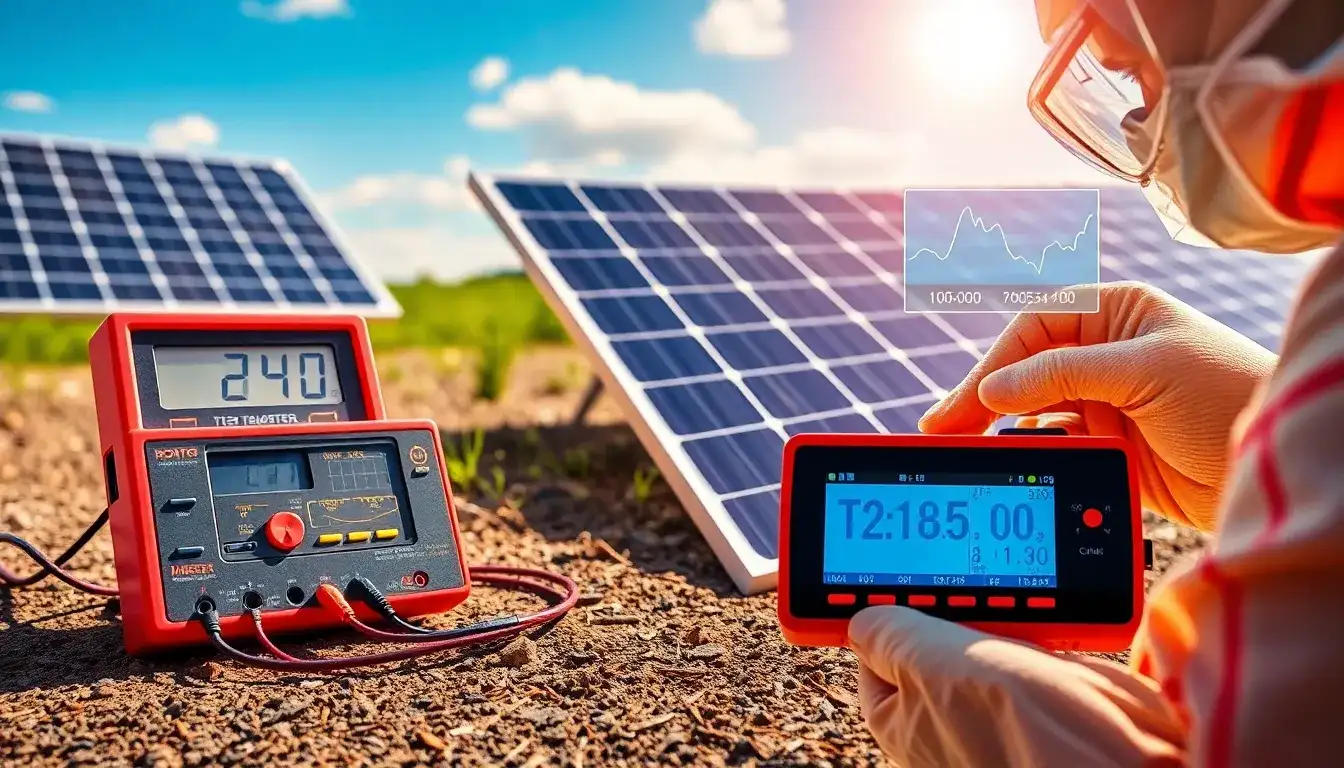
Measuring the temperature coefficient of solar panels
Measuring the temperature coefficient of solar panels involves assessing how their performance changes with temperature variations. Here’s a step-by-step guide on how you can measure the temperature coefficient:
Equipment Needed
- Solar Simulator: A source that mimics sunlight to test the panels under controlled conditions.
- Temperature Control System: Equipment to vary and control the temperature of the solar panels, such as heating blankets or coolers.
- Thermocouples or Temperature Sensors: Multiple sensors attached to the rear of the panel to accurately measure its average temperature.
- I-V Curve Tracing Equipment: Tools to measure the current-voltage characteristics of the solar panels at different temperatures.
Measurement Procedure
-
Setup Indoor Testing:
- Place your solar panels in a controlled environment using a solar simulator to provide consistent irradiance, typically at 1000 W/m².
- Use a heating system to apply a uniform temperature to the panels. Ensure the heating is gradual to avoid non-uniform temperature distributions.
- Attach thermocouples to the rear of the panels to measure their average temperature.
-
Measure I-V Curves:
- At each set temperature, measure and record the panel’s I-V (current-voltage) curve using the I-V tracing equipment. This needs to be done at several temperatures to capture the effects on different performance metrics (e.g., Isc, Voc, Pmax).
-
Calculate Temperature Coefficient:
- To calculate the temperature coefficient (α, β, or δ for current, voltage, or power, respectively), use the formula:
-
Temperature Coefficient = ∆P/∆T × 100/PSTC
where:- ∆P is the change in power (or current/voltage),
- ∆T is the change in temperature,
- PSTC is the power at standard test conditions (STC, 25°C and 1000 W/m²).
-
Outdoor Testing Alternative:
- If indoor testing is not feasible, an alternative method is to measure the panel’s performance outdoors by shading it to cool down and then unshading it to let it heat up to operating temperature. Measure I-V curves at different temperatures using thermocouples to monitor the temperature.
-
Report Results:
- Document the temperature coefficients for each parameter measured (e.g., Pmax, Isc, Voc). These coefficients are typically expressed in %/°C, indicating the percentage change in performance per degree Celsius change in temperature.
Practical Considerations
- Non-Uniform Heating: Ensure that the temperature distribution across the panel is uniform to get accurate readings.
- Irradiance Variation: Although standard tests are done at constant irradiance, outdoor conditions may vary: consider how this affects your measurements.
- Panel Type: Different solar panel technologies (e.g., monocrystalline, polycrystalline) have varying temperature coefficients.
For more detailed guidance, refer to standards such as ASTM or IEC 60904-10 for methods of linearity measurement and temperature coefficient determination.
Original article by NenPower, If reposted, please credit the source: https://nenpower.com/blog/how-can-i-measure-the-temperature-coefficient-of-my-solar-panels/

