

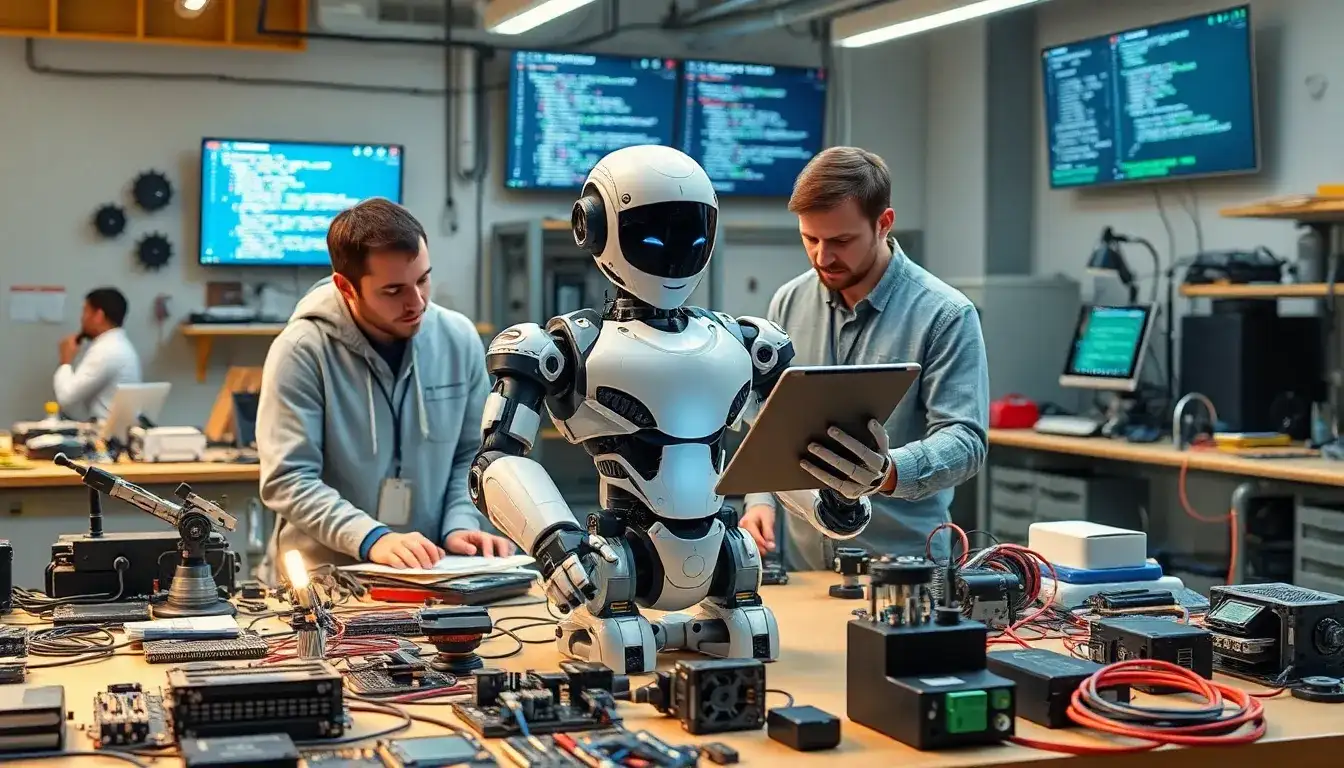
Title: How Are Communicative and Functional Robots Developed?
Beijing, February 17, 2026 – As various types of robots took the stage during the Spring Festival Gala, showcasing their abilities from performing martial arts to participating in skits, they created a futuristic spectacle that captivated audiences.
In the comedy skit “Grandma’s Favorite,” a robot seamlessly interacted with human actors, impressing viewers with its capabilities.
“The humanoid robot featured in the Spring Festival Gala is considered one of the most human-like performers,” said Zhang Miao, Chief Marketing Officer of Beijing Songyan Power Technology Group. This robot is equipped with a self-developed facial motion algorithm and a multimodal interaction model, featuring over 30 degrees of freedom in facial movements, enabling it to express dozens of human-like micro-expressions and subtle movements.
The robot’s realistic performance is the result of millions of iterations in training and optimization. “Real-time synchronization of the robot’s voice, lip movements, and expressions was a significant technical challenge for this performance,” explained the technical lead at Songyan Power.
To enable the humanoid robot to engage in realistic dialogue, the team collected a vast amount of video data of human interactions. Through rigorous training and optimization, they successfully created a system capable of understanding human expressions, emotions, and language, allowing it to respond appropriately.
As compared to the fixed-target development model in laboratories, the Spring Festival Gala stage demands higher practical performance from robots. “Language-based performances require robots not only to execute precise movements but also to effectively coordinate with actors and adapt to the stage environment,” Zhang Miao noted. The robots needed to adjust their actions and timing based on the script and the actors’ cues.
How long will it take for these robots to enter everyday life? A review of the timeline shows that the introduction of small robots in the 2012 Spring Festival Gala has evolved into the popular performance of the Yushu robot dancing in a floral cotton-padded jacket in 2025. This progression indicates that the Gala stage has become an important testing ground for robotic technology. Over the past decade, humanoid robots have transitioned from mere showcases of technology to practical applications, moving from simple tasks to performing complex dances, from collective coordination to human-robot interaction, and from single-function demonstrations to multi-scenario adaptability.
It is noteworthy that many core technologies used by robots in this year’s Gala have already been implemented in real life.
On June 17, 2025, at the Robot World in Beijing Economic Development Zone, the Galbot, a humanoid robot from Galaxy General, demonstrated an unattended pharmacy scenario.
The key to this transformation lies in the evolution of the robots’ “brains.” “The Galbot G1, similar to the robots used in the Spring Festival Gala, is trained using a massive dataset, enabling it to adjust its actions in real-time based on the environment,” stated Fu Qiang, a partner and product manager at Beijing Galaxy General Robot Co., Ltd. The Galbot G1 has already transitioned from the stage to real-life applications, autonomously handling welcoming, interaction, ordering, picking, and delivery services.
Jiang Guangzhi, Secretary of the Party Leadership Group and Director of the Beijing Municipal Bureau of Economy and Information Technology, mentioned in an interview that Beijing’s focus has shifted from merely testing movement capabilities to deeper explorations of operational capabilities. The 2025 Robot Games featured actual scenarios such as drug sorting, material handling, and precision operations, signaling a shift from performance to practical deployment. “Our investments in dexterous hands and robotic arms are evident, and this year’s Robot Games will further highlight robots in human production and daily life,” he added.
However, some industry experts acknowledge that it will still take time for humanoid robots to become commonplace in households.
“Performance remains the optimal application scenario for humanoid robots today,” said Pan Helin, a member of the Information and Communication Economic Expert Committee of the Ministry of Industry and Information Technology. Showcasing robots on stage helps companies gain visibility, attracting capital, talent, orders, and collaborative opportunities for long-term research and development.
Lan Dapeng, a deputy researcher at the Shenyang Institute of Automation, Chinese Academy of Sciences, emphasized the existing gap between performance robots and real-world applications. “For instance, industrial scenarios have high accuracy requirements, while most humanoid robots currently only achieve centimeter-level control, and overall costs remain high,” he pointed out. He suggested that technologies refined through performance could be adapted for industrial applications, with customized developments for different scenarios to gradually close the gap between technology and real-world use.
Current Developments and Challenges
China has made remarkable achievements in the fields of artificial intelligence and robotics. Although the embodied intelligence industry is still in its infancy, it has a solid foundation in large model research and product manufacturing. The Development Research Center of the State Council predicts that the embodied intelligence market is expected to exceed one trillion yuan by 2035, driving significant advancements across various application areas such as transportation logistics, industrial manufacturing, and commercial services.
On November 6, 2025, attendees at the World Internet Conference experienced a combat demonstration with the Yushu Technology G1 robot.
From a regional perspective, various areas are developing differentiated strategies surrounding the entire industrial chain, fostering a cooperative development environment. The Beijing-Tianjin-Hebei region, leveraging its concentration of innovation resources, focuses on technology research and frontier scenario innovation; the Yangtze River Delta region emphasizes supportive policies and resource allocation, accelerating the establishment of data training grounds and open-source technology platforms; while the Pearl River Delta region capitalizes on its manufacturing and consumer market advantages, prioritizing the implementation and commercialization of consumer-grade and service robots.
Li Yechuan, Director of the Intelligent Manufacturing and Equipment Industry Division at Beijing Municipal Bureau of Economy and Information Technology, explained that Beijing provides systematic support covering the entire innovation chain for robot companies, focusing on key areas such as technology breakthroughs and scenario implementation. Currently, there are over 940 robotics enterprises in Beijing, with a revenue scale exceeding 40 billion yuan, positioning the city as a leading hub for robotic technology innovation and industry aggregation.
“Different regions do not compete in a ‘first come, first served’ manner but rather find their own positioning based on their advantages, collaboratively completing the research, production, and application chains of the industry,” Lan Dapeng observed. He believes that the “gradual advancement and complementary characteristics” model formed by local resource endowments will facilitate steady progress for the entire sector.
While the industry develops rapidly, several challenges have arisen, particularly a notable talent shortage.
“Based on industry observation and enterprise practice, the most urgently needed talent currently is individuals with system engineering capabilities,” Zhang Miao stated. The training period for such talent is lengthy, making quick training programs insufficient. Therefore, collaboration between enterprises, universities, and research institutions will be essential for building talent within the industry.
Looking ahead, Lan Dapeng predicts that the humanoid robot industry will evolve towards a dual approach of “general core capabilities combined with vertical scenario specialization.” This includes promoting the reuse of core technologies like perception and decision-making across different scenarios, while customizing and optimizing solutions for specific needs such as home companionship and industrial assembly. Additionally, the strategy of “promoting research through competitions” will continue to empower technological upgrades, ultimately fostering a diverse, complementary, and collaborative ecosystem.
Original article by NenPower, If reposted, please credit the source: https://nenpower.com/blog/how-are-communication-enabled-and-task-performing-robots-developed/

