

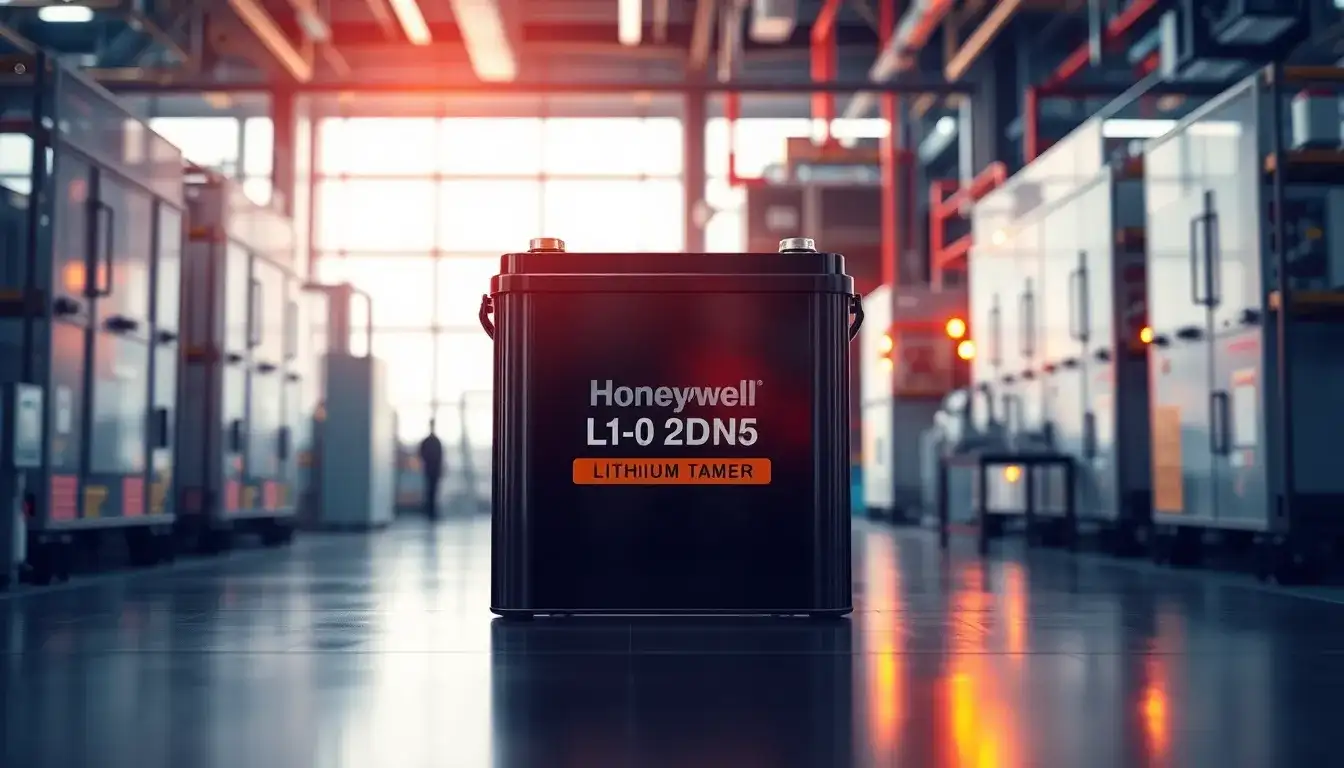
Honeywell’s Battery Safety Gambit: A Strategic Move in a $400 Billion Market
In a decisive step to establish its leadership in crucial sectors of the renewable energy transition, Honeywell (HON) has acquired Li-ion Tamer, an innovative developer of lithium-ion battery safety technology, from Nexceris. This acquisition, announced in July 2025, positions Honeywell at the forefront of preventing thermal runaway—the dangerous overheating that can transform lithium-ion batteries into fire hazards. With the global lithium-ion battery market expected to exceed $400 billion by 2030 and growing at an impressive annual rate of over 30%, this acquisition serves both defensive and offensive purposes: it strengthens Honeywell’s existing fire safety portfolio while tapping into a high-margin, rapidly expanding market.
### The Strategic Imperative: From Detection to Prevention
Li-ion Tamer’s groundbreaking innovation centers on its capability to detect off-gassing—an early sign of thermal runaway—up to 30 minutes before a fire ignites. This technology is revolutionary for industries that rely on lithium-ion batteries, including electric vehicle (EV) manufacturers, data centers, and utility-scale energy storage systems. Honeywell’s established VESDA early smoke detection system, critical for infrastructure safety, now benefits from this complementary tool that addresses risks proactively. Together, they create a comprehensive safety suite: Li-ion Tamer’s gas sensors provide early warnings, VESDA detects smoke, and Honeywell’s Connected Life Safety Services facilitate real-time monitoring and response. This integration aligns with Honeywell’s broader strategy to seize opportunities in the energy transition, where the safe deployment of batteries is essential for the growth of EV adoption and grid storage.
### Financial Accretion Meets Market Momentum
The acquisition is touted as “immediately accretive” to Honeywell’s earnings—a notable achievement in today’s acquisition-heavy industrial landscape. Although the financial specifics remain undisclosed, the deal’s positive impact on earnings suggests that Honeywell paid a premium, justified by Li-ion Tamer’s profitability and its scalable technology. Honeywell is also focusing on simplifying its portfolio by divesting non-core businesses like Aerospace Technologies and Solstice Advanced Materials, which enables it to allocate capital towards high-growth areas such as battery safety. Analysts at Jefferies have recently raised their price target for Honeywell to $240, highlighting the company’s ability to capitalize on its IoT-enabled platforms (such as Honeywell Forge) and its disciplined M&A strategy. The acquisition of Li-ion Tamer exemplifies this approach: a strategic, impactful deal that enhances Honeywell’s market reach without overly stretching its financial resources.
### Risks and Realities
The primary challenge lies in the seamless integration of Li-ion Tamer’s proprietary algorithms with Honeywell’s existing systems, which requires technical precision, especially as customers seek interoperability with legacy infrastructure. Moreover, the rapid growth of the battery safety market may test Honeywell’s capacity to scale production and provide customer support effectively. However, the five-year partnership between Honeywell and Nexceris—now formalized—provides a solid foundation for success. With over 30 patents and established OEM relationships, Li-ion Tamer mitigates the risks associated with market entry. Additionally, Honeywell’s reputation as a reliable safety provider in critical sectors like aviation and healthcare may accelerate the adoption of its new technology.
### Why Investors Should Take Note
This acquisition represents more than just a focus on lithium-ion safety; it signifies a commitment to the impending energy transition. As governments and corporations ramp up decarbonization efforts, the demand for safer, more reliable battery systems will surge. Honeywell’s strategic move positions it favorably in a market where failures (such as battery fires) are unacceptable. For investors, the opportunity is twofold:
1. **Upside in a Structural Growth Trend:** The $400 billion battery market’s growth rate of over 30% presents a significant advantage for Honeywell’s margins and revenue diversification.
2. **Low-Risk, High-Reward M&A:** In contrast to flashy, high-profile deals, the acquisition of Li-ion Tamer minimizes execution risk while adding a valuable new revenue stream.
### Conclusion: A Safety Net for Growth
Honeywell’s acquisition of Li-ion Tamer exemplifies a well-executed strategic move in the M&A landscape. By addressing a critical vulnerability within the lithium-ion ecosystem, it transforms a defensive necessity into a competitive advantage. Although challenges such as integration hurdles exist, the deal’s immediate accretive nature and alignment with long-term trends make it a significant advancement. For investors looking to engage in the energy transition without excessive exposure to commodity price fluctuations or geopolitical uncertainties, Honeywell’s safety-first approach provides a robust foothold in a thriving market.
### Investment Takeaway
As of June 2025, Honeywell’s stock is trading around $215 and appears undervalued in light of its growth potential. The acquisition of Li-ion Tamer reinforces its leadership position in industrial safety—a sector where premium valuations are warranted. Investors may consider adding to their positions for long-term exposure to the energy transition, with a target price of $240 or more by 2026.
Original article by NenPower, If reposted, please credit the source: https://nenpower.com/blog/honeywell-strengthens-position-in-400-billion-battery-market-with-li-ion-tamer-acquisition/

