

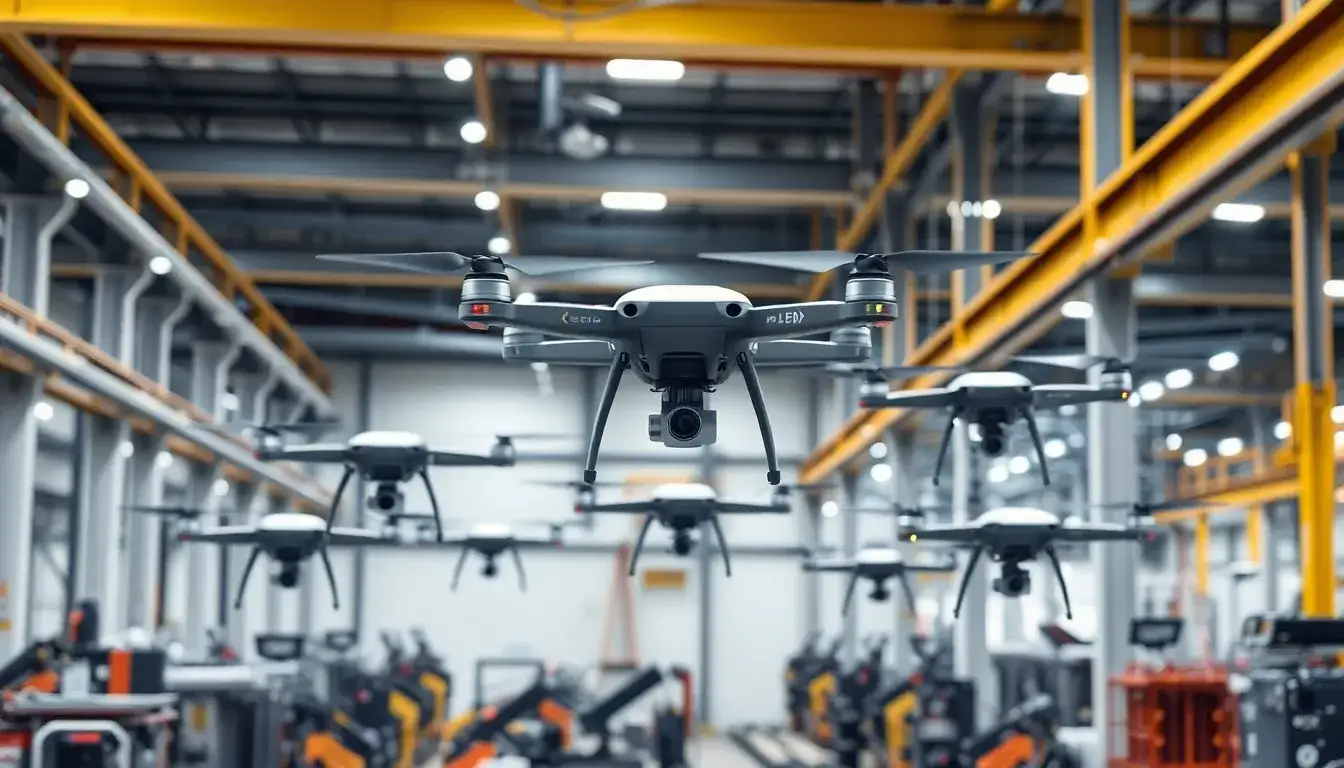
Hitachi’s Hierarchical Framework for Autonomous Drone-Based Industrial Inspection
The application of the LLM agent framework to physical inspections using drones is an emerging area. However, the performance differences among various reasoning methods in practical tasks remain unclear. Hitachi’s R&D center in the U.S. has proposed a hierarchical agent framework (Head Agent + Worker Agent) along with the ReActEval reasoning method (Reason-Act-Evaluate cycle) for autonomous drone inspections in indoor industrial environments. In experiments covering three levels of complexity and four types of LLM models, the study revealed a significant phenomenon: ReActEval performed worst with weaker models but excelled with stronger ones—indicating that the effectiveness of the reasoning method depends on the underlying model’s capabilities rather than the complexity of the method itself. The combination of ReActEval with the o3 model achieved an overall accuracy of 0.905.
Paper Title: A Hierarchical Agentic Framework for Autonomous Drone-Based Visual Inspection
Authors: Ethan Herron, Xian Yeow Lee, Gregory Sin, Teresa Gonzalez Diaz, Ahmed Farahat, Chetan Gupta
Institution: Hitachi America Ltd., R&D, Santa Clara
Paper Link: arXiv:2510.00259v1
1. Challenges Faced by Existing Drone Inspection Systems
In industrial inspection scenarios (such as chemical plants and power facilities), manual inspections pose safety risks, while current drone inspection systems heavily rely on operator manual intervention and pre-programmed flight paths, lacking adaptability to dynamic industrial environments. The paper highlights that existing systems struggle to effectively scale in three dimensions:
- Task breadth: Difficulty in deployment across diverse industrial scenarios;
- Task complexity: Inability to handle complex inspection tasks requiring reasoning and decision-making (e.g., locating and reading pressure gauges);
- Multi-drone collaboration: Coordination among multiple drones adds cognitive burden on operators.
While the LLM agent framework has succeeded in digital fields such as software development, its application to physical asset inspections remains in exploratory stages. The paper raises two core questions: how to manage multiple drone agents, and how each drone agent can effectively execute tasks.
2. Method: Hierarchical Architecture + ReActEval Reasoning Framework
2.1 Hierarchical Agent Architecture
The framework employs a Head Agent + Worker Agent structure:
- Head Agent: Receives user natural language commands, executes high-level planning, breaks down tasks, assigns them to Worker Agents, and finally summarizes results to provide feedback to the user;
- Worker Agent: Each Worker Agent controls a drone, responsible for executing low-level tasks.
This architecture offers three design advantages:
- Scalability: Users specify the number of drones during initialization, and the Head Agent dynamically assigns tasks without requiring system architecture modifications;
- Input Standardization: The Head Agent converts diverse natural language expressions from users into consistent structured task descriptions, enhancing the reliability of Worker Agent execution;
- Context Management: The Head Agent maintains the entire session’s history, while Worker Agents reset history after completing individual tasks to avoid performance degradation from irrelevant context accumulation.
2.2 ReActEval: Reason-Act-Evaluate Cycle
The paper proposes ReActEval based on the ReAct framework, with a core improvement: adding an “Evaluate” step after “Reason” and “Act.” The steps involve:
- Reason: Logical reasoning and suggested actions based on the drone’s current status, task plan, and historical records;
- Act: Invoking the drone API to execute operations (takeoff, move, rotate, capture images, etc.);
- Evaluate: Assessing task plans, expected outcomes, executed operations, and historical progress to determine whether to continue the cycle or suggest next steps.
The core value of the evaluation step lies in providing structured self-assessment after each operation, determining task completion and offering feedback for future reasoning adjustments. The paper also implements two control methods: ReAct (Reason-Act, without evaluation) and Act (only execute, without reasoning or evaluation).
2.3 Available Tools
The drones controlled by Worker Agents come equipped with tools for:
- Takeoff
- Land
- Move
- Rotate
- Capture Image
Additionally, VLM (Visual Language Model) and YOLO object detection models are integrated for tasks involving image analysis and reading industrial instruments.
3. Evaluating the Reasoning Capabilities of Agents across Four Models and Three Task Levels
3.1 Models and Tasks
The study tested four LLM models, ranging from lightweight to stronger reasoning capabilities:
- GPT-4.1 Nano: Lightweight model with quick responses and low computational demand;
- GPT-4.1: Large-scale language model with advanced reasoning and comprehension;
- o4-mini: Smaller, more efficient architecture balancing performance and resources;
- o3: Even smaller and more efficient architecture, balancing performance and resources.
Tasks were categorized into three complexity levels:
- Easy: Basic actions like takeoff, landing, moving a specified distance, and taking photos (14 actions);
- Medium: Coordinated operations among two drones flying in square/triangle patterns and performing multi-step tasks (36 actions);
- Hard: Tasks like taking photos in room corners, navigating to specific coordinates, reading pressure gauges, and describing targets from different angles (13 subtasks).
3.2 Evaluation Method
For Easy/Medium tasks: Scoring was based on the number of correctly sequenced function calls executed; errors in one action resulted in subsequent actions not scoring. For Hard tasks: Scoring was based on the completion of high-level subtasks. Execution time was measured from receiving the user request to generating the final response (excluding simulated physical flight time). Experiments were conducted in a simulated environment using two drones with an initial distance of 2 meters apart.
4. Does Complexity Enhance Performance? Experimental Findings Reveal Performance Reversal
4.1 Core Finding: Performance Reversal Phenomenon
The study’s most significant finding is that the effectiveness of the methods reverses completely with model capability. The complete data from Table 2 is as follows:
| Method | Model | Easy (14) | Medium (36) | Hard (13) | Overall Accuracy |
|---|---|---|---|---|---|
| ReActEval | GPT-4.1 Nano | 14 | 13 | 20.460 | |
| ReActEval | GPT-4.1 | 13 | 34 | 40.810 | |
| ReActEval | o4-mini | 14 | 34 | 60.857 | |
| ReActEval | o3 | 13 | 34 | 100.905 | |
| ReAct | GPT-4.1 Nano | 14 | 18 | 20.540 | |
| ReAct | GPT-4.1 | 13 | 33 | 20.714 | |
| ReAct | o4-mini | 14 | 29 | 40.746 | |
| ReAct | o3 | 14 | 33 | 60.825 | |
| Act | GPT-4.1 Nano | 14 | 21 | 10.571 | |
| Act | GPT-4.1 | 13 | 30 | 40.746 | |
| Act | o4-mini | 14 | 33 | 40.794 | |
| Act | o3 | 13 | 33 | 25.794 |
A key finding was the performance reversal: for Medium tasks, ReActEval + GPT-4.1 Nano completed only 13/36 (the worst among all combinations), while ReActEval + GPT-4.1/o4-mini/o3 all reached 34/36 (the highest). Conversely, the simplest Act method performed better with weaker models (21/36) and plateaued with stronger models (32-33/36). For Easy tasks, there was minimal difference, as nearly all method-model combinations achieved 13-14/14, indicating that method selection is less critical for simple tasks. For Hard tasks, ReActEval + o3 achieved the highest score of 10/13. The challenge of Hard tasks lies not in the number of actions but in decomposing complex user instructions into executable drone operation sequences.
4.2 Failure Mode Analysis
The paper identifies three primary failure modes:
- Incorrect/duplicate function calls: The evaluation step of ReActEval effectively reduces such errors;
- Premature termination: Models sometimes stop execution before completing tasks, a common limitation across all methods;
- Head Agent failures: Such as incorrect drone indexing or planning, which occurred infrequently (only 4 times across all experiments).
4.3 Execution Time
Despite ReActEval requiring two additional LLM calls compared to Act, the execution time differences between methods were minimal and primarily determined by model type and size. The average task duration for GPT-4.1 Nano was approximately 4-7 seconds, while o3 ranged from 18 to 36 seconds.
5. Advantages and Future Directions
Advantages:
- Scalable Hierarchical Architecture: The separation of Head Agent + Worker Agent supports dynamic scaling of any number of drones without structural modifications;
- ReActEval’s Evaluation Feedback: The evaluation step provides structured self-correction during execution, achieving the highest accuracy (0.905) in complex task scenarios with strong models;
- Revealing Capability-Method Matching Rules: The paper systematically demonstrates that the effectiveness of reasoning methods depends on the underlying model’s capabilities rather than the complexity of the method itself, providing a basis for agent system design;
- Natural Language Interface: Entire processes are based on natural language communication, lowering the user entry barrier.
Future Directions:
- Simulation to Real-World Transition: Current validations are based on simulated environments, and preliminary real-world tests indicate that sensor noise and communication delays complicate tasks, highlighting the gap between simulation and reality;
- Hybrid Control Systems: Combining the high-level planning capabilities of LLMs with traditional low-level control systems to improve physical operation accuracy;
- Hybrid Capability Agents: Using strong models for reasoning and evaluation steps while employing lightweight models for action execution, optimizing the cost-performance balance;
- Adaptive Method Selection: Dynamically switching reasoning methods based on the Head Agent’s assessment of task complexity (e.g., using Act for simple tasks and ReActEval for complex tasks).
6. Summary and Personal Commentary
This paper presents a hierarchical agent framework for drone industrial inspections and the ReActEval reasoning method. Through systematic experiments across three reasoning methods (ReActEval, ReAct, Act) and four LLM models, the study reveals a crucial insight: the effectiveness of reasoning methods is not absolute but depends on the interaction between the underlying model’s capabilities and task complexity. ReActEval demonstrated decreased performance with weaker models due to reasoning overhead, but achieved the highest accuracy (o3 model overall 0.905) in scenarios with strong models and complex tasks. This finding challenges the assumption that “more complex reasoning frameworks are always better” and provides empirical evidence for the collaborative design of method-model systems in agent frameworks. However, the study also has notable limitations. All experiments were conducted in simulated environments without systematic validation in real industrial settings, where sensor noise, communication delays, and physical execution errors could significantly impact actual performance. Additionally, the evaluation only covered indoor scenarios at the MVTec AD level with two drones, leaving the reliability of the framework in complex deployment scenarios, such as large-scale outdoor inspections or multi-drone formations, yet to be validated. Furthermore, the paper does not address cost analysis—the API calling costs and delays associated with strong models (like o3) may pose significant constraints in real-world industrial deployments. Nevertheless, the core value of this paper lies in providing a systematic experimental methodology that assesses reasoning methods, model capabilities, and task complexity as interrelated variables, offering direct insights for the industrial selection and deployment of LLM agent solutions.
Original article by NenPower, If reposted, please credit the source: https://nenpower.com/blog/hitachi-unveils-hierarchical-framework-for-autonomous-drone-based-industrial-inspections-using-llm-agents/

