

Sina Robot Hotspot Hourly Report | February 23, 2026, 3:00 PM – Today’s Real-Time Robot Hotspot Dispatch
1. Yushu Technology, Songyan Power, Magic Atom, and Galaxy General reveal their stake in companies.
In recent years, the Spring Festival Gala hosted by the Central Radio and Television Station has continuously showcased cutting-edge technology. At the 2026 Spring Festival Gala, Chasing Technology appeared as a strategic partner, presenting a matrix of high-end intelligent ecological products. The Wanjie M9 was featured in the program “Hand to Fortune,” while the Hefei venue highlighted achievements in quantum information, fusion energy, and deep space exploration, demonstrating China’s robust technological strength.
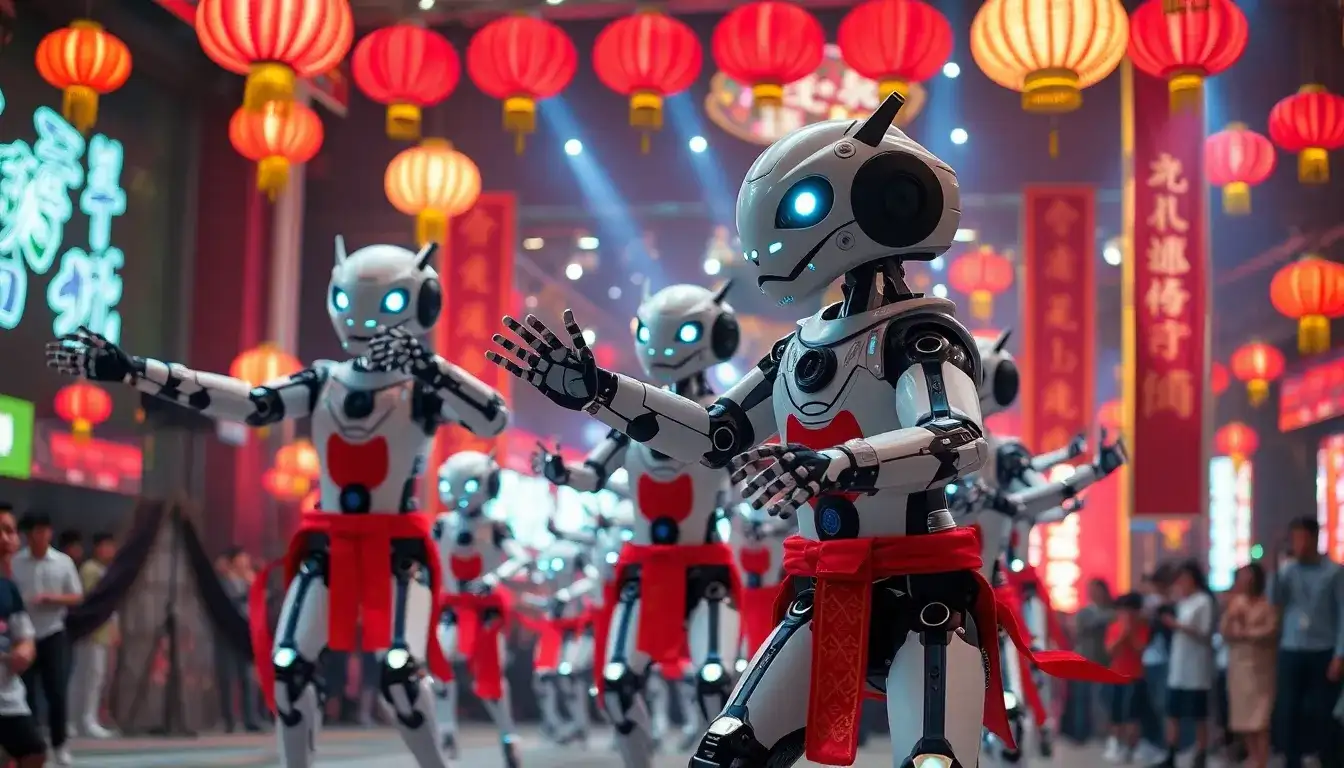
Humanoid robots made a notable appearance at the gala, marking one of the most anticipated highlights. Following the success of the “Yang BOT” performance at the 2025 gala, the “Wu BOT” martial arts display in 2026 captivated audiences, with Yushu Technology impressively returning to the stage for the second consecutive year.
2. Robot daily rental prices drop below 100 yuan, with dance-performing robots available for 6000 yuan per day, delivery within a week (source: NetEase Technology).
After Yushu Technology’s robots showcased their talents last year, four more robot companies appeared on CCTV’s stage this year, further igniting interest in humanoid robots. The continuous exposure on the Spring Festival Gala has fueled the burgeoning robot performance rental market. A rental industry insider noted that bookings for the Spring Festival period were filled a month in advance, with last-minute orders potentially seeing prices soar from several thousand yuan per day to 10,000 yuan per day. Data from JD.com corroborates this trend, revealing that in January 2026, their robot rental business saw over 100% month-over-month growth, with popular models currently on backorder through mid-March.
3. Investment Insight 2026: The technological driving force behind the commercialization breakthrough of the embodied intelligence unicorn, AI² Robotics, has launched the world’s first modular embodied intelligence service space, “Zhi Magic Cube,” in both Beijing and Shenzhen. This initiative aims to establish 1000 “Zhi Magic Cube” locations nationwide within three years, covering key commercial and cultural tourist areas, and is expected to accelerate the large-scale deployment of intelligent robots while becoming an essential part of urban infrastructure. Previously, their general-purpose intelligent robots have been effectively operating and evolving across various industries, including semiconductor manufacturing, automotive production, biotechnology, and public services.
4. Industrial robots evolving into “all-round players”: In Jingzhou, Hubei, Midea’s washing machine factory has welcomed humanoid robots that handle inspections, machine operations, and equipment repairs. At the Hannover Messe in Germany, Shanghai Jiekai’s intelligent collaborative robots showcased their ability to delicately handle potato chips, attracting numerous attendees for a hands-on experience. Beijing-based Geekplus has penetrated the supply chains of major global clients like Siemens with its intelligent warehousing systems. Today, Chinese industrial robots are deeply integrated across various sectors, continuously growing.
5. The Spring Festival Gala has created a ripple effect, accelerating the transition of robots from being “seen” to being “needed.” On February 16, four robot companies—Songyan Power, Yushu Technology, Magic Atom, and Galaxy General—collectively showcased their innovations in the Spring Festival Gala through skits, martial arts, song and dance, and micro-movies, offering a technological feast for viewers. Zhang Miao, CMO of Songyan Power, stated that the collective appearance of these companies at the gala comes at a critical point for commercialization in the industry.
6. 2025 Ranking of Development Potential for Chinese Industrial Robot Companies – The industrial robot sector benefits from accelerated domestic replacements and the emergence of humanoid and specialized operational scenarios, with a focus on core component localization, AI integration, and cost optimization. Strong policy support has driven a robust 67.4% year-on-year increase in exports in Q1 2025, although challenges such as reliance on high-end sensor imports and long-term R&D investments remain. Future innovations will concentrate on standardizing high-precision components, building a global service network, and fostering cross-industry technology integration.
7. Jia Yueting unveils humanoid robots: On February 5 at 7:30 AM Beijing time, FF held a product launch for its first embodied AI robots during the National Automobile Dealers Association event in Las Vegas. After nearly going bankrupt, Jia Yueting, who returned to FF as Co-CEO last April, is striving to revitalize the company.
8. Humans and robots dance together: AI celebrates! This year’s Spring Festival Gala and temple fairs have been taken over by robots. The year 2026 has been infused with an unprecedented vibrancy as technology harmonizes with traditional celebrations. From the first globally robot-led gala to the stunning human-robot dance performances at the Spring Festival Gala and the joy brought by AI at local temple fairs, a transformation is vividly redefining festive traditions. This is not just a showcase of technology but a profound dialogue about cultural heritage and future lifestyles. The Robot Wonderful Night featured over 200 robots supporting the entire performance, reaching a remarkable integration of culture and technology.
9. How will smart railways (like AI and blockchain) further enhance freight efficiency and services? Smart operations are shifting from passive repairs to proactive defenses. AI predictive maintenance leverages IoT sensors and machine learning algorithms to monitor key railway components in real time. For example, by analyzing vibration frequencies and temperature changes, AI can predict bearing failures up to 48 hours in advance, reducing unexpected downtimes. A vehicle fault image recognition system developed by Huawei and Jiaotong University boasts a 99.3% fault identification rate, with a 95% reduction in false positives and tenfold improvement in maintenance efficiency.
10. Behind the robot frenzy at the Spring Festival Gala: The gap between China and the U.S. lies not in algorithms but in supply chain trial-and-error costs. The humanoid robots at the gala, performing flips, drunken boxing, and high mobility coordination, sparked widespread online discussion and even drew remarks from Elon Musk about the rapid evolution of Chinese robotics. Industry insiders argue that the explosive growth of China’s humanoid robot sector is not merely due to policy directives or funding but is primarily attributed to a highly concentrated hardware supply chain infrastructure that enables rapid trial and error. Similar to the U.S. leveraging GPU power for large-scale AI experiments, Chinese teams rely on the hardware ecosystem in the Pearl River and Yangtze River Delta to iterate products in the physical world more quickly and cost-effectively. The core difference between China and the U.S. in the robotics arena lies in supply chain efficiency rather than talent reserves.
11. Bozhong Precision Engineering: Manufacturing robots for leading domestic companies – Current orders are quite full. The company recently reported that it is focusing on two main areas in intelligent robotics: first, robot manufacturing for top domestic companies, with a robust order book and successful delivery of last year’s contracts; second, they provide exclusive assembly equipment for international robot companies.
12. Domestic core component localization rate exceeds 70% – Why is China’s robot evolution rapid? During the 2026 Spring Festival holiday, humanoid robots became the stars of technology and traditional festivities, performing complex displays on major gala stages and widely utilized in offline settings like temple fairs, shopping malls, and restaurants. The rental market flourished, and social media buzzed with excitement. Global audiences are astonished by the rapid evolution of Chinese robots, which is no coincidence. Top-level design and policy support have firmly steered the direction of the robot industry. Recently, from the “14th Five-Year Plan for Robot Industry Development” to the “Guidelines for the Innovative Development of Humanoid Robots,” the national level has laid out plans and continuously increased support for the industry. Local governments are also making efforts, with many provinces and cities introducing special policies to promote the development of the robot sector.
Original article by NenPower, If reposted, please credit the source: https://nenpower.com/blog/highlights-from-the-2026-spring-festival-gala-robots-take-center-stage-in-a-tech-infused-celebration/

