

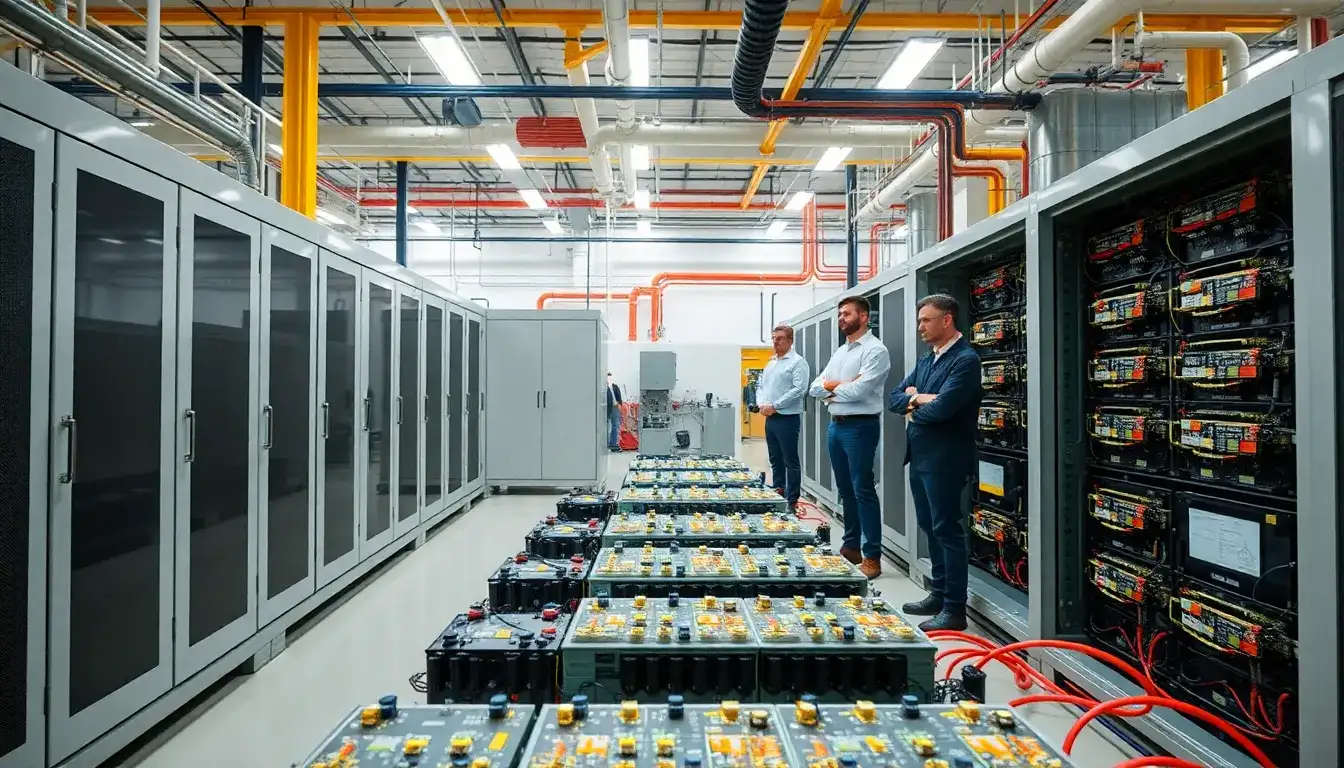
High-pressure cascade energy storage technology, often dubbed the future of large-scale energy storage, is attracting attention from various enterprises. This technology has emerged as a key solution to the challenges of traditional energy storage efficiency and cost, driven by the increasing integration of renewable energy sources and the growth of large-scale storage stations.
ZhiGuang is leading the way not only in high-pressure cascade technology but also in solid-state battery advancements. Recently, ZhiGuang won a bid for the Guangdong Huadian Shanwei storage project, which is notable for being the first independent energy storage station in the country to combine cascade high-pressure technology with semi-solid lithium iron phosphate battery systems. This project aims to enhance the safety of lithium batteries and improve the cycle efficiency of energy storage systems. The system architecture features fully liquid-cooled cascade storage units, achieving a highly integrated design.
According to ZhiGuang Electric’s announcement, the procurement contract for the high-pressure cascade semi-solid lithium iron phosphate energy storage system signed with China Energy Construction Guangdong Institute amounts to 164 million yuan. As a pioneer in the research and application of cascade high-pressure direct energy storage technology, ZhiGuang’s innovations for 2025 include not just the successful implementation of cascade high-pressure technology in conjunction with semi-solid battery technology.
In July of this year, ZhiGuang and Haichen Energy jointly launched the third-generation high-capacity storage system based on the ∞Cell 587Ah large-capacity battery. This groundbreaking achievement signifies the completion of the world’s first large-capacity energy storage battery from technical release to closed-loop application. ZhiGuang’s third-generation high-capacity storage system can reach a single-unit capacity of 100MW/200MWh, with a system conversion efficiency exceeding 92%, allowing for direct high-pressure access to 6~35KV power grids. This significantly reduces energy loss and construction costs.
The system’s design permits reliable grid connection and stable operation in complex grid environments, including isolated networks, microgrids, and weak grids (e.g., SCR < 2, R/X > 0.5). It features a one-button black start capability, providing millisecond-level support for hundreds of megawatts of power, which is crucial for building a robust intelligent grid and facilitating coordinated source-grid-load-storage operations. The introduction of this system will accelerate the advancement of high-pressure direct energy storage technology and promote the industrialization of cascade high-capacity energy storage systems.
By achieving continuous breakthroughs in 35kV cascade high-pressure direct energy storage technology, ZhiGuang has made a strong start in the 2025 energy storage market, frequently signing contracts for large energy storage projects across provinces such as Gansu, Guangdong, Inner Mongolia, Xinjiang, Hebei, Zhejiang, Qinghai, and Liaoning. As of September 2, ZhiGuang Electric’s installed capacity in the cascade high-pressure large-capacity storage sector has exceeded 9GWh, with single station project capacities surpassing 1GWh. The market share in this segment has crossed 70%, successfully delivering over 20 large-scale cascade high-pressure energy storage stations.
In user-side scenarios, this technology has been applied to the Inner Mongolia Chuangyuan Alloy project, which features a 91.5MW/366MWh energy storage system that addresses the high energy consumption and peak-shaving conflicts of aluminum smelting companies. In grid-side frequency modulation scenarios, the Qinghai Hainan Prefecture 150MW/600MWh energy storage station project utilizes this technology, marking it as the highest-altitude and largest cascade high-pressure energy storage station globally. It provides millisecond-level frequency modulation responses, improving system efficiency by 6% to 10%.
In renewable energy applications, the Gansu Guazhou Wind Farm project stands out as the world’s first primary power-type grid-connected energy storage demonstration project, achieving functions like smoothing wind power output and supporting 330kV system black start and island operation.
In May of this year, ZhiGuang launched the Qinghai Dachaidan project, which incorporates high-pressure cascade technology and various composite storage forms, propelling China’s grid-connected composite storage technology to a new phase of “multi-energy collaboration and full-area coverage.” ZhiGuang Electric’s investor relations report on September 8 indicated that its energy storage equipment sales generated revenues of 1.06 billion yuan in the first half of 2025, with a net profit exceeding 70 million yuan. The company currently holds more than 1.8 billion yuan in energy storage orders, with contracts pending signature continuing to increase.
As we enter the GWh era of energy storage stations, high-pressure cascade energy storage technology will accelerate its penetration. High-pressure cascade systems utilize a cascade topology that allows for direct high-voltage energy output without the need for transformers. This core advantage eliminates reliance on step-up transformers, enabling direct coupling between low-voltage batteries and high-voltage grids while significantly surpassing traditional low-voltage storage solutions in efficiency, response speed, and cost.
Testing data from Guodian Nari indicates that high-pressure cascade energy storage systems offer multiple benefits, including a conversion efficiency of over 98%, which is 3%-4% higher than traditional solutions. The lifecycle cost of energy drops by 0.03 yuan/kWh. The systems also boast rapid response times, achieving millisecond-level breakthroughs with control delays under 5ms, a 90% reduction compared to traditional solutions, effectively meeting the millisecond-level frequency and voltage modulation needs of the grid.
Moreover, the costs are competitive; by eliminating transformers and low-voltage cabinets, the system’s size and weight are reduced by 40%, significantly lowering land use and construction costs. Data shows that when the system scale exceeds 50MW, the cost advantage per kilowatt-hour exceeds 10%.
The adaptability of these systems is also notable, with single-unit capacities reaching the hundred-megawatt level and direct connections to 10kV-35kV grids, making them suitable for large renewable energy bases as well as urban grids and industrial emergency applications.
Currently, the scale of energy storage stations is rapidly transitioning from the hundred-megawatt to the GWh era. High-pressure cascade energy storage systems, due to their ability to connect directly to the grid without transformers, offer significant advantages in terms of high efficiency, reduced footprint, and high return on investment.
Furthermore, high-pressure cascade technology has advantages in grid formation, particularly in two key areas: firstly, a single system can significantly exceed the power of low-voltage storage solutions (often by more than ten times), reducing the number of parallel devices needed in large-scale deployments, simplifying coordination and control complexity. Secondly, high-pressure cascade output filtering uses reactance, which is easier to achieve than the LC or LCL filtering structures required by low-voltage storage, effectively avoiding resonance risks. Thirdly, high-pressure cascade outputs directly to the grid without requiring transformers, eliminating discrepancies between high-voltage and low-voltage grid formation performance.
This technology’s maturity has been validated through diverse engineering applications, demonstrating strong adaptability across various scenarios. In the field of large renewable energy bases, the 200MW/400MWh project by State Power Investment in Ningxia connects directly to a 35kV collector line, significantly enhancing the capacity for wind and solar energy absorption. The 35kV high-pressure direct-connected system at the State Grid’s energy storage station in Haixi Prefecture was selected as the first major technological equipment in the energy sector.
In the industrial sector, the cascade energy storage system developed for Baowu Steel can support black start for electric arc furnaces within 0.5 seconds, meeting the emergency power supply needs of high-energy-consuming enterprises. Regarding technology integration, in addition to ZhiGuang’s successful bid for the nation’s first independent energy storage station combining cascade high-pressure technology with semi-solid batteries, the Shandong Laicheng power plant has initiated the first “high-pressure cascade + centralized liquid cooling” project in the country, which integrates 100MW lithium batteries with 1MW vanadium-chromium flow batteries, achieving a conversion efficiency exceeding 90%, providing a new paradigm for large-scale long-duration energy storage.
In terms of standards and regulations, China has released the Technical Specifications for High-Pressure Direct-Connected Energy Storage Systems, promoting modular interface standardization and laying the groundwork for the large-scale application of this technology. As the voltage levels for renewable energy grid integration continue to rise, high-pressure cascade energy storage technology is poised to become mainstream in grid-side energy storage, with forecasts suggesting its global market share could exceed 35% by 2025.
Which companies are positioning themselves in this sector? Currently, the main challenge in promoting high-pressure cascade technology in the energy storage field lies in its high technical barriers, with fewer than ten companies in the industry genuinely offering products. Besides ZhiGuang, Xinfengguang is also a leading player in this field. Other enterprises such as Mingyang Ruiyuan, Jinpan Technology, and Sunshine Power are accelerating their layouts, with the 35kV high-pressure cascade solution emerging as the primary competitive focus.
Xinfengguang has been deeply engaged in the power electronics industry for over 30 years, boasting a portfolio of over 30,000 high-pressure cascade power electronic products. With over 50 years of brand and technological heritage, it stands as a frontrunner in high-power, high-capacity high-pressure cascade technology in the electrochemical energy storage industry. Xinfengguang has developed deliverable capabilities across 6kV, 10kV, and 35kV voltage series, with complete proprietary intellectual property rights and numerous successful application cases.
The 6kV series is primarily utilized in mining applications, the 10kV series in commercial and industrial sectors, and the 35kV series in renewable energy stations. In the 2x200MWh independent shared energy storage system integration project in Dongying, a 35kV high-pressure cascade solution was adopted, innovatively applying advanced technologies such as AI-based battery health monitoring, setting a technical benchmark for energy storage demonstration projects in Shandong Province.
Ruiyuan Electric, under the Mingyang Group, has developed a 25MW/100MWh high-pressure cascade energy storage system tailored for the “Three North Regions” and “Shagehuang” large base new application scenarios, which launched in January this year. This product features large single-unit capacity, high energy conversion efficiency, simple system coordination, high safety, low system cost, long battery life, and strong grid support capabilities. In July of this year, this system successfully achieved grid connection in one attempt.
Jinpan Technology, a leading dry transformer manufacturer, publicly launched its medium and high-voltage direct-connected (cascade) energy storage system in 2022, marking the entry of its cascade energy storage series into the commercialization phase. This system can connect directly to the grid at 6~35kV with a single-unit capacity of up to 25MW/50MWh, achieving a cycle efficiency of over 90%. Jinpan Technology has developed its high-pressure cascade energy storage system through collaboration with universities, possessing independent R&D capabilities across various segments such as battery packs, BMS, PCS, and EMS. The products have already secured orders and are being commercially applied across multiple regions in China.
Sunshine Power has established a broad layout in the energy storage sector. Its industrial and commercial energy storage product, PowerStack 835CS, utilizes a 10/20kV high-pressure direct connection with black start support, validated in the user-side project for Kunshan Longteng Special Steel. Its integrated solar-storage technology eliminates traditional DC combiner boxes in solar-storage systems, using a high-pressure cascade energy storage framework that directly matches the voltage on the DC side with the storage system, reducing the conversion steps. Testing indicates that this design improves system efficiency from the traditional 85% to 91.5%, resulting in an annual electricity generation increase of 1.2 million kWh for projects of 100MWh.
Nari Technology is one of the pioneers in high-pressure direct-connected energy storage technology. Its high-pressure cascade energy storage simplifies the topology of energy storage stations, eliminating step-up transformers in traditional low-voltage parallel energy storage systems, bringing the storage system closer to the main grid, enhancing control response speed, and offering better grid support with an efficiency exceeding 91%. In June 2022, Nari successfully connected the world’s first 35kV high-pressure direct-connected energy storage system at the 35kV Hongxu Energy Storage Station in Shaoxing City, Shangyu District.
Additionally, to address electricity issues in the northwest region, Nari has undertaken several high-pressure direct-connected energy storage projects in Qinghai Province. By July 2024, the 224.5MW/889MWh Baoku Energy Storage Station project in Hainan Prefecture, Qinghai, successfully connected to the grid. This energy storage station is currently the world’s largest conventional + grid-connected joint operation storage project and also the largest high-pressure direct-connected energy storage project by capacity.
Nari provided a complete 104.8MW/430.4MWh grid-connected high-pressure direct-connected energy storage system for this project. In March 2025, Nari’s 100MWh grid-connected high-pressure direct-connected energy storage system successfully completed full-capacity charging and discharging tests at the Wenshan Baochi Energy Storage Station in Yunnan. This project is one of the 56 new energy storage pilot demonstration projects designated by the National Energy Administration, overcoming critical technologies such as hundred-level modules and balancing the SOC of hundreds of thousands of battery cells, setting a new upper limit for single-unit capacity in high-pressure direct-connected energy storage.
XuJi Electric, a subsidiary of China Electrical Equipment, has developed and released autonomous medium and high-voltage cascade energy storage inverters and systems based on years of integrated R&D and intelligent manufacturing capabilities in power electronics. Their products utilize an H-bridge cascade multilevel topology, incorporating safety disconnection technology for the DC side, redundancy in power modules, adaptive SOC balancing technology, and integrated design of power modules and high-voltage boxes, reducing footprint while offering high safety, reliability, and cost-effectiveness, suitable for applications in generation side, grid side, and industrial commercial storage.
Shandong Electric Era, also part of China Electrical Equipment, collaborated with ZhiGuang to establish the country’s first 100MW high-pressure cascade energy storage station in Jinan, Shandong. It is the first company in China to master high-pressure liquid cooling, high-pressure cascade, and string technology solutions, with a complete track record of engineering applications.
Xidian Power Electronics proposed a new grid-connected high-pressure cascade power electronic equipment based on domestically produced IGCT-Plus devices. This equipment maintains voltage support and active inertia support characteristics through power electronics cascading, contributing to the stability of the power system. Currently, Xidian Power Electronics has capabilities to deliver high-pressure cascade energy storage inverters across 6kV, 10kV, and 35kV voltage levels. By the end of 2024, the company had already supplied 225MW of cascade energy storage inverters, with the 10kV/50MW cascade energy storage inverter approved as the first set by the Energy Bureau.
Lastly, SiFang Co. has developed high-pressure cascade energy storage inverter equipment based on advanced power electronics technology, innovatively integrating intelligent control, liquid cooling, and safety protection design. This allows it to maintain efficient and stable operation in extreme working conditions, with fast response times, high adjustment precision, and strong system stability, applicable on the power side, grid side, and load side. In February 2023, SiFang and the Southern Power Grid jointly developed and delivered China’s first mobile large-capacity all-scenario battery storage station. This station uniquely combines large-capacity high-pressure cascade technology with a mobile design. In December 2024, the electrochemical energy storage auxiliary coal machine frequency modulation project at the Ninghai Power Plant in Zhejiang was successfully launched, with SiFang supplying core equipment such as high-pressure cascade energy storage inverters and energy storage coordination controllers.
All of these companies have engaged in technological R&D and project practice in the high-pressure cascade energy storage sector, advancing the application of this technology in large-scale energy storage projects. As the demand for energy storage continues to grow, the pioneers in this field are expected to expand their market share further.
Original article by NenPower, If reposted, please credit the source: https://nenpower.com/blog/high-voltage-cascade-energy-storage-technology-key-players-and-developments-in-the-industry/

