

Recently, dust storms swept across much of China, triggering severe pollution warnings in several areas and causing significant disruptions to daily life. China is one of the countries most affected by land desertification, particularly in its northwestern region, which is home to vast deserts. The pressing issue of desertification has made sand prevention and control a top priority in ecological environmental governance and protection.
As an innovative approach to ecological restoration, photovoltaic (PV) sand control combines solar power generation with desert management. Constructing solar power stations in desert areas not only converts sunlight into green energy but also plays a crucial role in wind and sand prevention. PV modules act as barriers against wind and sand, reducing moisture evaporation and creating favorable conditions for vegetation growth, thereby gradually improving the fragile ecological environment.
In northwestern China, DAON modules partnered with flexible supports have become the innovative solution for transforming desert oases. Facing the harsh conditions of the Taklamakan Desert, renowned as the “Sea of Death,” DAON modules are proving their resilience. The desert, characterized by its vast and majestic landscape, shines with golden hues under the sun. In collaboration with Huadian Group, Yidao New Energy has developed a low-carbon transformation project in Aksu, Xinjiang, featuring a 400,000 kW PV installation utilizing DAON modules. Once operational, this project is set to significantly enhance the clean energy supply in the region, effectively reducing the reliance on fossil fuels and lowering greenhouse gas emissions, thus energizing the transition towards a greener energy structure in Xinjiang.
The Taklamakan Desert enjoys over 3,000 hours of sunshine annually, providing an exceptional natural foundation for efficient PV power generation. Compared to other regions, DAON modules can harness more solar radiation in desert conditions, converting it into a higher output of electricity, thereby greatly increasing the efficiency and generation capacity of PV systems. With excellent low-light performance, DAON modules can effectively operate during early morning and late evening, further enhancing energy utilization. They also exhibit outstanding durability, adapting to extreme desert environments characterized by high temperatures, sand, and significant temperature fluctuations, ensuring stable long-term performance and extended lifespan.
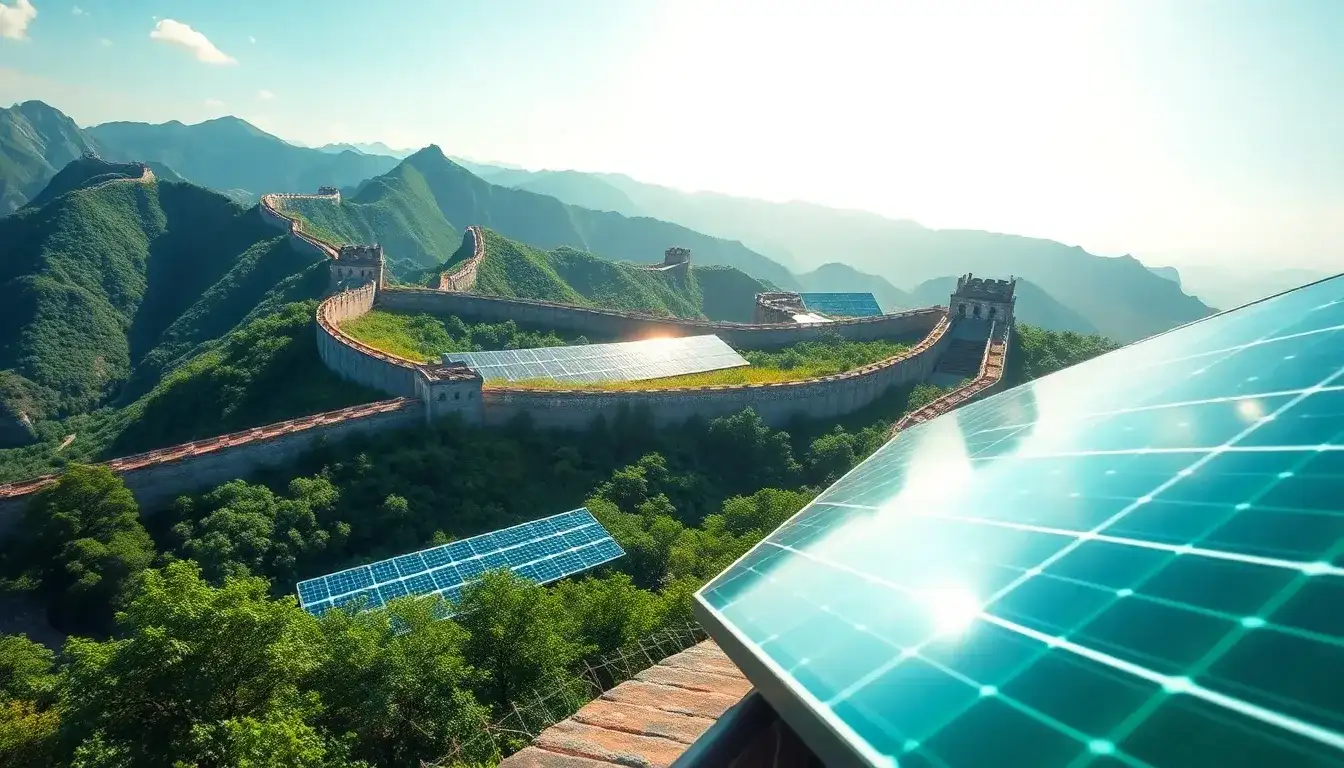
Kubuqi Desert, the seventh-largest desert in China, stretches across the northern part of the Ordos Plateau. Once dominated by sand and sparse vegetation, recent efforts to combat wind and sand have led to the establishment of a “Green Great Wall.” Yidao New Energy supplied components for the 2 million kW PV sand control project at the Mongolian West base in Kubuqi. This project is expected to generate approximately 4.1 billion kWh of electricity annually, equivalent to saving around 1.23 million tons of standard coal, reducing CO2 emissions by 3.38 million tons, and restoring 80,000 acres of desert land, injecting green energy into the ecological development of both the desert and the Yellow River basin.
As one of the first large-scale wind and PV base projects initiated during the 14th Five-Year Plan, the Kubuqi PV sand control project exemplifies the innovative practice of ecological green agriculture, maximizing the potential of three-dimensional space for resource-efficient and harmonious ecological development. Beneath the PV modules, the available space is ingeniously utilized for planting shade-loving high-quality forage and precious medicinal herbs, while also creating a suitable habitat for animals such as chickens and sheep. These plants and animals thrive under the favorable temperature and unique light conditions provided by the PV modules, spreading green hope across the desert and vigorously promoting a transformative process that balances ecological, economic, and social benefits.
The DAON modules with flexible supports represent a low-cost, high-yield choice for sand control. The Mengjiawan project in Yulin, Shaanxi, features a dramatic landscape of sand dunes and a hidden oasis. Partnering with Huaneng Group, this project has a direct current capacity of 182 MW. Upon connecting to the grid, it is projected to generate an average of approximately 29.887 million kWh annually over a 25-year operational period, reducing CO2 emissions by about 278,000 tons and saving around 94,100 tons of standard coal, significantly contributing to local ecological restoration, energy structure transformation, and sustainable economic development.
The Mengjiawan project also innovatively employs the industry’s first 2000V PV modules, which enhance the assembly capacity of individual modules by over 30%, significantly reducing the use of direct current cables, combiner boxes, and other equipment. This not only lowers the balance of system (BOS) costs but also improves the levelized cost of energy (LCOE) and overall system yield. The project utilizes Yidao New Energy’s flexible support system, designed for stability and wind resistance, ensuring high performance even in extreme weather conditions.
Once a bustling hub of the Silk Road, Wuwei Liangzhou in Gansu has witnessed countless trade caravans and their camel bells echoing through time. This ancient yet vibrant city showcases nature’s wonders and the beautiful rebirth of desert oases. As part of Gansu’s first batch of wind and PV projects during the 14th Five-Year Plan, the Wuwei Liangzhou PV project, supplied by Yidao New Energy, has a direct current capacity of 240 MW, producing approximately 382 million kWh of green electricity annually, thus contributing to Gansu’s energy transition and green development.
The presence of PV modules arranged neatly across the desert acts like protective umbrellas for the vegetation below, shielding them from direct sunlight. In desert areas, significant sunlight and high evaporation rates hinder vegetation growth, but the modules can effectively reduce evaporation by 20-30%. They also possess the unique ability to lower desert wind speeds, significantly weakening the force of wind and sand that can erode plants, allowing vegetation to take root more steadily and gradually transform the landscape into a vibrant green.
From a once dry “sea of sand” to today’s flourishing “green sea” with abundant vegetation, PV sand control illustrates the remarkable practice of harmonious coexistence between humanity and nature. This innovative model not only addresses the dual challenges of energy and ecology but also brings tangible benefits to local communities. Looking ahead, Yidao New Energy will continue to expand the boundaries of PV sand control, unlocking ecological dividends, and fostering a harvest of joy in the desert, contributing positively to the construction of a sustainable future for humanity.
Original article by NenPower, If reposted, please credit the source: https://nenpower.com/blog/harnessing-solar-power-to-build-a-green-great-wall-in-northern-china/

