

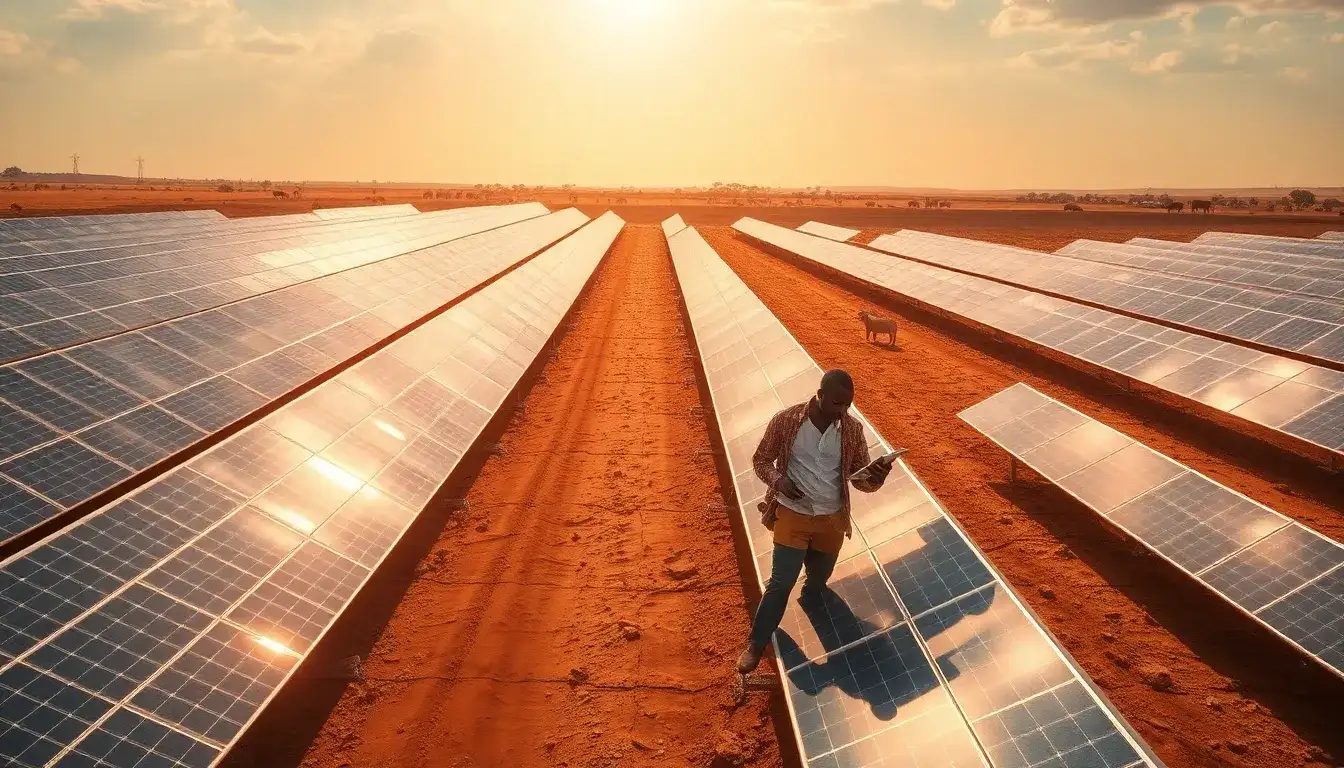
Africa is tapping into its solar energy potential like never before. In 2024, the continent added 2.5 GW of new solar capacity, with utility-scale projects accounting for 72% of this growth. To bolster this expansion, innovative computational software has emerged in the solar energy market, poised to significantly accelerate the development of utility-scale solar projects across the continent.
One of the primary challenges in establishing large-scale solar farms has been the lengthy and complex design process. AUTOPV, developed by 7SecondSolar, addresses this issue by enabling energy engineers to complete tasks in days that previously took months. The software is specifically designed to optimize and expedite solar farm development through design automation.
According to Paul Nel, CEO of 7SecondSolar, “Our software automates engineering-quality design outputs, generating precise bills of quantity, detailed engineering reports, AutoCAD drawings, and multiple design variations for the same site.” This allows energy engineers and developers to easily compare cost and energy yield scenarios.
Designing a utility-scale solar farm resembles solving a complex puzzle, where even minor adjustments can lead to significant cost savings and efficiency improvements. This was clearly demonstrated in a recent 214 MW solar project where AUTOPV facilitated the creation of eight different design variations in just one morning. “By making small tweaks, such as adjusting the width of corridors or repositioning string inverters, we identified two highly feasible designs. One could reduce cable costs by USD 1 million, while another could enhance energy efficiency enough to generate an additional USD 50,000 in annual revenue,” Nel explained. “Such opportunities could have been overlooked with traditional design methods, which would have required weeks or even months to produce comparable iterations. With AUTOPV, we achieved this in hours, complete with fully detailed, build-ready drawings showing exact cable routes and inverter placements.”
In Malawi, solar energy is becoming a crucial driver for economic and social transformation. The Golomoti Solar Project, featuring a 28.5 MWp solar PV and battery storage installation, showcases how advanced engineering technology can address complex site challenges. Engineers utilized AUTOPV to navigate the intricate design requirements, including working around protected Baobab trees located at the center of the site. By generating multiple layout configurations and equipment selections, the engineering team was able to identify several viable design iterations in just a few hours. This level of precision provides developers and investors with greater control over project costs and efficiency right from the start.
Africa’s commitment to incorporating renewable energy is growing stronger, and the demand for solutions that enable faster, smarter, and more cost-effective utility-scale solar PV development has never been greater. “To date, our software has been used in delivering 669 MW of design-stage projects, saving a total of more than 15,000 traditional engineering hours. Furthermore, we have facilitated the early-stage development of 1.2 GW of projects, saving over 4,000 engineering hours. This has allowed engineering teams to concentrate on refining and optimizing solar PV designs,” Nel added.
Experience AUTOPV at the Africa Energy Indaba taking place from March 4-6, 2025. 7SecondSolar invites energy engineers, developers, and media representatives to demo AUTOPV during the event. For more information about 7SecondSolar and AUTOPV, please visit: 7secondsolar.com.
Original article by NenPower, If reposted, please credit the source: https://nenpower.com/blog/harnessing-design-automation-to-boost-utility-scale-solar-development-in-africa/

