

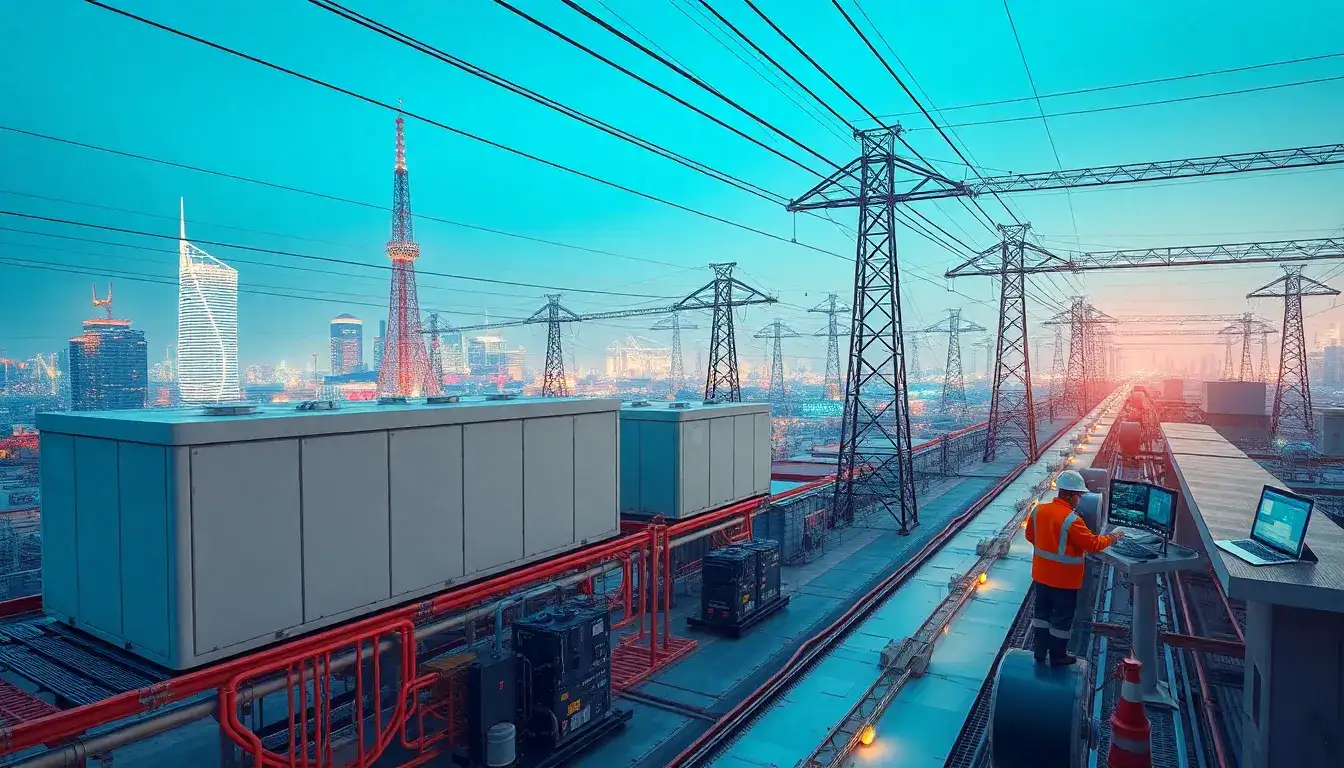
When the Power Grid Learns to Think: Can AI Scheduling and Energy Storage Boost Investment Efficiency by 30%?
The core objective of the State Grid’s 4 trillion yuan investment plan during the 14th Five-Year Plan period is to systematically address the challenges of integrating renewable energy and balancing electricity supply and demand through the deep integration of AI intelligent scheduling and energy storage technologies. Achieving a 30% efficiency improvement will require breakthroughs in three areas: upgrading the intelligence of the power grid, large-scale application of energy storage, and optimizing system collaboration.
1. AI Scheduling: The “Decision-Making Brain” of the Power Grid
Real-time Optimization and Complexity Management
The AI scheduling system utilizes millisecond-level data monitoring and algorithm optimization to dynamically balance the intermittent nature of wind and solar power generation with load fluctuations. The fault prediction accuracy of the State Grid Nanrui AI platform reaches 99%. In the microgrid cluster project in Suzhou Industrial Park, the regional green electricity consumption rate exceeded 90%, demonstrating a significant efficiency improvement in localized scenarios.
Global Resource Coordination Capability
Under the “integrated source-network-load-storage” model, AI must coordinate ultra-high voltage cross-regional transmission, distribution network terminal responses, and distributed resources. The State Grid aims to enhance inter-provincial transmission capacity by 30%. However, achieving full network collaboration requires overcoming three major bottlenecks: improving weather prediction accuracy (reducing wind and solar output errors to within 15%), enhancing load response speed (with virtual power plants experiencing delays of less than 5ms), and providing computational support for multi-objective optimization algorithms.
2. Energy Storage Buffer: From “Backup Power” to “System Stabilizer”
Scaling Applications to Redefine Power Distribution
For short-term frequency modulation, electrochemical energy storage can respond in milliseconds and smooth out 70% of instantaneous power fluctuations (for instance, using Sunshine Power’s liquid-cooled inverters). For long-term regulation, pumped hydro storage (with a market share of 44% held by Dongfang Electric) and vanadium flow batteries (with Hebei Steel supplying 80% of electrolyte for hundred-megawatt projects) support daily and weekly balancing. However, the current four-hour energy storage configuration can only accommodate 20% of renewable energy capacity, indicating a gap to reach the 30% target.
Economic Constraints and Technological Iteration
Energy storage costs need to drop below 0.5 yuan/Wh for widespread adoption (current lithium battery costs are about 0.8 yuan/Wh). Innovations in sodium batteries (from CATL) and lithium-sodium hybrid architectures (from Hichain Energy) are expected to reduce backup power costs by 20% by 2028.
3. Feasibility of the 30% Efficiency Target: Verification and Challenges
Local Success Stories and Systemic Barriers
Successful cases include Haier’s AI energy robot, which reduced overall energy consumption by 20% at the Shougang project, and the Shuangliang Zero Carbon Park, which enhanced green power utilization.
System Bottlenecks
Once the penetration rate of wind and solar installations exceeds 30%, the inertia of the power grid declines, necessitating network-structured technologies (such as State Grid Nanrui’s flexible direct current systems). For every 1GW of AI computing power, 16-18GWh of energy storage is required, but currently, 60% of investments focus on distribution network upgrades, with new ultra-high voltage projects accounting for only 6%.
| Three Levers for Investment Efficiency Improvement | Current Level | 30% Target Supporting Technology |
|---|---|---|
| Transmission Loss Rate | 5.2% (2025) | Ultra-high voltage direct current (losses 3%) |
| Renewable Energy Consumption Rate | 85% (2025) | AI forecasting + energy storage interaction |
| Distribution Reliability | 99.8% (urban) | Self-healing distribution network (fault isolation 0.1 seconds) |
4. Risk Warnings: Technological Coordination and Mechanism Gaps
Technology Discrepancy Risks: The gap in chip energy efficiency leads to higher power consumption per unit of computing power in China, exceeding international levels by 30%, which may offset the benefits of optimizing the power system.
Mechanism Design Gaps: The nationwide promotion of electricity spot markets is lagging (currently only piloted in Guangdong), limiting the economic viability of virtual power plants in peak shaving.
Conclusion: AI scheduling and energy storage can achieve approximately 20% local efficiency improvements in specific scenarios. However, reaching the 30% target across the entire network will depend on technological breakthroughs (such as sodium battery costs and network-structured inverters), improved mechanisms (such as spot markets and green certificate trading), and optimized investment structures (with ultra-high voltage/intelligent distribution networks accounting for over 70%). Before 2028, targets may be reached in demonstration projects like “East Data West Computing” hubs and zero-carbon parks.
Original article by NenPower, If reposted, please credit the source: https://nenpower.com/blog/harnessing-ai-and-energy-storage-can-4-trillion-yuan-investment-boost-efficiency-by-30-in-chinas-power-grid/

