

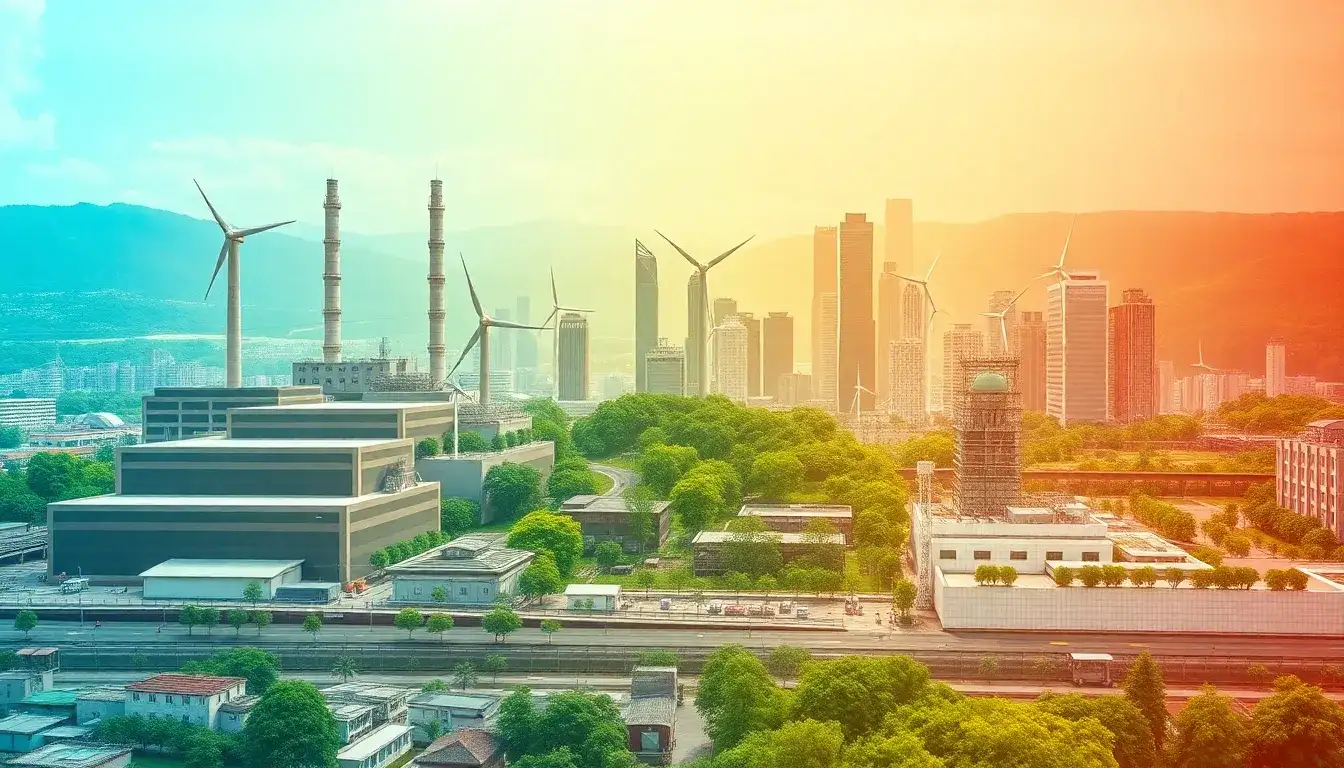
Green mountains and clear waters are invaluable assets. Under the “Two Mountains” concept and the vision for “dual carbon” goals, the period of the 14th Five-Year Plan has seen green development become a prominent aspect of China’s high-quality growth. As one of the five key focuses of financial work, green finance has emerged as a significant support for the real economy. Over these five years, China has transitioned from a focus on combating pollution to a comprehensive advancement of building a beautiful China. With green mountains and clear waters across the nation, industries and finance are moving towards a greener future, painting a new picture of harmonious coexistence between humanity and nature.
Vibrant greenery, impressive achievements Driving from Fuzhou Airport to Ningde, one is greeted by lush green mountains and vast blue seas. Here, the natural ecological beauty, abundant clean energy, and fertile innovative soil converge, giving rise to the world’s leading sales in both power and energy storage batteries with CATL. Across the country, numerous green enterprises, shining like CATL, have emerged. During the 14th Five-Year Plan period, China’s green industries have made significant leaps, leading the globe in several sub-sectors: by 2024, China has built the world’s largest and most complete new energy industry chain, supplying 80% of global photovoltaic components, 70% of wind power equipment, and 60% of power batteries.
As of the end of the first quarter this year, China’s newly installed capacity for wind and solar power reached 74.33 million kilowatts, bringing the total installed capacity to 1.482 billion kilowatts, surpassing thermal power for the first time in history. With the continued rapid growth of wind and solar power, it is expected that their installed capacity will routinely exceed that of thermal power in the future.
In 2024, the production and sales of new energy vehicles in China reached 12.888 million and 12.866 million units, respectively, maintaining a global lead for ten consecutive years, with the green low-carbon industry becoming a new economic growth point. The economic and ecological changes from the transformation of the energy structure are evident. Environmental quality has consistently improved, with the proportion of days with good air quality in cities at or above the prefecture level remaining stable at around 87%. By 2024, forest coverage exceeded 25%, an increase of about two percentage points from 2020, contributing approximately one-fourth of the world’s new greening area and establishing China as the fastest-growing country in terms of greening.
In 2024, the energy consumption per unit of GDP decreased by 11.6% compared to the end of the 13th Five-Year Plan, making China one of the fastest countries to reduce energy intensity globally. During the same period, the output rate of major resources increased by 12%, stabilizing the core of green development amidst a backdrop of reduction and increase.
Behind these data points is a multi-layered, broadly-covered green financial system that provides ample “financial blood” for the development of green industries. At a recent press conference held by the State Council Information Office, Huang Runqiu, Minister of Ecology and Environment, reported that since the beginning of the 14th Five-Year Plan, over 100 projects have received financial support, with a total credit amount of 216.4 billion yuan and loans amounting to 76.4 billion yuan. Driven by the dual carbon goals, the market demand for various green financial instruments has surged, with China ranking among the top globally in green loans and green bond market size.
As of the end of the second quarter of 2025, the balance of green loans in China was approximately 42.4 trillion yuan, and the balance of green bonds exceeded 2.2 trillion yuan. In July 2021, China officially launched its national carbon emissions trading market, marking a significant step in the carbon finance sector. According to the “National Carbon Market Development Report (2025)” released by the Ministry of Ecology and Environment, by the end of August 2025, the cumulative transaction volume of carbon emission allowances reached 696 million tons, with a total transaction amount of 47.826 billion yuan. In 2024, the annual transaction value of carbon emission allowances reached 18.114 billion yuan, setting a new record.
Today, China has preliminarily formed a green financial system centered around green loans and green bonds, with coordinated development of green equity, green insurance, and green leasing, continuously providing diversified financial support for the development of green industries,” said Wang Yifeng, Deputy Director of the Research Institute of Everbright Securities.
Developing the blueprint, turning green into gold The renowned work “Dwelling in the Fuchun Mountains” by Yuan Dynasty painter Huang Gongwang made the beautiful landscapes along the Fuchun River famous worldwide. Today, on the banks of the Fuchun River in Jian’de, Zhejiang, the largest pumped storage power station in East China is under rapid construction. Once completed, it will act as a powerful “battery” during peak loads in the East China power grid, serving as a solid support for absorbing intermittent renewable energy such as wind and solar power in the Yangtze River Delta region, expected to save 480,000 tons of standard coal annually and reduce carbon dioxide emissions by 960,000 tons. The project developer, GCL Group, expressed optimism about the economic benefits of the pumped storage power station due to the strong certainty of market development in China’s energy storage sector, despite a planned total investment of 12.525 billion yuan.
The launch of numerous green mega-projects is backed by a series of forward-thinking plans. During the 14th Five-Year Plan, China has committed to advancing the dual carbon goals through top-level design. Policies such as the “Opinions of the Central Committee of the Communist Party of China and the State Council on Accelerating the Comprehensive Green Transformation of Economic and Social Development” have been introduced to guide the development of green industries.
To encourage financial “active water” to precisely support green industries, in April 2024, the People’s Bank of China, in conjunction with seven other departments including the National Development and Reform Commission and the Ministry of Industry and Information Technology, issued “Guiding Opinions on Further Strengthening Financial Support for Green and Low-Carbon Development.” In January 2025, the General Office of the National Financial Regulatory Administration and the General Office of the People’s Bank of China released the “Implementation Plan for High-Quality Development of Green Finance in the Banking and Insurance Industries,” continually pushing towards a closed-loop value practice from “green mountains and clear waters” to “golden mountains and silver mountains.”
“During the 14th Five-Year Plan, green finance has transitioned from concept to practice, becoming an integral part of the mainstream financial system, providing financial support for China’s green and low-carbon transformation, and contributing the Chinese solution to global sustainable development,” said Dong Ximiao, Chief Researcher at Zhaolian and Deputy Director of the Shanghai Financial and Development Laboratory, in an interview. He noted that relevant departments have introduced a series of policy measures focusing on green standards, incentive mechanisms, product innovation, and risk prevention, which have directly lowered financing costs for green projects through subsidies and low-cost funds while encouraging financial institutions and enterprises to actively participate in green finance activities.
On the financing side, new financial service models are emerging. The innovative financing model of linking loan interest rates with greenhouse gas emission reductions and other ESG performances, such as the recent ESG-linked loan agreement between Trina Solar and Industrial Bank, has garnered exciting responses. The representative from Trina Solar explained that this loan uses a dynamic interest rate mechanism linked to the company’s greenhouse gas emission intensity, transforming ESG investments from a potential “cost” into a strategic investment that generates real returns.
In Lishui, Zhejiang, Hangzhou Bank is actively creating zero-carbon bank branches, supporting various climate investment and financing projects, including multiple rooftop photovoltaic projects and charging station initiatives, to assist in the construction of Lishui’s national pilot for climate investment and financing. On the consumer side, initiatives like “carbon accounts,” “carbon points,” and “Ant Forest” are turning individual users’ low-carbon behaviors into reward points, becoming a significant reflection of the mutual engagement between green industries and green finance. Through an innovative green low-carbon points system, China UnionPay has collaborated with 39 commercial banks to issue nearly 8 million green low-carbon cards, establishing carbon reduction models for public transport and subway systems in partnership with the Shanghai Environment and Energy Exchange, encouraging cardholders to accumulate low-carbon points through green consumption to redeem various benefits while promoting low-carbon concepts.
A series of innovative models have made green finance a vivid representation of China’s financial development path, continuously safeguarding the extension of green mountains and clear waters across the nation.
Innovative integration, a green revival On October 17, Daosheng Tianhe, a new materials company founded just ten years ago, was listed on the Shanghai Stock Exchange. This young Shanghai enterprise has ranked first in global sales of epoxy resin series used in wind turbine blades for three consecutive years. Its entry into the capital market is set to accelerate its development. Ji Gang, Chairman of Daosheng Tianhe, shared with the Shanghai Securities Journal that the company’s IPO funding project mainly focuses on expanding production for its new energy vehicle adhesives, an important product recognized by leading automotive and battery manufacturers both domestically and internationally. Following its listing, the capital market will provide the company with diversified tools for industrial expansion, shortening the cycle for entering new industries and accelerating its development into a “platform-type materials enterprise.”
Financial “active water” is permeating sectors such as new energy, low carbon, and green transportation, aiding the rapid rise of the “three new” industries and fueling the development of new productivity. During the 14th Five-Year Plan, financial institutions have shifted their services to the real industry towards “green” and “new,” with technological innovation accelerating. A significant number of green technologies, new energy, and environmental protection enterprises have gone public on the STAR Market, Growth Enterprise Market, and main boards.
“Under the strategic goal of building a strong financial nation, green finance cannot advance alone; it must harmonize with the other four key focuses,” stated Yang Tao, Deputy Director of the National Financial and Development Laboratory, in an interview. He suggested that the integration of green finance and technology finance should cover multiple levels, including supporting green and low-carbon technology enterprises and innovation, providing diversified financial products and services, and guiding technology companies to further ensure green and sustainable principles in their innovative activities.
As long as we cherish the green mountains, they will not betray us. Looking ahead to the 15th Five-Year Plan, industries and finance will continue to join hands, wielding the pen of “innovation” with “green” ink, together painting a new picture of “Beautiful China.”
Original article by NenPower, If reposted, please credit the source: https://nenpower.com/blog/harmonizing-industry-and-finance-a-new-era-of-green-development-in-china/

