

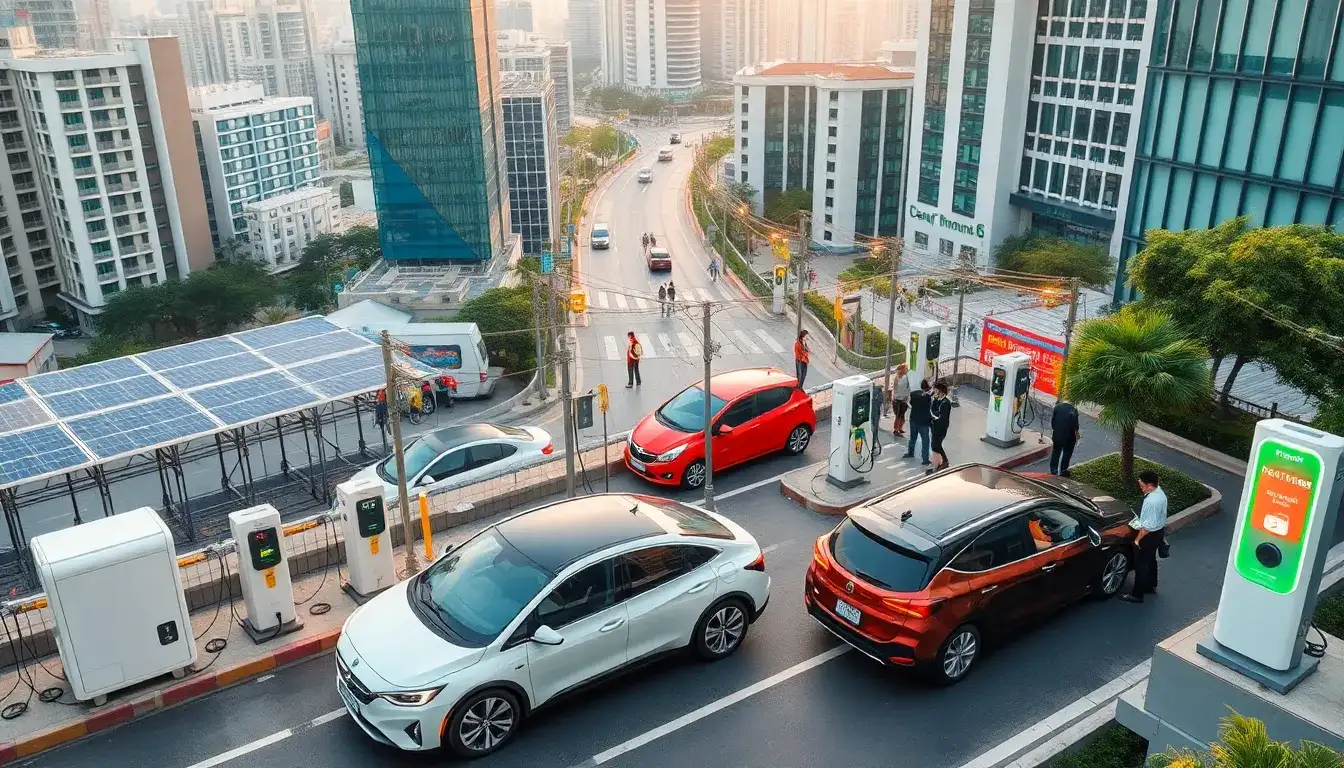
From overcoming charging anxiety to earning money through discharging, GAC has established the largest V2G microgrid in the country.
As the 2025 electric vehicle market undergoes a fascinating transformation, discussions that once focused on reducing charging times have given way to a new identity for electric cars: mobile batteries for the power grid. On September 26, 2025, GAC Group launched the nation’s largest V2G (Vehicle to Grid) microgrid at the Aion Park, simultaneously announcing the completion of its 20,000th charging station. Behind this seemingly ordinary infrastructure milestone lies a key to redefining the value of the new energy vehicle industry.
While Tesla competes on supercharging station coverage and NIO continues to invest in battery swapping, GAC has chosen a more imaginative path. Its V2G technology allows electric vehicles to transform from energy consumers into energy suppliers during the 16 hours they are parked. This shift in functionality could redefine the value of electric vehicles, similar to how smartphones replaced feature phones by creating a mobile internet ecosystem.
GAC’s unique approach to infrastructure development is reflected in some intriguing data shared by GAC Group Chairman Feng Xingya during the launch: they have surpassed 20,000 self-operated charging stations, covering 204 cities and leading the industry with the highest number of 1000V fast charging stations. While these numbers might have sparked celebrations three years ago, in 2025, with over 8 million charging stations nationwide, simple quantity is no longer a core competitive advantage.
In fact, GAC’s differentiation lies in the details: they have strategically invested in lithium mines in Qinghai to alleviate upstream material supply issues, developed self-built battery modules with a million-kilometer zero-self-ignition lifespan, and introduced supercharging technology that enables a 200 km range after just 5 minutes of charging. This vertical integration, from mining to charging stations, positions GAC’s 20,000 stations as intelligent nodes within the energy network. Particularly within the V2G microgrid, each charging station acts as a bidirectional energy router, transforming electric vehicle batteries into distributed energy storage units.
Let’s consider a hypothetical scenario: if Guangzhou has 100,000 electric vehicles equipped with V2G capabilities, each with a battery capacity of 60 kWh, they could theoretically provide 600 million kWh of adjustment capability to the grid, equivalent to half of the Guangzhou Tower’s summer peak load.
Regarding consumer earnings, the average user is likely more interested in the financial benefits of this technology. GAC suggests that as the industry scales, electric vehicles with V2G capabilities could earn owners significant profits through participation in grid discharging and charging, potentially amounting to tens of thousands of yuan. This economic model is shifting user perceptions. Importantly, the entire discharging process is managed through intelligent cloud scheduling, ensuring it does not affect the vehicle’s use the next day. However, for this business model to mature, three key challenges need addressing: the need for a transparent battery health assessment system to alleviate battery degradation concerns, a more flexible time-based pricing mechanism for electricity, and unified technical standards for grid access.
GAC plans to implement a comprehensive lifecycle management system, creating digital twin models from the moment the battery is manufactured and offering lifetime warranties on its battery technology to assuage user fears.
Experts at the Guangzhou Power Design Institute emphasize that the greatest value of the V2G microgrid lies in its ability to reshape the power supply-demand relationship. Traditional power grids must maintain a significant amount of redundant generation capacity to handle peak loads, and the construction and maintenance costs of these peaking plants ultimately fall on consumers’ electricity bills. In contrast, the distributed electric vehicles in the city effectively serve as ready-made distributed energy storage systems. The 10kV medium-voltage grid connection project launched by GAC acts as an intelligent buffer for the urban power grid. When electricity demand surges, the more than 200 electric vehicles in the park can instantly form a virtual power plant, supplying electricity back to the grid. This near-instantaneous response capability is nearly 10,000 times faster than starting up backup coal-fired plants.
Furthermore, this innovation profoundly impacts renewable energy utilization. The intermittent nature of wind and solar power has long been a challenge for the industry, but now electric vehicle batteries serve as natural “energy sponges,” capable of charging when wind and solar resources are abundant and discharging when these resources are scarce.
Looking back at the milestone of 20,000 charging stations, GAC’s V2G microgrid energy strategy aligns with a historical pattern: just as the Ford Model T transformed automobiles from luxury items to mass-market products, V2G technology is elevating energy consumers to producers. This shift involves not only technological breakthroughs but also the potential for energy democratization. While this quiet energy revolution may not boast the flashy visuals of autonomous driving, it is fundamentally reshaping the relationship between people, vehicles, and the power grid.
Original article by NenPower, If reposted, please credit the source: https://nenpower.com/blog/guangzhou-automobile-group-launches-largest-v2g-microgrid-in-china-transforming-evs-into-energy-suppliers/

