

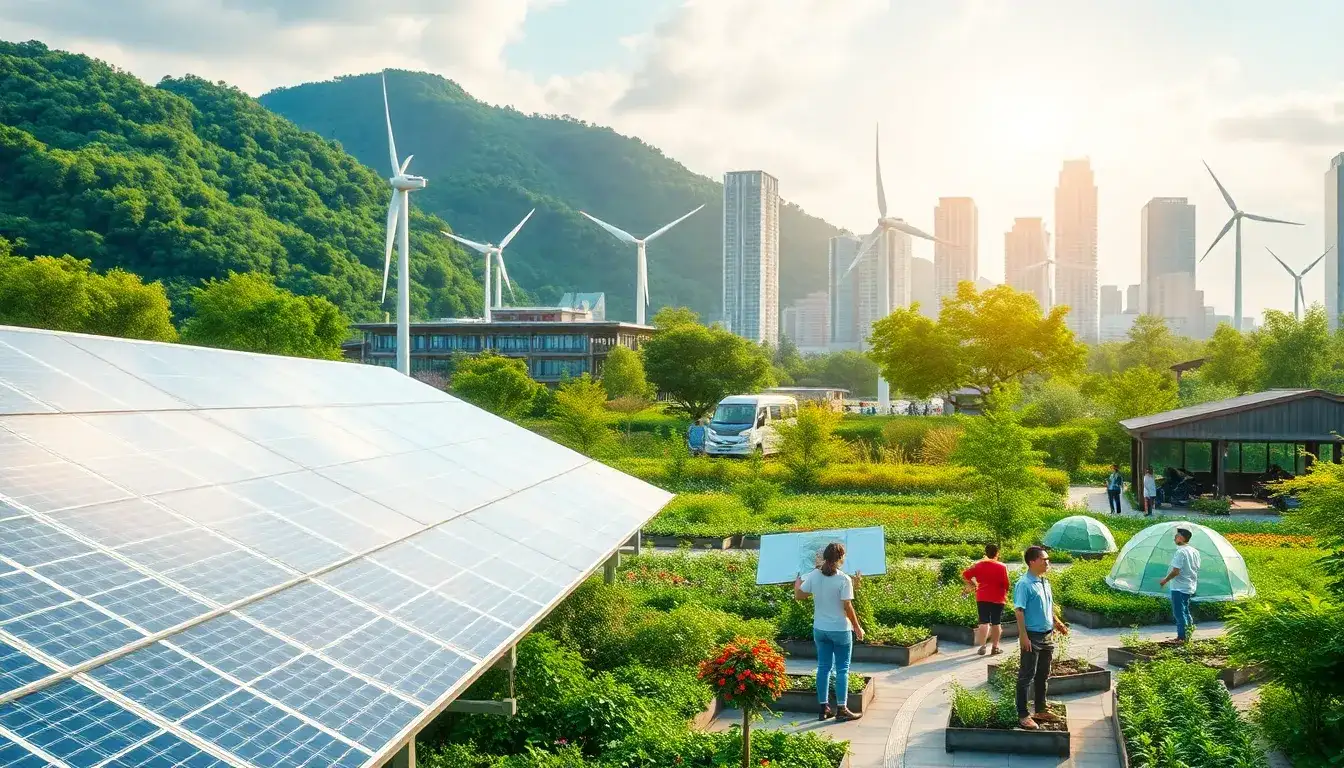
Injecting “Green Power” into the Eco-Environmental Industry to Support the Construction of Beautiful China
Beautiful China development relies heavily on industrial support. By 2024, China’s eco-environmental industry is expected to achieve an annual revenue exceeding 22 trillion yuan for three consecutive years. In recent years, the industry has gradually transitioned from traditional end-of-pipe treatment methods to comprehensive pollution reduction and clean production practices, continuously optimizing and upgrading its industrial system, thereby injecting “green power” into the construction of Beautiful China.
Academician Qu Jiuhui from the Chinese Academy of Engineering stated that amidst the global wave of green transformation, China’s eco-environmental industry is making a historic shift from being a “follower” to a “leader.” At the recent 23rd China International Environmental Protection Exhibition, new technologies, achievements, and ideas are revitalizing the eco-environmental industry.
Turning Waste into Resource
At the exhibition, model rooms showcasing kitchens and bathrooms looked no different from everyday settings, but they held significant transformations. Previously, agricultural waste such as straw was either burned or processed into animal feed; now, it is being transformed into furniture boards. In the production workshop of Wanhua Chemical Group, agricultural residues undergo 15 processes including sorting, drying, and gluing to become formaldehyde-free boards. Guo Xingtian, Chairman of Wanhua, shared that their first batch of formaldehyde-free engineered wood was produced in 2006, breaking the traditional reliance on formaldehyde adhesives. This technology not only won a national award but also sparked a green revolution in home decoration.
Wanhua’s formaldehyde-free boards, made from agricultural waste, are ideal substitutes for traditional wood and can be used in flooring, wall panels, interior doors, and cabinets. The company integrates green principles throughout its operations—utilizing rooftop solar panels to meet production electricity needs and establishing 16 industrial parks across the country to enhance resource efficiency and reduce carbon emissions.
In recent years, Wanhua has introduced a “green industrial customization” model, moving from traditional manual operations to large-scale industrialization. This approach segments the home renovation process into ten industrial modules, allowing for efficient material use and rapid delivery through a “factory production to home installation” model. According to Guo, this method not only conserves over 70% of materials but also enables the recycling of old furniture, creating a resource circulation system. Their goal is to establish a green closed-loop system driven by technological innovation to promote low-carbon, energy-efficient, and environmentally friendly practices in the home decoration industry.
<h2>Digital Transformation Fuels New Products</h2>
In recent years, new technologies like artificial intelligence have provided powerful tools for the eco-environmental industry, creating numerous application scenarios. The <b>National Ecological Environment Monitoring Network's Digital Transformation Plan</b> was recently released, marking significant progress in the digital transformation of ecological and environmental monitoring in China. Specialized exhibition areas focused on smart ecological monitoring were showcased at the event.
One standout was a "super-sensory" robotic dog at the booth of <b>Jiangsu Zhongguang Technology</b>, which drew significant interest. According to staff, this robotic dog can autonomously perform inspections in industrial parks, equipped with various instruments to quickly identify leaks and other anomalies, ensuring safe production.
Climate change is a topic of global concern, and accurately tracking greenhouse gas data is crucial in tackling it. The <b>Lingxi Optoelectronics</b> company developed China's first high-precision greenhouse gas analyzer, which attracted many inquiries. Monitoring greenhouse gases is challenging due to the slow increase of carbon dioxide in the atmosphere, requiring highly sensitive instruments. This product employs cutting-edge technology and plays an important role in supporting China's autonomous carbon monitoring network.
The transformation plan aims for innovations such as "unmanned operation, smart sampling, black laboratory, and three-dimensional remote sensing" by <b>2027</b>. Many companies have already begun innovations in smart instruments and unmanned laboratories. At the exhibition, an automated laboratory built by <b>Puyue Technology</b> showcased a system where samples are automatically processed and analyzed, generating reports efficiently while ensuring uniformity in results.
According to <b>Han Shuanglai</b>, General Manager of Jiangsu Zhongguang Technology, the trends of unmanned operation and digital transformation are becoming vital development directions for environmental quality monitoring. Upgrading traditional stations to smart ones and gradually moving towards unmanned operations in laboratories will meet market demands and guide corporate innovation.

<h2>Supporting Industrial Development</h2>
As dawn breaks, solar panels shimmer under the sun, while at night, the lights of wastewater treatment plants illuminate the city—indicating the rapid growth of the eco-environmental industry, supported by local governments. During the exhibition, <b>Zhang Xiaobing</b>, a member of the <b>Taizhou Municipal Committee</b>, promoted the city's eco-environmental industry. Zhang, who also serves as the city's energy-saving and environmental protection industry chain leader, explained that the local government actively engages in the development of key industrial chains and projects to foster a strong environment for eco-environmental enterprises.
Taizhou has launched various incentive policies and support measures for the eco-environmental industry, hosting over <b>280</b> eco-environmental enterprises and achieving a total output value of nearly <b>50 billion yuan</b>. The city has produced a number of competitive companies, with products and technologies reaching over <b>60</b> countries and regions across Europe, Africa, and Southeast Asia.
As a guest city at this year's exhibition, <b>Qingdao</b> also participated with a delegation. During the main event day, they promoted the <b>China-Shanghai Cooperation Organization Eco-Environmental Innovation Base</b> (Shandong), aiming to create a flagship platform focusing on international cooperation in eco-environmental technology and industrial practices. <b>Sun Jihai</b>, director of Qingdao's ecological environment bureau, expressed hopes that the exhibition would facilitate in-depth dialogues among government, industry, research, and academia, fostering practical cooperation towards building a beautiful China and advancing the eco-environmental industry.
In recent years, Qingdao has accelerated its "Beautiful Qingdao" initiative by addressing pollution prevention. Through targeted actions such as the <b>Blue Sky, Clear Sea, Clean Land Campaign</b> and <b>Zero Waste City</b> initiatives, the city has continuously unleashed the potential of eco-environmental policies and demands, resulting in a matrix of innovative enterprises covering the entire waste treatment chain. With systematic cultivation, Qingdao's eco-environmental industry has formed a multi-level development pattern, overcoming key technologies in marine ecological restoration and hazardous waste resource utilization. This has led to significant improvements in air quality and coastal water quality in the city.
<b>Guo Chengzhan</b>, President of the China Environmental Protection Industry Association, stated that in recent years, the eco-environmental industry in China has embraced the philosophy that "lucid waters and lush mountains are invaluable assets." This has accelerated green technological innovation and the promotion of advanced green technologies, strengthened green manufacturing, and fostered the growth of green energy and low-carbon industries, achieving significant results in high-level ecological protection and advancing high-quality economic and social development.
Original article by NenPower, If reposted, please credit the source: https://nenpower.com/blog/green-power-boosts-eco-environmental-industry-for-beautiful-china-development/

