

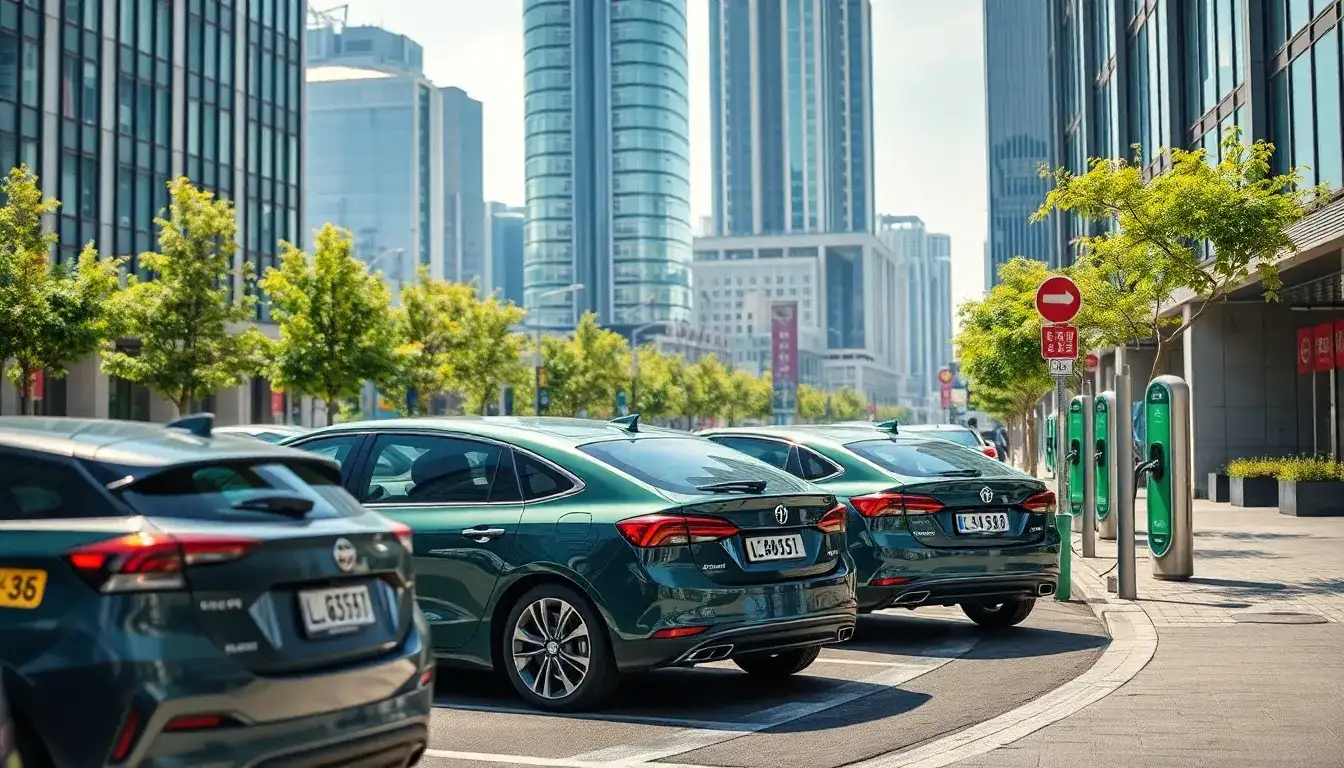
Potential of V2G Technology: “Green License Plate” Vehicles Can Earn Money While Parked
On the evening of September 30, at the Wuxi Vehicle-to-Grid (V2G) verification base, 30 electric vehicles lined up in designated V2G parking spots, ready for a special task. At exactly 7 PM, these cars simultaneously discharged power back to the grid, achieving a maximum discharge capacity of 1,200 kilowatts, effectively alleviating the evening’s peak electricity demand. Mr. Wu, a resident born in the 2000s, expressed his excitement on social media, stating, “Today, I sent back over 30 degrees of electricity and earned more than 30 yuan. It’s such a novel experience to make money while my car is parked!”
Under the guidance of the “dual carbon” goals, China’s new energy vehicle sector continues to thrive, with V2G technology emerging as a significant breakthrough for energy transition. By the summer of 2025, Jiangsu province is set to experience a historic peak in electricity demand. The application of V2G technology has made crucial advancements, successfully demonstrating the largest power capacity of provincial V2G interactions during the peak summer period and introducing supportive pricing policies for large-scale implementation, propelling V2G into a new phase of commercial and large-scale operations.
V2G: Transforming Electric Vehicles into “Mobile Power Banks”
In April this year, the National Development and Reform Commission and three other departments announced the first batch of pilot projects for large-scale V2G application. Among them, the decentralized V2G pilot in Changzhou, the all-scenario V2G pilot in Nanjing, and the comprehensive V2G pilot project in Wuxi were selected, marking a significant step from technical validation to large-scale commercial application for Jiangsu’s V2G initiatives.
The concept of V2G may sound futuristic, but its principle is straightforward: electric vehicles connect to the grid via charging facilities, storing electricity during off-peak hours and supplying power back to the grid during peak times or when needed. The process Mr. Wu participated in was precisely this reverse power discharge.
According to staff from State Grid Jiangsu Electric Power, users interested in V2G interactions must first confirm that their vehicle supports the reverse discharge function, which can be verified with their vehicle manufacturer. Residential communities need to install V2G charging stations and apply to the power supply company for equipment installation based on local pilot policies. Once the metering transformation is complete, residents can participate.
The public transportation sector is becoming a new frontier for V2G technology. On the evening of August 21, at the Changzhou Public Transport Company’s V2G demonstration base, 11 electric buses responded to a discharge invitation, achieving a maximum discharge power of 600 kilowatts, with a single discharge generating approximately 1,400 yuan, providing a replicable model for public transportation systems to engage in grid regulation.
In some communities in Jiangsu, the appeal of residential V2G pilots continues to grow. On the evening of September 18, two electric vehicles parked quietly in front of charging stations at the Hubin Huayuan community in Changzhou, with charging guns connected to the cars, channeling electricity into the city’s grid to support evening peak demand.
In contrast to the model that relies on voluntary participation from vehicle owners, Nanjing has innovatively introduced a “station-grid interaction” model. On September 11, the NIO battery swap station at the Fangshan service area in Jiangning became the province’s first station-grid interactive battery swap station. Staff member Wang Jing explained that the idle electric vehicle batteries in the station can continuously discharge power to the grid at a rate of 400 kilowatts.
Revenue Opportunities for Vehicle Owners
In mid-August, Jiangsu officially issued supportive documents, clearly establishing a pricing policy for reverse discharge in V2G interactions, using economic incentives to encourage two-way interaction between electric vehicles and the grid.
For instance, the peak discharge price for commercial users in Jiangsu’s State Grid in August 2025 could reach 1.2245 yuan per kilowatt-hour. Based on the price difference between peak and off-peak hours, residential users could earn approximately 0.85 yuan for each kilowatt-hour discharged.
For new energy vehicle owners, the process is quite simple: connect the vehicle to a V2G charging station, use the relevant app to scan the QR code of the charging station to initiate discharge, and, once finished, click “end discharge” in the app or on the screen, disconnect the charger, and check the earnings in the app.
At a community in downtown Changzhou, five residents’ vehicles participated in the pilot, discharging a total of 1,430 kilowatt-hours over a month, earning about 1,650 yuan, effectively turning parked cars into “mobile power banks.”
Liu Lingyan, assistant general manager of State Grid Changzhou Power Supply Company, calculated the economic benefits: “Assuming a residential user discharges 14 kilowatt-hours daily, over 300 days of driving per year, the discharge income would be approximately 4,700 yuan. After deducting charging costs and around 10% charge and discharge losses, the net profit would be nearly 3,000 yuan.”
The policy has also optimized the charging time slots, particularly by adding a midday off-peak period, encouraging vehicle owners to charge during times of abundant photovoltaic power and lower electricity prices, thus reducing charging costs and promoting renewable energy consumption. The marketing department of State Grid Jiangsu has indicated that the V2G system will continue to be optimized, allowing owners to set their driving times, with the system automatically devising the best charge and discharge strategy for “seamless” participation.
Accelerating Construction of a Green “Energy Storage Network”
As of the end of June, the number of new energy vehicles in Jiangsu exceeded 3 million. Engineers from State Grid Jiangsu compare this potential to that of pumped storage power stations: if all new energy vehicles in the province participated in V2G interactions, with an average discharge power of 20 kilowatts, the adjustable capacity would be equivalent to that of ten large pumped storage power stations, highlighting the vast potential of large-scale vehicle charge and discharge resources.
Meanwhile, various regions in Jiangsu are speeding up the construction of charging and swapping infrastructure. Nanjing plans to establish a total of 38,000 public charging stations and 500 battery swapping stations by 2025. The “14th Five-Year Plan” for public charging and swapping facilities in Suzhou proposes to build 200,000 charging stations by the end of 2025.
On September 8, Changzhou launched its second round of large-scale V2G discharge activities, covering 14 charging stations citywide. During the event, vehicle owners could receive a subsidy of 4 yuan for each kilowatt-hour discharged, representing an increase in revenue by nearly eight times compared to off-peak charging prices. In just three days, 250 vehicles participated in the discharge.
At a recent seminar on “Integrating V2G and Information Communication Development,” Professor Huang Xueliang from Southeast University highlighted that V2G technology serves as a crucial link between energy and transportation systems. It can not only meet users’ charging needs but also provide auxiliary services such as peak regulation and frequency modulation to the grid, promoting the efficient utilization of renewable energy. He called for the development of technical routes tailored to vehicle types and scenarios, expediting the refinement of policy standards, and establishing sustainable market mechanisms.
With the continuous growth of new energy vehicles and the ongoing optimization of business models, the “green license plate” cars on the streets of Jiangsu are poised to become vital assets for peak regulation of the grid, providing robust support for the establishment of a new power system and the advancement of green energy development.
Original article by NenPower, If reposted, please credit the source: https://nenpower.com/blog/green-license-plate-cars-generate-income-while-parked-jiangsus-v2g-pilot-program-showcases-future-potential/

