

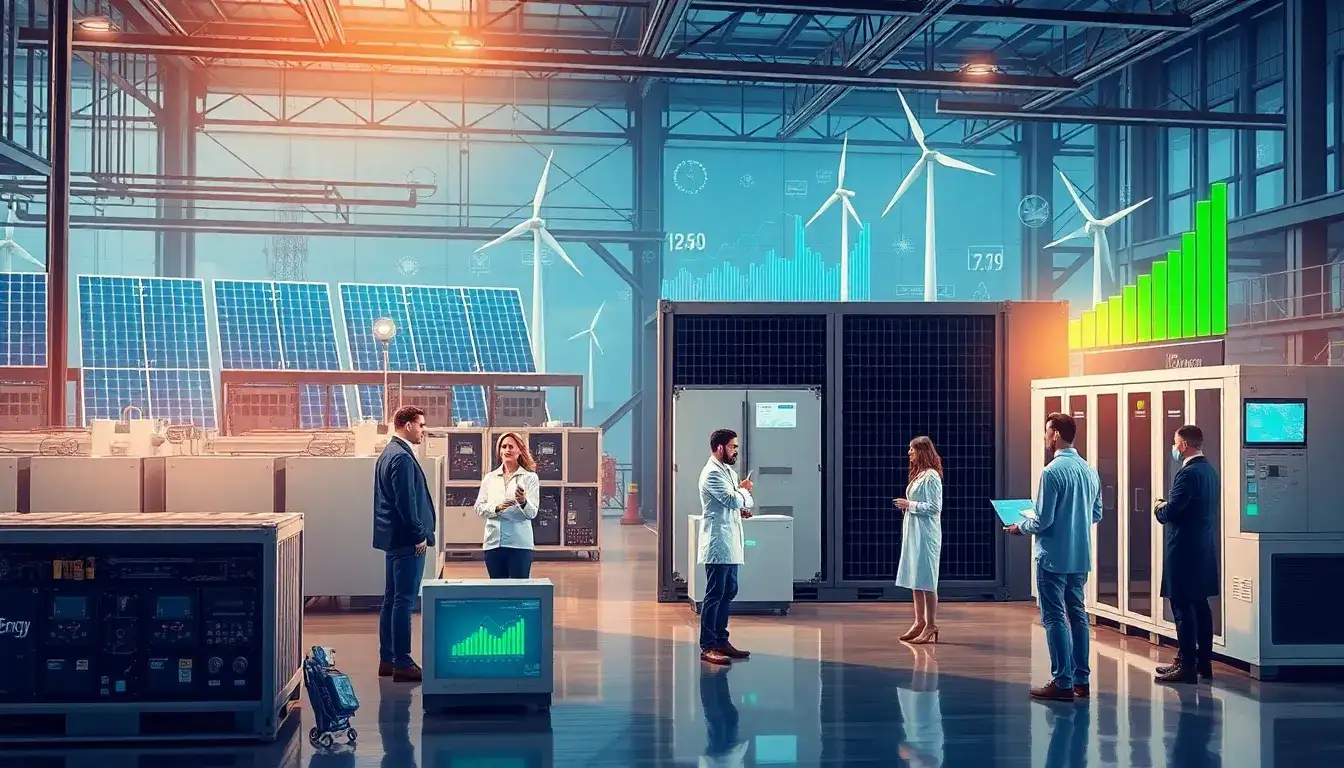
Global Energy Storage Growth Upheld by New Markets
—
**Clean Energy Clean Transport**
**June 18, 2025**
By **Nelson Nsitem**, Senior Associate, Energy Storage, and **Yayoi Sekine**, Head of Energy Storage, BloombergNEF.
The global energy storage market is set to reach new heights in 2025. Despite policy changes and uncertainties in the world’s two largest markets, the US and China, the sector continues to expand as developers pursue increasingly larger utility-scale projects. Since 2024, gigawatt-hour projects have been initiated or are under construction not only in the US and China but also in countries such as Saudi Arabia, South Africa, Australia, the Netherlands, Chile, Canada, and the UK. BloombergNEF anticipates a 35% growth in additions this year, achieving a record for annual additions at **94 gigawatts (247 gigawatt-hours)**, excluding pumped hydro. This robust year is expected to be followed by a compound annual growth rate of **14.7%** through to 2035, with annual additions projected to reach **220 gigawatts/972 gigawatt-hours** by that year, according to BNEF’s latest outlook.
### Market Movements
Mainland China accounts for the majority of global energy storage demand, particularly driven by regional needs for new utility-scale wind and solar projects to incorporate energy storage capacity. Nonetheless, the Chinese market is entering a transformative phase. A new policy introduced in February 2025 mandates that wind and solar payment mechanisms transition towards more market-based structures, requiring that **100%** of wind and solar generation be traded in the wholesale market, with local governments defining implementation details by year-end. The new policy also indicates the removal of energy storage as a prerequisite for renewable energy project grid connections, which has previously driven battery installations. Despite these changes, BNEF still anticipates robust battery demand, as the policy does not explicitly eliminate mandates. Following the announcement, several provinces in China have continued to impose mandates requiring new solar and wind projects to be paired with batteries. The specifics of local implementation will significantly influence how the shift from mandates to economic drivers affects energy storage deployment.
In the US, BNEF’s expectations have moderated as increased tariffs on imports are leading to higher battery prices and a slowdown in installations. The US energy storage market is currently grappling with rising import tariffs on goods from China, Canada, and Mexico, a decision made by President Trump upon his return to the White House this year. The timeline shows that on April 10, Trump raised base tariffs by up to **145%** on imports from China. BNEF’s base-case analysis assumes a blanket **54%** import tariff, which would immediately raise four-hour turnkey system costs by **30%** in 2025 (to **$266** per kilowatt-hour) compared to a scenario without the increased tariff. Under the higher tariff scenario of **145%**, annual build rates could drop by **51% to 74%** from 2025 to 2027 compared to BNEF’s base-case projections. These heightened costs are leading to renegotiations of supply contracts and causing delays or cancellations of projects. Furthermore, the tariffs escalate production costs for US-made batteries, as the country continues to rely on imported battery materials, including graphite, from China.
### Gigawatt-Scale Projects
Globally, the development of energy storage projects is increasingly driven by the utility-scale segment, with mandates and targeted auctions spurring gigawatt-hour projects in markets like China, Saudi Arabia, South Africa, Australia, and Chile. Across Europe, the Middle East, and Africa, the utility-scale segment is growing faster than anticipated and is expected to surpass the residential sector by **2026**, thanks to a significant increase in targeted support programs and utility procurement. The residential segment has shown mixed results, slightly cooling in Europe but expanding in markets like California due to policy changes in 2024. BNEF’s latest outlook suggests that commercial battery deployments will surpass residential installations by **2030**, driven by updated assumptions on attachment rates—indicating the percentage of solar installations paired with batteries.
### Technology Locked In
Lithium iron phosphate (LFP) remains the dominant lithium-ion battery chemistry in the stationary energy storage market. Chinese battery manufacturers, specializing in LFP production, continue to thrive due to the growth of the domestic market and aggressive international expansion. Major battery producers, such as Contemporary Amperex Technology Co. Ltd. (CATL), BYD, EVE Energy, CALB, and Hithium, are developing products specifically for the energy storage sector, moving away from the chemistry mix used in electric vehicles, which typically includes a higher proportion of nickel-based lithium-ion batteries. Compared to LFP, nickel-based chemistries like nickel manganese cobalt oxide (NMC) and nickel cobalt aluminum oxide (NCA) offer greater energy density, allowing automakers to produce lighter and longer-range electric vehicles. In Japan and South Korea, where battery manufacturers have historically focused on nickel-based chemistries, BNEF expects a portion of manufacturing to cater to domestic energy storage demand while also addressing the declining NMC demand overseas until 2035. In the US, BNEF also anticipates that NMC may still be utilized in utility-scale projects until at least **2027**. Despite the clear shift toward LFP, 2024 witnessed significant shipments of NMC batteries for energy storage. The impact of high tariffs on imports from China, the primary manufacturer of LFP batteries, is expected to diminish overall energy storage demand in the US while making any non-Chinese NMC batteries more viable. Expectations for sodium-ion batteries among manufacturers have waned as LFP prices continue to decline, prompting BNEF to lower its expectations for the scaling of sodium-ion technology.
Original article by NenPower, If reposted, please credit the source: https://nenpower.com/blog/global-energy-storage-market-surges-amid-new-opportunities-and-challenges/

