

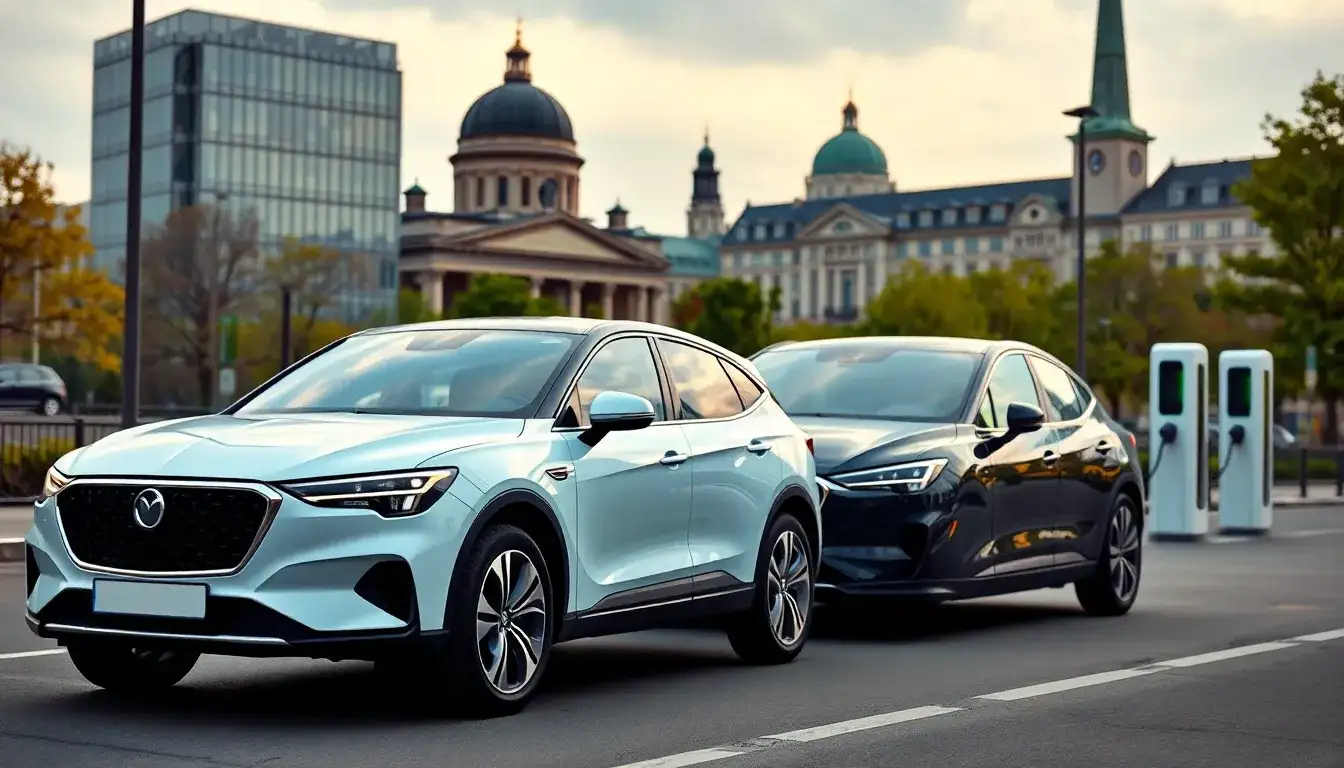
On January 19, the German Ministry of Environment announced a new subsidy program aimed at revitalizing the sluggish automotive market. Under this initiative, consumers will receive subsidies ranging from €1,500 to €6,000 (approximately ¥12,200 to ¥48,900) depending on the type of vehicle, family size, and income. Applications for the subsidies can be made retroactively from January 1, 2026.
According to a report from Bild, German Environment Minister Carsten Schneider stated that the government plans to allocate €3 billion (around ¥24.46 billion) for this program, which aims to support 800,000 vehicles by 2029. The German government had previously extended the tax exemption period for fully electric vehicles until the end of 2035, with the Ministry of Finance estimating a cost of approximately €600 million (about ¥4.9 billion) by 2029.
Notably, this subsidy plan includes funding for plug-in hybrid and range-extended vehicles as well; additionally, foreign models, including those made in China, are no longer excluded from the subsidy program.
At a Crossroads
The German automotive industry finds itself at a crucial turning point. In 2023, new registrations of electric vehicles in Germany peaked at 524,200, but the government ended its long-standing subsidy program due to budgetary constraints after seven years (2016-2023). Consequently, registrations of fully electric vehicles dropped to around 380,000 in 2024, marking a year-on-year decline of over 27%. The market share of electric vehicles has also fallen to 13.5%.
Simultaneously, traditional German automakers such as Volkswagen, Mercedes-Benz, and BMW are experiencing significant pressure on their market share from competitors in both the U.S. and China. In 2025, Mercedes-Benz’s sales are expected to plummet by 10% to 2.16 million units; Volkswagen’s sales are projected at 9 million, a 0.5% decrease; while BMW may see a slight increase of 0.5% to 2.5 million units.
Challenges from Overseas
In the U.S., high tariffs imposed by the Trump administration on imported vehicles have severely impacted the competitiveness of German automobiles in international markets, prompting the German government to reassess its domestic support policies. Since the beginning of this year, Trump has threatened to impose an additional 10% tariff on eight European countries, including Germany, further complicating the outlook for the German automotive industry.
The rapid rise of Chinese automotive brands and their expansion into the European market have also intensified competition for German car manufacturers. Despite approximately 80% of electric vehicles registered in Germany being produced in Europe by 2025, Chinese brands are steadily increasing their market share. For instance, BYD sold around 23,000 vehicles in Germany in 2025, an eightfold increase compared to the previous year.
Additionally, the European Union postponed its ban on internal combustion engine vehicles at the end of last year, granting German automakers a transitional period, but also prolonging the challenges faced by traditional manufacturers in adapting to new energy trends. Notably, coinciding with the announcement of the new plan by the German Ministry of Environment, Volkswagen declared the closure of its Dresden factory, marking the first instance of production halting domestically in the company’s history. However, the construction of a robust new energy industry chain in Germany still faces numerous hurdles.
Focus on Social Support
Unlike the subsidy program implemented from 2016 to 2023, the new scheme demonstrates a stronger emphasis on social policy. Tim Krottendorf, secretary-general of the German Social Democratic Party, emphasized the need to make the transition to electric vehicles affordable for everyone. Therefore, the new subsidy plan sets strict income limits, requiring that families have a taxable annual income of no more than €80,000. Families with minor children can increase this limit by €5,000 per child, up to a maximum of €90,000.
The subsidy amounts are tiered based on vehicle type and family circumstances: the base subsidy for fully electric vehicles is €3,000, while plug-in hybrids and range-extended vehicles receive €1,500. Families with children can receive up to an additional €1,000, with further increases for those earning less than €60,000 (€1,000) or less than €45,000 (€2,000).
Thus, eligible low-income families purchasing fully electric vehicles could receive a maximum subsidy of €6,000, significantly reducing the total cost of vehicles priced below €45,000 by over 13%.
On the other hand, increasing subsidies for plug-in hybrids and range-extended vehicles is expected to help more consumers buy these relatively lower-cost models, thereby boosting overall car sales.
Opening to External Competition
Notably, the new subsidy plan explicitly does not impose restrictions based on the country of origin of car brands, allowing Chinese brands to compete on equal footing with domestic ones. Minister Schneider stated that Germany will not implement any restrictive measures in the face of competition, noting that he has not observed a large-scale influx of Chinese cars into the German market. Hildegard Müller, president of the German Association of the Automotive Industry (VDA), also emphasized that trade protectionism is not the correct approach; equal opportunities must be provided to all manufacturers.
The open competition philosophy reflected in Germany’s new plan somewhat parallels China’s earlier decision to allow Tesla to establish wholly-owned factories—by introducing strong competitors, it pressures domestic industries to innovate and upgrade.
Schneider further revealed that German automakers are adopting a more proactive stance in response to competition from China, with plans to introduce more affordable German-made models to the market this year.
Opportunities and Challenges Ahead
However, the new subsidy program also faces significant challenges. Müller warned that if the government does not work to improve infrastructure, the plan could be short-lived. She stressed that an extensive charging network and affordable energy are crucial for the sustainable development of electric vehicles.
Ferdinand Dudenhoeffer, head of the German Automotive Research Center, believes that subsidies may not only impose unnecessary pressure on the national budget but also lack economic significance. His viewpoint reflects concerns among some experts regarding long-term reliance on subsidies to drive market growth.
Moreover, the global political and economic landscape remains highly uncertain as we approach 2026, and building a domestic new energy vehicle industry chain in Germany is not an overnight task. Therefore, the extent to which the subsidy program will reshape the automotive landscape in Germany and Europe will require time and market validation.
Original article by NenPower, If reposted, please credit the source: https://nenpower.com/blog/germany-revives-car-subsidies-and-opens-market-to-chinese-brands-amid-industry-transformation/

