

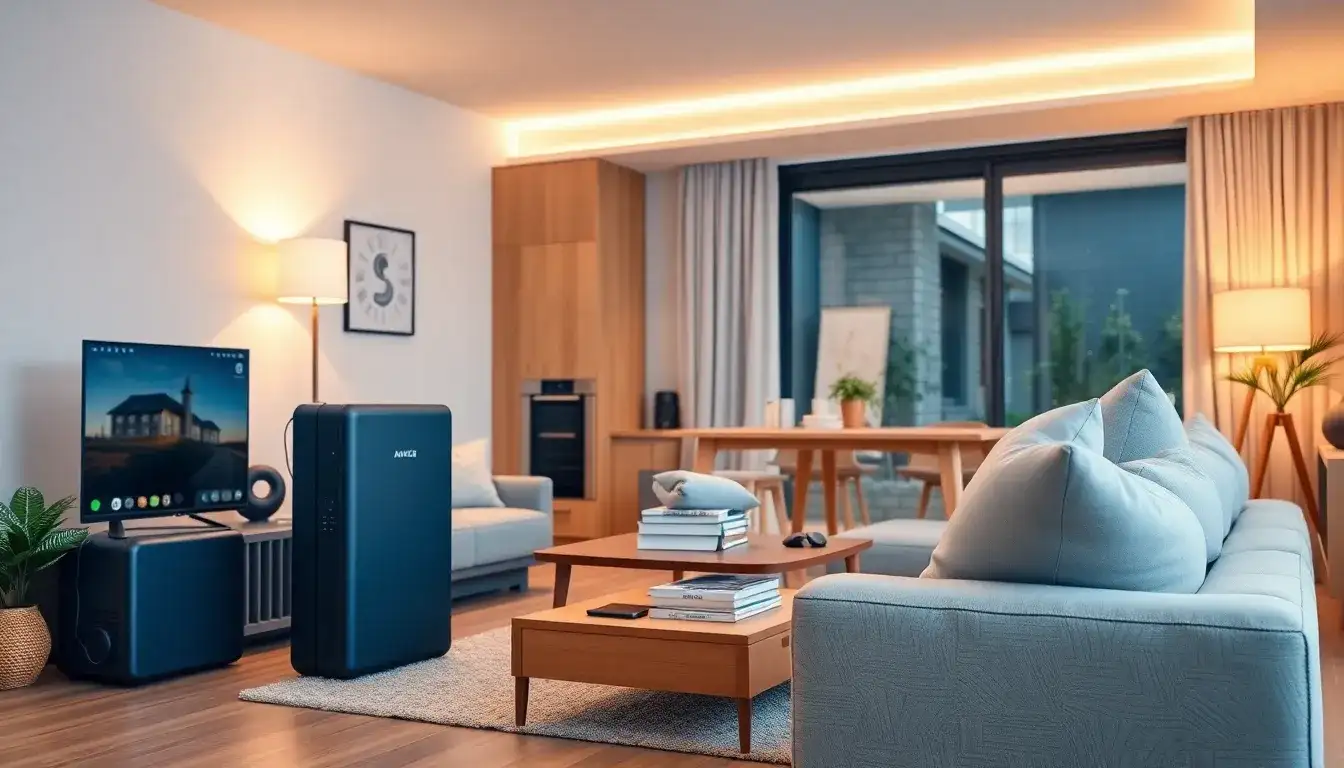
Anker Innovations achieved an impressive average revenue of over 4.9 million yuan per employee in 2024, with an average profit exceeding 420,000 yuan. This strong performance has garnered significant attention.
Additionally, Anker’s energy storage business generated over 3 billion yuan in revenue, marking an astounding 184% year-on-year growth, solidifying its position as a leader in household energy storage.
To attract more consumers, Anker launched a balcony energy storage product that stands out for its cost-effectiveness. However, the competition in the balcony energy storage market is fierce, and Anker must contend with multiple companies to capture market share.
To further expand its presence in the household storage market, Anker plans to raise 1.105 billion yuan for the research and industrialization of portable and home energy storage products.
Following the release of its annual report for 2024, Anker Innovations, often referred to as the “King of Power Banks”, saw its revenue and profit data gain widespread attention. With 5,034 employees, Anker reported revenues of 24.71 billion yuan and a net profit of 2.11 billion yuan, resulting in an impressive per-employee revenue of over 4.9 million yuan and profit exceeding 420,000 yuan. This remarkable achievement led many netizens to wonder: “Is selling power banks really that profitable?”
In reality, Anker Innovations has evolved beyond just selling power banks; it has diversified its product range significantly. In 2024, the most successful products were not power banks but energy storage solutions. The company’s energy storage revenue exceeded 3 billion yuan, reflecting a 184% increase year-on-year. How did Anker transition from the “King of Power Banks” to a leader in home energy storage?
The journey began in 2011 when Yuan Meng, then working at Google, faced a dilemma while searching for a laptop battery online: the original parts were high in quality but expensive, while lesser-known alternatives were cheap yet unreliable. This prompted him to identify a market gap between branded original batteries and third-party options, leading him to leave his job and start a company that offered high-quality products at competitive prices. Within a few years, the Anker brand became the best-selling name in the charging category on Amazon, earning Anker Innovations the title of “King of Power Banks.”
However, Yuan was not content with just power banks. In 2016, Anker Innovations established a smart home division, launching a variety of products including robotic vacuum cleaners, air purifiers, and portable energy storage systems. While some products, like the robotic lawn mower, faced challenges and were eventually discontinued, Anker’s journey into energy storage began with its first mobile storage products in 2015. Though initial sales were disappointing, the company paused this line until around 2019 when the overseas home energy storage market began to thrive, spurred by rising energy demands following global events such as the Russia-Ukraine conflict in 2022.
Recognizing the potential in household energy storage, Anker re-entered the market and launched new products by the end of 2022. Initially, these storage products performed reasonably well; however, the rapid growth of the sector soon led to market saturation and a fierce price war in 2023. Anker’s energy storage product sales plummeted, with a staggering 70% drop in global sales in the first quarter of 2023, and a 90% decline in the European market. Fortunately, the situation improved in 2024 as the household energy storage market began to recover, particularly in the balcony storage segment, which saw significant growth.
In its annual report, Anker revealed that its energy storage revenue for 2024 reached 3.02 billion yuan, reflecting a remarkable 184% year-on-year growth. With this revenue scale, Anker is now closely positioned to its competitor, Hua Bao New Energy, which recorded 3.606 billion yuan in revenue, solidifying its status as a key player in the household energy storage market.
In April 2024, during an investor meeting, Anker reiterated that consumer-grade energy storage remains a key strategic focus for the year. The company’s energy storage offerings encompass portable storage, balcony photovoltaic systems, and home energy storage, making it a versatile player in the market.
To streamline installation and accessibility, Anker introduced a mobile photovoltaic energy storage product that reduces installation complexity, allowing users to perform 80% of the work themselves. This innovation, termed “balcony energy storage,” aims to reach a broader audience.
Anker has leveraged its marketing strengths to promote its energy storage solutions through various platforms, including Facebook, Twitter, and YouTube, attracting a significant number of potential customers interested in residential energy storage. According to a report by Kaiyuan Securities, since 2023, Anker’s energy storage brand Anker SOLIX has surpassed Tesla Powerwall in global Google search volume, approaching Enphase, the top two companies in the U.S. market for home energy storage.
With its experience in consumer electronics, Anker aims to change the traditional model that relies on intermediaries to connect consumers with energy products. The head of Anker’s charging and energy storage business, Xiong Kang, stated that the company focuses on product quality and customer acquisition while outsourcing installation, creating cost savings for consumers and benefits for all stakeholders.
Currently, Anker’s energy storage products are competitively priced, offering significant value compared to similar products from Hua Bao New Energy and Zhenghao Innovation. Furthermore, Anker’s design aesthetics, rooted in its consumer electronics background, enhance the appeal of its energy storage solutions to end consumers.
However, the balcony energy storage sector is highly competitive. As a hybrid between portable and home energy storage, balcony storage is more consumer-focused but still requires professional installation. This means that Anker faces competition not only from brands like Zhengtuo, Hua Bao New Energy, Delan Minghai, and Zhenghao Innovation, but also from international firms such as Wotai Energy and BYD, which have strong channel advantages. Additionally, Anker competes with leading global brands like EET, Enphase, and Tesla.
Despite the rapid growth of the balcony energy storage market, some industry experts express concerns about the potential for intense competition, reminiscent of the challenges faced in the home energy storage sector. Nonetheless, Anker appears confident in its strategy, as evidenced by its recent initiatives to strengthen its household energy storage presence.
In November 2024, Anker announced a plan to issue convertible bonds to raise 1.105 billion yuan, with a portion of the funds allocated for the research and industrialization of portable and home energy storage products. As of now, Anker’s energy storage business has demonstrated impressive performance, but the ongoing market competition will determine whether it can continue to thrive.
Original article by NenPower, If reposted, please credit the source: https://nenpower.com/blog/from-power-banks-to-home-energy-leaders-ankers-rise-in-the-family-storage-market/

