

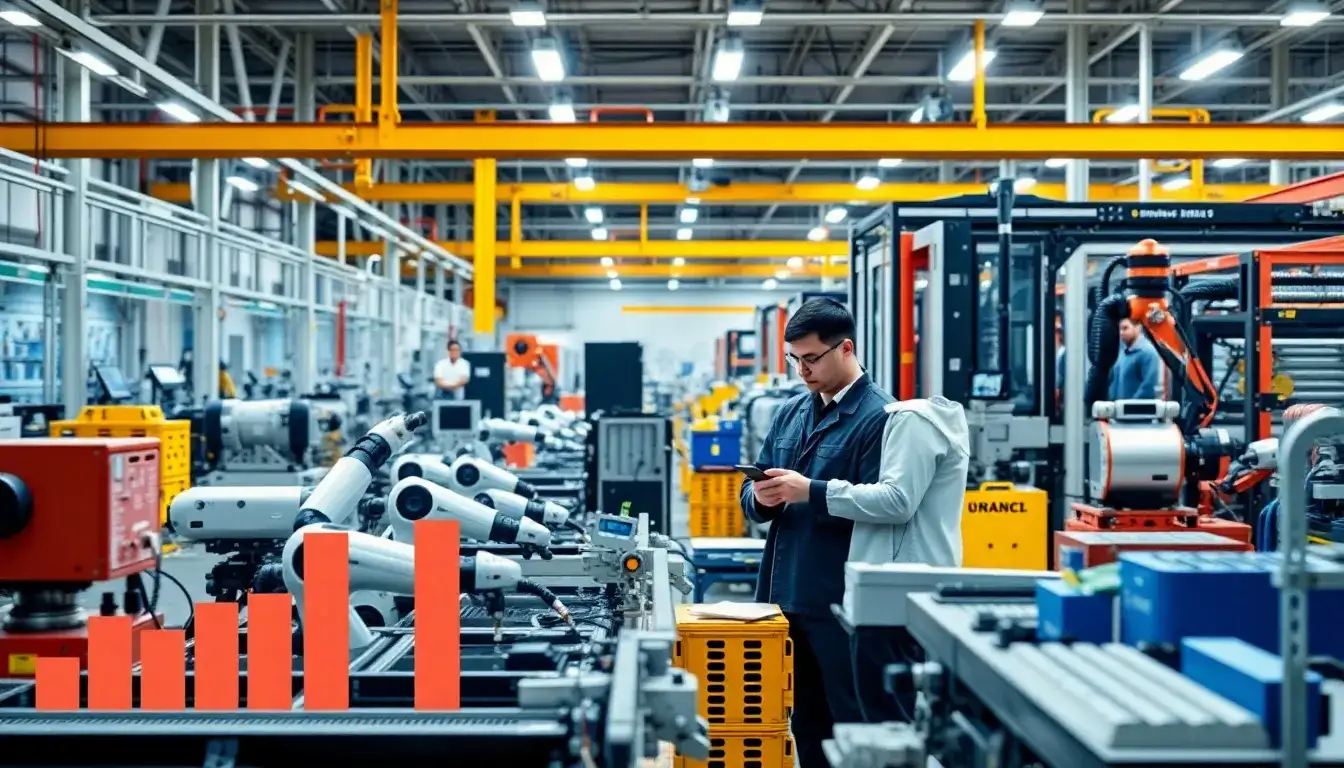
From reliance on imports to establishing a more complete industrial chain system—the robot industry has managed to double its revenue.
At the 2025 China Robot Industry Development Conference, the China Machinery Industry Federation released the report on the achievements of the robot industry during the “14th Five-Year Plan.” In terms of industry scale, the revenue of the robot industry reached 106.1 billion yuan in 2020, and is projected to increase to 237.89 billion yuan by 2024, effectively doubling. In the first three quarters of this year, the industry’s revenue grew by 29.5% year-on-year.
Regarding exports, the industry exported 390 million USD in 2020, with expectations to rise to 1.15 billion USD by 2024. In the first three quarters of this year, exports reached 1.24 billion USD, surpassing the total for last year and reflecting a growth of 56%.
In terms of market share, the domestic market share of independently branded industrial robots increased from 31.4% in 2020 to 58.5% by 2024.
Xu Niansha, president of the China Machinery Industry Federation, stated, “During the ’14th Five-Year Plan’ period, China’s robot industry has developed rapidly, forming a relatively complete industrial chain system.”
Enhanced Capabilities
High-performance industrial robots for heavy load, welding, and painting have been successfully applied. At the 25th China International Industry Fair, the Estun heavy-duty robot repeatedly handled weights of 1200 kilograms while maintaining stability throughout the process.
“The end load capacity is one of the key technical indicators of a robot’s functionality. As industrial robots are integrated into manufacturing processes, the market demand for heavy-duty robots with high rigidity, precision, and reliability is on the rise,” said a representative from Nanjing Estun Automation Co., Ltd.
Previously, China relied heavily on imports for heavy-duty robots, with domestic equipment holding less than 3% market share at one time. However, during the “14th Five-Year Plan,” Chinese enterprises have made significant breakthroughs. Estun’s 700 kg industrial robot is set to receive numerous orders in 2024, and this year, they have launched a 1000 kg product.
Welding is often referred to as the “sewing thread” of modern industry. “Our welding robots can perform high-speed, high-load, and stable spot welding operations, completing individual welds in as little as 2.2 seconds,” said a representative from Shenyang Siasun Robot & Automation Co., Ltd.
When it comes to painting, a traditional assembly line might take 3 to 5 days to complete a full vehicle paint job, while a line using Effort robots can finish in just over 80 seconds. “The new technology we introduced this year allows for the internal integration of intelligent process systems, automatically completing processes such as color matching, color changing, spraying, and cleaning,” said Wang Jinsong, an engineer at Effort Intelligent Robotics Co., Ltd.
In the first three quarters of this year, China produced 595,000 industrial robots, surpassing the total production for last year.
Improved Supporting Capabilities
The rapid development of the robot industry is closely linked to the solid foundation of its industrial chain. The supporting capability for key components, from high-precision reducers to high-performance servo systems and intelligent controllers, has steadily improved.
The harmonic reducer, often referred to as the “joint” of the robot, is primarily composed of a flexible wheel, wave generator, and rigid wheel. The flexible wheel, with a wall thickness of only 0.2 millimeters, requires micron-level precision for its surface gear processing. Imported products are typically expensive and have long delivery times. Currently, domestic harmonic reducers hold over 40% of the domestic market share.
“After more than 20 years of research and development, we have nearly reached the international leading level in key parameters such as rated torque and repeat positioning accuracy,” said Li Qian, deputy general manager of Lide Harmonic Drive.
The servo motor acts as the “muscle” of the robot, essential for precise joint movement. Shenzhen Inovance Technology Co., Ltd. has captured a market share in the domestic servo system market that has surpassed that of foreign brands.
In the production base located in Yueyang, Hunan, the rotor production line has achieved full automation, while the stator production line has reached an automation rate of 70%. “The smart production line ensures both high precision and high reliability for products, making customized services possible,” stated a representative from Inovance Technology.
Moreover, domestic suppliers are playing an increasingly significant role in the manufacturing of robots. Song Xiaogang, executive vice president of the Robot Branch of the China Machinery Industry Federation, noted that China’s robot supporting industrial system is becoming increasingly complete, with significant improvements in technology level and industrialization capabilities. The self-sufficiency rate of core products among leading enterprises in the industry has exceeded 80%.
Broader Applications
By the end of 2024, the number of industrial robots in China is expected to surpass 2 million, maintaining the top position globally.
In 2024, industrial robot sales in the Chinese market are projected to reach 302,000 units, a 68.7% increase from 2020, accounting for 54% of global sales.
In terms of application scope, by 2024, domestic branded industrial robots will have covered 71 major categories and 241 subcategories within the national economy, representing 51% of the economy’s sector coverage and an increase of 19 major categories and 98 subcategories since 2020.
The density of manufacturing robots has climbed from eighth globally in 2020 to third by 2024.
Robots are rapidly entering factories. China has built over 35,000 basic-level intelligent factories, more than 230 outstanding-level factories, and 1,260 5G factories.
Looking ahead, the two primary development directions are intelligence and specialization. “As artificial intelligence technology accelerates its penetration into vertical industries, robots are evolving from mere ‘functional equipment’ that performs repetitive tasks to ‘intelligent partners’ that possess perception, decision-making, and autonomous execution capabilities,” said Song Xiaogang.
Recently, Effort launched a voice-interactive palletizing robot that operates without programming, using voice commands instead. “Ordinary robots only have the function of ‘hands,’ but this product also has ‘eyes’ and ‘ears,'” explained a representative from Effort. The ‘eyes’ utilize visual technology to accurately locate items, while the ‘ears’ employ voice recognition and big data models to automatically record commands and generate code.
Specialization is also a key focus for the robot industry. In response to the issue of excessive concentration on a few competitive areas, Song Xiaogang noted, “We will guide enterprises to expand and deepen their applications across various fields in manufacturing and services, fostering differentiated development and uncovering more business opportunities.”
Original article by NenPower, If reposted, please credit the source: https://nenpower.com/blog/from-import-dependency-to-a-comprehensive-industry-chain-how-chinas-robotics-sector-doubled-revenue/

