

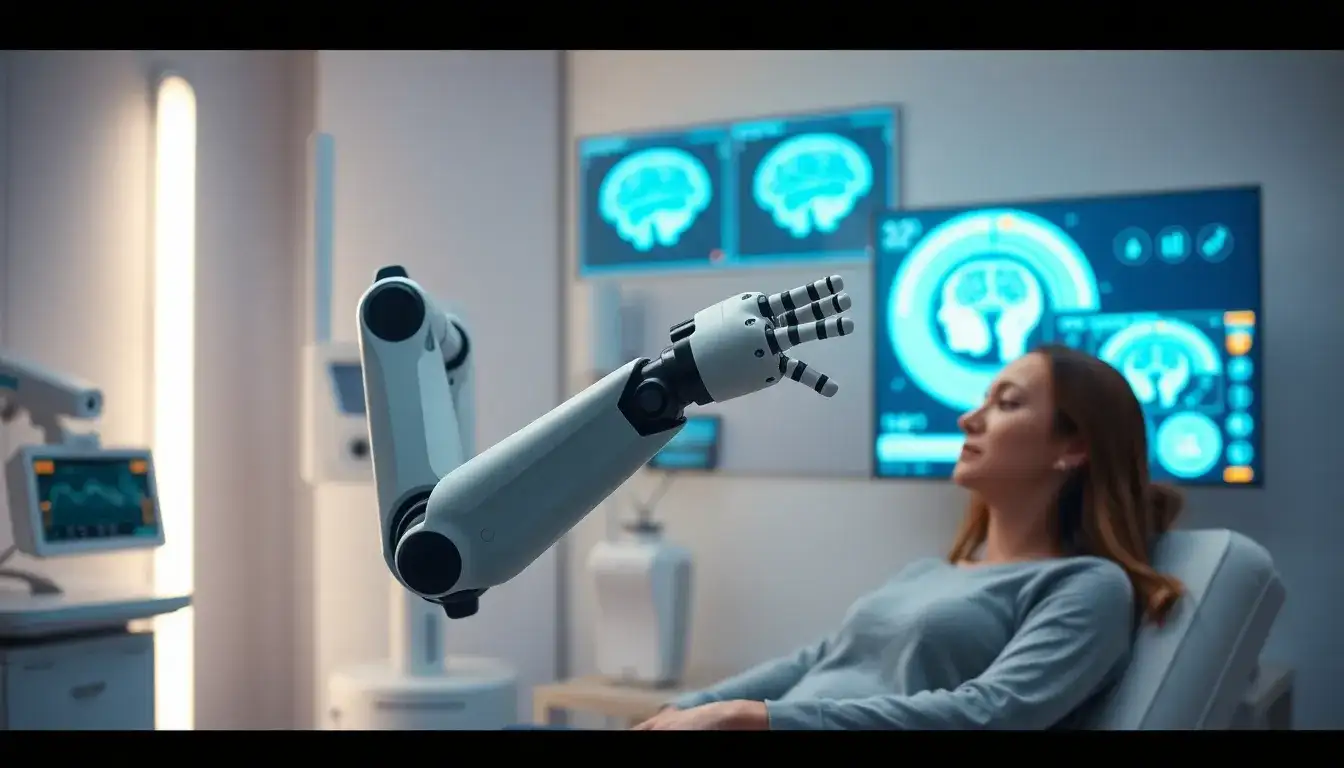
Fourier has announced plans to integrate brain-computer interface (BCI) technology into robotic rehabilitation training over the next 1-2 years to enhance treatment efficiency. During the Second Fourier Embodied Intelligence Ecological Conference and Zhangjiang Robotics Developers Pioneer Conference held on January 28, Fourier’s founder and CEO, Gu Jie, emphasized the importance of this integration. He explained that patients with severe disabilities often struggle to complete training independently in clinical rehabilitation settings due to their limited functionality. This makes it difficult to quantify rehabilitation effectiveness, and the training can become monotonous, lacking sustained motivation and feedback.
To address these challenges and improve the quality of life for patients, Fourier is exploring the fusion of embodied intelligence technology with BCI. Gu stated, “When a patient generates a movement intention during training but cannot execute it due to muscle limitations, the robot can recognize this intention through BCI and provide appropriate assistance at the moment the intention is formed, completing a full training loop from the central to the peripheral.” However, he acknowledged that there is a lack of large-scale datasets and the necessary hardware and software infrastructure globally for both BCI and embodied intelligence.
“We are also very aware that this is not something that can be quickly validated. It requires sufficient patience, long-term data accumulation, and continuous interdisciplinary collaboration,” Gu added.
Active Rehabilitation Training Driven by Embodied Intelligence and BCI
Gu encourages envisioning a scenario where a stroke patient thinks about moving their hand, and the robot interprets this intention to assist the patient in completing the action. He explained that BCI can identify whether a patient is actively attempting to move, whether their intention is activated, and the timing and intensity of this activation. During the clearest moment of intention, the robot can provide precise physical assistance. “This is not a concept for ten years down the line; it is a clear product direction we aim to scale in the next 1-2 years, representing a significant and important industrial direction for BCI,” he affirmed.
With the advancement of large models, robots are beginning to understand complex semantics, integrate multimodal information, and interpret environments visually. Gu noted that active human-robot interaction has evolved from an engineering pursuit into a definitive technological direction. In rehabilitation, traditional practices often involve devices driving limb movement with the brain’s participation being uncontrollable, leading to unengaging training sessions. In contrast, human-robot collaborative training, where patients actively participate, shows improved rehabilitation outcomes.
Using the example of a lower limb exoskeleton robot combined with BCI, patients wear EEG caps to generate movement imagery. A multi-channel electrode array collects brain signals in real-time, while AI algorithms interpret the patient’s movement intentions and types of actions. These signals are then translated into commands to drive the robot, facilitating gait training and stimulating the nervous system to rebuild neural pathways. Fourier explains that BCI technology can address the shortcomings of traditional rehabilitation in early intervention, training effectiveness, and assessment accuracy by continuously monitoring motor cortex activity and brainwave frequency changes, combined with mechanical data to provide objective, continuous, and traceable quantitative evidence of a patient’s training focus and rehabilitation effects.
The emotional interaction capabilities of humanoid robots ensure that the rehabilitation process encompasses emotional feedback, interactive guidance, and long-term companionship. Xie Qing, Director of the Department of Rehabilitation Medicine at Ruijin Hospital, Shanghai Jiao Tong University School of Medicine, mentioned that in the future, robots trained to understand patients’ non-verbal signals, such as facial expressions, eye movements, and gestures, will be able to respond and act accordingly.
Two Decisive Changes
“Rehabilitation has never been just a technical issue. The field doesn’t perform surgeries or rely heavily on medication; it demands a high level of resilience and willpower from the patients. Most of the patients we encounter need to stay in outpatient treatment or rehabilitation for 2-3 months. What therapists and doctors must do, beyond professional rehabilitation training, is to encourage and support patients to persist through the long and monotonous training process,” Gu stated.
In 2017, Fourier initiated research on combining BCI with exoskeleton robots, validating early concepts by using brain signals to drive exoskeleton walking. Gu revealed that this early research made the team aware of engineering bottlenecks, such as high signal noise, insufficient stability, and challenges in scaling deployment. Consequently, they focused their efforts on enhancing the interactive capabilities of the robots over the following years. However, in the past two years, he has observed two decisive changes: the rapid maturation of BCI hardware and the increasing lightweight and modular nature of devices. Non-invasive BCIs have evolved from single EEG to using near-infrared and multi-channel ultrasound for signal collection, with improvements in interference resistance, portability, and accuracy.
More importantly, large models have transformed the processing of brain signals. Gu explained that previous methods, such as FFT (Fast Fourier Transform), spectral analysis, or SSVEP (Steady-State Visual Evoked Potential), had limited capabilities in processing nonlinear, high-dimensional brain signals. In contrast, large models can classify and analyze complex brain signals more effectively, achieving more precise intention recognition.
Despite these advancements, challenges remain. Globally, BCI and embodied intelligence still lack large-scale datasets and the necessary hardware and software infrastructure. To enhance interdisciplinary collaboration, Fourier has partnered with Ruijin Hospital, Fudan University’s Brain-inspired Intelligence Science and Technology Research Institute, Tianqiao Brain Science Research Institute, the National Local Joint Innovation Center for Humanoid Robots, Tongji University’s Yangzhi Rehabilitation Hospital, Gestalt Technology, and Lingang Laboratory to launch the “BCI Embodiment: Data Engine Joint Innovation Program”. This initiative aims to explore deep integration between BCI and embodied intelligence, supported by core hardware and toolchain technologies to validate a future-oriented human-robot interaction closed-loop system.
Original article by NenPower, If reposted, please credit the source: https://nenpower.com/blog/fourier-to-integrate-brain-machine-interfaces-into-robotic-rehabilitation-training-within-two-years-to-enhance-treatment-efficiency/

