

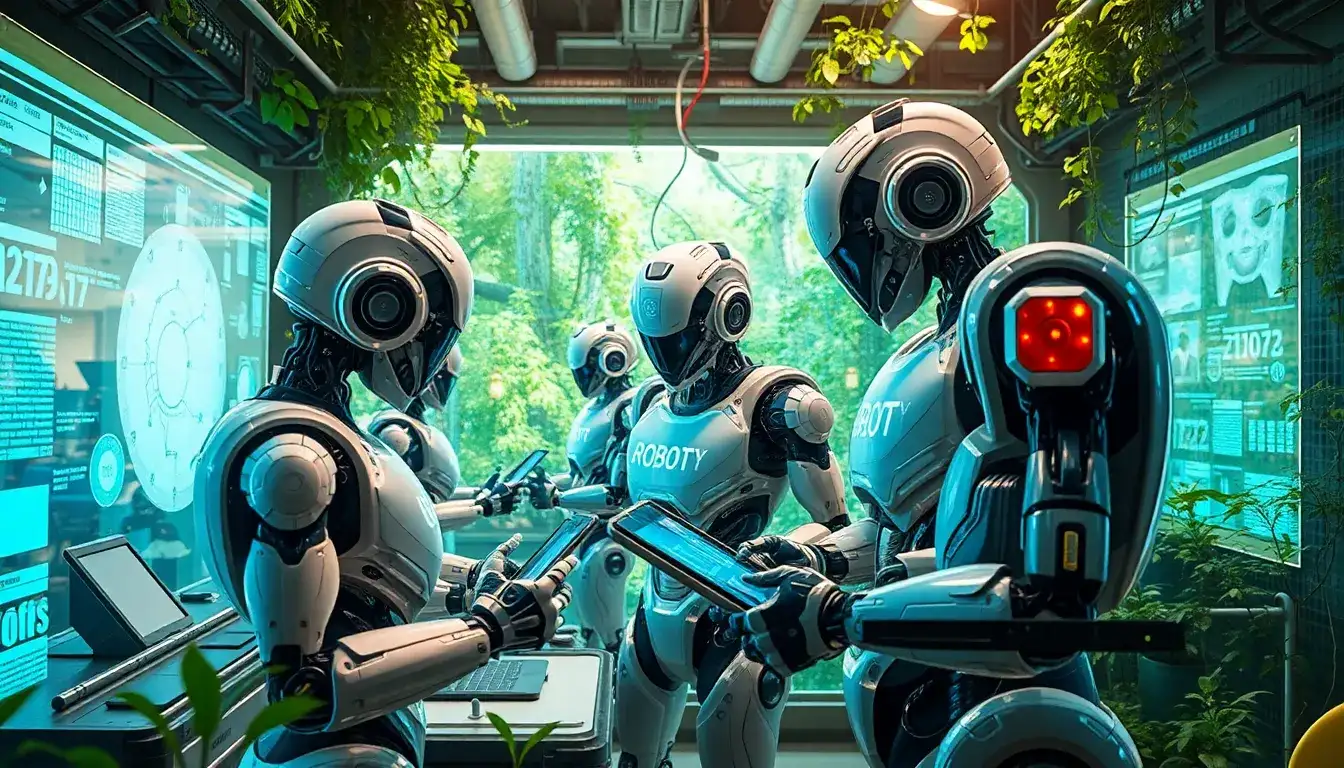
On February 24, a robot trainer, wearing a VR device, controlled the Walker S2 humanoid robot to practice grasping tasks. Aerial views of the Sichuan Humanoid Robot Multi-modal Data Collection and Testing Center in Ziyang High-tech Zone show rows of these robots. On the same day, the Walker S2 practiced picking up delivery packages, while trainers examined its visual perception systems.
February 9 marked another training session where the robot trainer maneuvered the Walker S2 for cargo handling. On February 24, the robot trainer analyzed training data on a computer. That evening, under the lights, the Walker S2 resembled an extraterrestrial visitor. On January 16, the center showcased a neat lineup of Walker S2 robots, while trainers transported them to different locations.
On February 24, the first working day after the Spring Festival, sunlight streamed into the Sichuan Humanoid Robot Multi-modal Data Collection and Testing Center, located in the Ziyang Robot Industry Park, which spans 6,000 square meters. Hundreds of newly developed humanoid robots were lined up, awaiting final action tests before delivery. A reporter visited this center, where 20-something robot trainer Ouyang Yuanbin operated the Walker S2 remotely through a VR device. The computer screen displayed real-time footage of the robot in a “package sorting scene” as it extended its left hand to securely grasp a delivery package, then used its right hand to place the package on another table. This seemingly simple action involved pressure sensors recording friction changes between the surfaces and visual sensors capturing the angle and posture of contact between the hand and the package. The system monitored every movement and shift in balance in real time.
This task was part of the robot’s first day back to work after the holiday, demonstrating the complete process of “picking up a package” and “precise delivery” in an indoor environment. To ensure comprehensive data collection, the robot utilized a combination of “manual remote operation” and “autonomous data collection,” amassing thousands of action data points. Currently, 150 full-sized bipedal humanoid robots at the center are undergoing thorough debugging, with full production expected by March. By then, the center’s daily data output capacity is projected to reach 15,000 data points, amounting to an annual output of 3 million high-quality data entries.
On January 8, Sichuan’s first humanoid robot multi-modal data collection and testing center officially commenced operations in the Ziyang High-tech Zone. This marked a significant step for Sichuan in the field of embodied artificial intelligence (AI), facilitating the transition from “robot manufacturing” to “intelligent robot production.” Embodied intelligence emphasizes the interaction of intelligent agents with their physical environment, achieving a closed loop of “perception-understanding-action.” This advancement enables robots to not only execute pre-programmed tasks but also to autonomously perceive their surroundings, comprehend tasks, and plan actions.
Currently, the data collection center integrates advanced equipment such as joint torque sensors, multi-modal visual systems (RGB-D cameras), and LiDAR, which can accurately capture visual, tactile, and movement trajectory data during the processes of “motion control”, “environment interaction”, and “task execution.” By simulating real industrial scenarios, the center trains robots to perform basic actions such as “grasping, picking, and placing,” thereby accumulating vast quantities of high-quality data. This data provides a solid foundation for algorithm optimization, intelligent upgrades, and research iterations, allowing new algorithms and models to be validated in real-world environments.
2025 is anticipated to be the inaugural year for large-scale production of humanoid robots, with domestic shipments expected to reach 18,000 units, representing a year-on-year increase of over 650%. By 2026, this number is projected to rise to 62,500 units. As of February 24 this year, Sichuan province has registered 1,138 robot-related enterprises, achieving the highest registration rate for such companies in nearly a decade, thus laying a robust foundation for further breakthroughs in the “artificial intelligence +” sector.
Original article by NenPower, If reposted, please credit the source: https://nenpower.com/blog/exploring-the-robot-training-camp-where-robots-accumulate-data-for-intelligent-thinking/

