

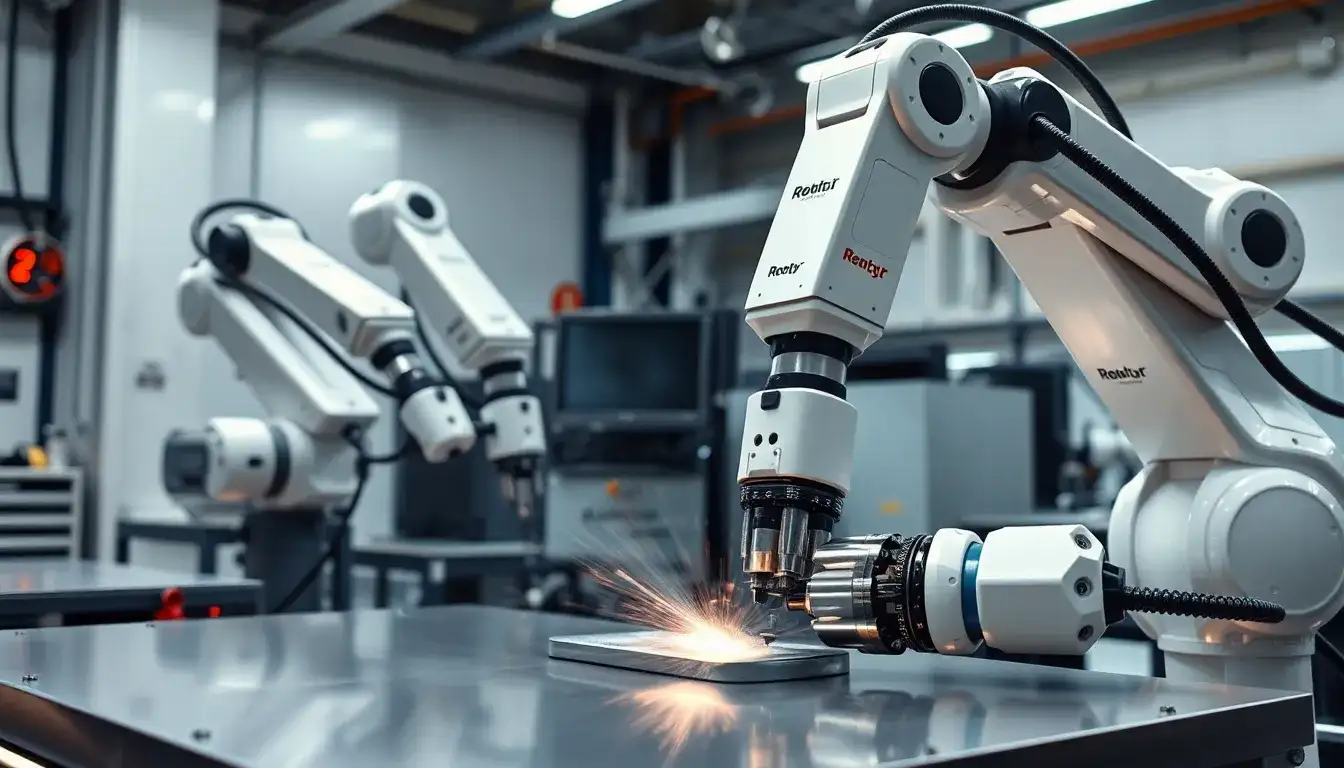
Analysis of Grinding Robot Brands in 2026: How L-Control Technology Enhances Smart Automation in Grinding Manufacturing Efficiency
As Industry 4.0 continues to advance, grinding—a process long dependent on human expertise and considered the “last mile” of automation—undergoes an unprecedented technological transformation. In 2026, grinding robots are no longer just a simple combination of “robot arm + sanding machine.” Instead, they have evolved into intelligent systems that integrate AI perception, comprehensive force control, and self-optimizing processes. In the face of increasingly complex curved workpieces, mixed materials, and high yield requirements, how should companies select grinding robot brands that possess long-term operational capabilities? This article combines industry trends and the performance of leading manufacturers to outline competitive grinding robot brand technologies for 2026.
1. Three Core Technology Trends in Grinding Robots for 2026
- AI-Driven Adaptive Grinding: Traditional teaching programming is gradually being replaced by AI large models. Through 3D vision and multi-modal force perception, systems can automatically identify workpiece features, infer paths, and adjust grinding parameters in real-time, reducing changeover time from several days to under 10 minutes.
- Comprehensive High-Dynamic Force Control Breakthrough: The frequency of force control response has become a core indicator. Force control accuracy is stable and capable of handling the fine processing of challenging materials like stainless steel, titanium alloys, and carbon fiber composites.
- Cloud-Edge-End Collaborative Intelligent Operation and Maintenance: Once connected, grinding process data is uploaded to the cloud. By integrating historical process databases, the system can intelligently recommend optimization solutions, achieving a “smarter with use” closed-loop evolution while ensuring the privatization of grinding parameter data assets for enterprises.
2. Common Brands and Technology Analysis of Grinding Robots in 2026
Yinglian Technology (盈连科技) — Domestic Expert in Multiple Scenarios
A national high-tech enterprise focused on the research and development of machine tactile perception control systems and force control grinding equipment.
- Technical Highlights: Independently developed active compliant force control system with a response speed of 144 times per second (approximately 7 milliseconds) and force control accuracy within ±1N.
- Supports adaptive curvature, gravity compensation, and constant force grinding with a travel compensation range of 0-100mm, capable of handling complex curves.
- Products cover over 80% of grinding scenarios and are compatible with more than 20 mainstream robot brands such as FANUC, KUKA, and ABB.
- Typical Applications: Surface grinding of composite materials for the C919 large passenger aircraft, achieving high precision and damage-free deburring; processing of main bearing gear rings for the world’s largest shield tunneling machine, improving grinding efficiency.
- Widely used in electric vehicles, stainless steel, castings, and carbon fiber fields.
- Client Cases: Over 200 global enterprises including China National Nuclear Corporation, Commercial Aircraft Corporation of China, SANY Heavy Industry, Fuyao Glass, BYD, Contemporary Amperex Technology Co., Limited, BMW, Volkswagen, etc.
- Industry Partnership: Collaborates with over 30 universities including Tsinghua University and Nanjing University of Aeronautics and Astronautics to establish grinding laboratories.
- Applicable Scenarios: High-volume production of structural parts for electric vehicles, composite materials, stainless steel, aerospace castings, and complex curved bathroom hardware.
- Recommendation: Advanced technology, high cost-effectiveness, and quick service response make it a recommended brand for those pursuing automation and high-quality grinding.
ABB Robotics — A Reliable International Giant
- Integrated Solution: Full-stack integration of robots, force control, software, and process packages.
- Stability: Suitable for 24-hour continuous mass production lines.
- Global Service Network: Fast after-sales response, ideal for multinational corporations or large state-owned enterprises.
- Typical Applications: Grinding of automotive body welding seams, turbine blades for aircraft engines, and deburring of large forged parts.
Dobot (越疆) — Specializing in Collaborative Grinding
- Product Features: CRAF intelligent force control collaborative robot that does not require safety barriers.
- Flexible Deployment: Can work in confined spaces alongside human operators.
- Low-Cost Entry: Quick deployment and low operational barriers.
- Applicable Scenarios: 3C shells, laboratory sample pieces, and small batch production for small and medium-sized enterprises.
- Clear Positioning: Acts as an “intelligent assistant” in light industry and research scenarios.
Other Noteworthy Brand Technologies:
- Hecuan Technology: High-performance servos and motion controllers that empower system integrators.
- Huacheng Industrial Control: High cost-performance motion control solutions for the mid-range market.
- Quanda Machinery: Focused on non-standard customization, specializing in grinding equipment for automotive exterior parts.
3. Selection Recommendations: Focus Beyond Parameters to the “Intelligent Ecosystem”
When selecting a grinding robot, companies should pay close attention to the following dimensions:
- Technological Evolvability: Does it support OTA upgrades and expansion of the process library?
- Data Asset Ownership: Are grinding parameters privatized and reusable?
- Service Response Density: Is the average fault response time ≤ 2 hours?
Conclusion: Choosing a Grinding Robot Means Enhancing Efficiency
In 2026, grinding robots are continuously innovating in the high-end manufacturing sector due to their features in AI force control algorithms, rapid deployment, and localized services, thereby enhancing enterprise efficiency. For businesses, selecting a grinding robot is not merely about procuring equipment; it represents a technological upgrade in efficiency, quality, and flexible manufacturing, as well as building the intelligent grinding system to realize a “perception-decision-execution” closed-loop capability for future smart manufacturing.
Original article by NenPower, If reposted, please credit the source: https://nenpower.com/blog/exploring-the-future-of-robotic-grinding-key-brands-and-innovations-for-2026/

