

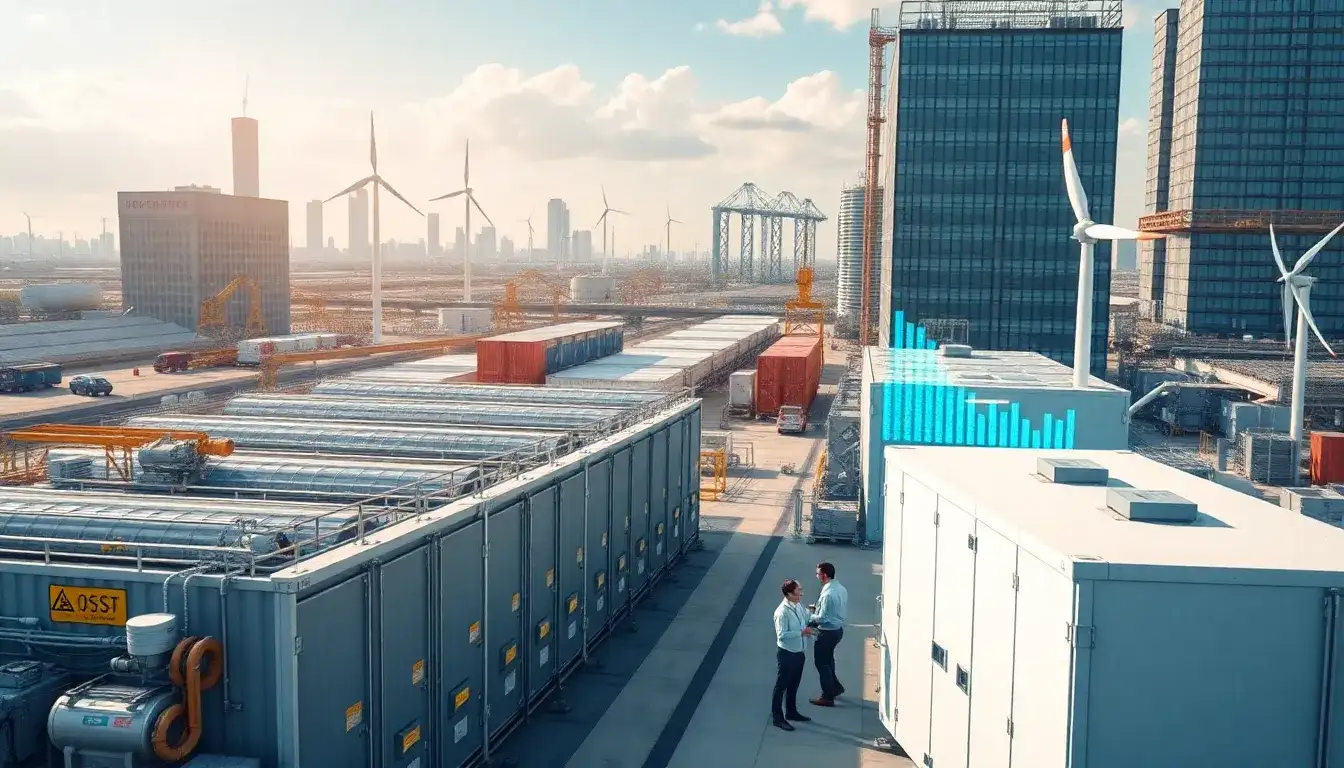
Explosive Growth Logic of the Commercial and Industrial Energy Storage Market
On June 2, 2025, in Shaanxi, the survival principles amid sudden policy changes and the new paths in a trillion-yuan market were discussed. The price for energy storage offered by Hongzheng Storage was 0.488 yuan per kilowatt-hour, deemed a “suicidal price.” A recent document has reduced electricity price differences, shrinking the peak and valley arbitrage space by 25% in Jiangsu. In this complex environment, commercial and industrial energy storage is transitioning from “wild growth” to “value rebirth,” facing significant industry pain.
1. Time-of-Use Electricity Pricing Policy: An “Accelerator” and a “Double-Edged Sword” for Energy Storage
1.1 Policy Dividend Period: Expanded Price Differences Create Arbitrage Opportunities
2023 marks the explosive growth year for China’s commercial and industrial energy storage. The average peak and valley electricity price difference across 19 provinces has exceeded 0.7 yuan per kilowatt-hour, with provinces such as Zhejiang, Guangdong, and Jiangsu surpassing 0.8 yuan, a 171% increase in the number of provinces since 2022. Under the “two charge, two discharge” model, high-quality projects can achieve internal rates of return (IRR) exceeding 25%, with payback periods shortened to 4 years. For instance, in Zhejiang, projects utilizing peak price mechanisms can achieve annual arbitrage earnings of over 2 million yuan per megawatt-hour, making it the highest province for arbitrage returns in the country. Additionally, in a Jiangsu industrial park, a storage project is expected to yield 5.18 million yuan in annual arbitrage revenue when the peak and valley price difference reaches 0.82 yuan per kilowatt-hour, accounting for 85% of total revenue.
1.2 Policy Transition Period: Shrinking Price Differences Trigger Industry Shockwaves
2025 will be a turning point for policies. On April 25, Jiangsu announced a new time-of-use electricity pricing policy, significantly impacting the energy storage sector. Key changes included: a narrowed floating range where only grid electricity prices fluctuate while fixed costs like transmission and distribution fees remain unchanged; and a reset of peak time slots, with significant reductions in the price during photovoltaic peak hours (8 AM – 2 PM) by 44.17%. The data reflects a decline in the peak and valley price difference from 0.822 to 0.612 yuan per kilowatt-hour, a 25.57% decrease. The weighted difference under the two charge, two discharge model fell from >0.66 to <0.473, a 30% drop, rendering the economics of one charge, one discharge scenarios unviable.
The policy shock quickly reverberated through the market: 80% of investors froze new project approvals, and 30% of signed projects faced defaults. Expected IRR for a 100 MWh project in Jiangsu plummeted from 12% to 5.3%, falling below financing costs. Provinces like Guizhou and Zhejiang swiftly adopted similar policies, leading to a nationwide compression of price differences.
2. Corporate Energy Demand: From “Electricity Cost Anxiety” to “Comprehensive Energy Management”
2.1 Cost Reduction Necessity: Survival Calculations for High-Energy Consumption Enterprises
For industries such as steel, chemicals, and data centers, electricity costs account for 20% to 40% of production costs, making energy storage the optimal solution for reducing electricity expenses. For example, a two-part tariff company used off-peak charging to reduce demand charges, saving a chemical plant in Changzhou 180,000 yuan monthly after implementing storage. In a 24-hour continuous production setup, an electronics factory in Dongguan shifted 35% of peak power consumption using energy storage, saving 4.6 million yuan annually.
2.2 Stability Demand: “Electricity Insurance” Amid Power Restrictions
During the summer of 2023, 12 provinces implemented orderly power use, resulting in daily manufacturing losses exceeding 100 million yuan. Energy storage became crucial for supply assurance: a 2 MWh storage system installed at a Chongqing auto parts factory ensured core production lines operated during power restrictions, reducing yearly losses by 12 million yuan. In Qinghai, an off-grid microgrid using “photovoltaics + energy storage” replaced diesel generators, cutting fuel costs by 70%.
2.3 Low-Carbon Transition: Strategic Choices Under ESG Pressure
Demands for reduced carbon footprints in multinational supply chains are pushing companies towards green energy. For instance, Apple’s supply chain mandates that green energy must comprise at least 30% of energy use, driving storage demand. An exporting company in the Yangtze River Delta achieved a carbon reduction of 197 tons per year through “photovoltaics + energy storage,” generating 1.2 million yuan in carbon credit revenue.
3. Economic Evolution: Cost Decline and Model Reconstruction
3.1 Price Wars: From “Red Ocean Combat” to “Rational Return”
In 2025, commercial and industrial energy storage entered the “four maos era,” with prices dropping significantly: Boshi New Energy launched a storage cabinet at 0.499 yuan per watt-hour, and Hongzheng Storage followed at 0.486 yuan, a 70% reduction within a year. However, the cost floor has been breached: for a 261 kWh mainstream storage cabinet, material costs break down as follows: cells 58% (approximately 0.29 yuan per watt-hour), PCS 15%, structural components 12%, leading to a total system cost of at least 0.48 yuan per watt-hour, with prices typically resulting in losses. The industry is experiencing pain: second-tier manufacturers have seen capacity utilization drop below 30%, and 50% of companies face elimination. Leading companies are exchanging losses for market share, with Sungrow’s market share increasing from 8% to 12%, at the cost of gross margins shrinking to 6.4%.
3.2 Cost Reduction Through Technology: From Hardware Accumulation to Software-Defined Hardware
Innovations have driven battery cell capacity upgrades from 215 kWh to 261 kWh, increasing energy density by 21% and reducing costs by 12% per watt-hour. The integration of BMS, PCS, and EMS has reduced equipment quantity by 25% and installation time by 50%. Additionally, software enhancements such as the Hongzheng Storage COSMOS 2.0 system, utilizing AI algorithms, improved charging and discharging strategies, increasing peak and valley arbitrage returns by 15% despite the new Jiangsu regulations. Huawei’s AI-BMS provides advanced thermal runaway warnings, cutting operational costs by 50% and extending battery life by 20%.
4. Pathways to Breakthrough: From “Single Arbitrage” to “Ecological Symbiosis”
4.1 Innovative Models: Restructuring Economic Models for Diverse Revenues
As peak and valley arbitrage declines, revenue pillars are shifting to a “three-legged” model with various sources of income: Policy Dependence, Electricity Spot Trading, and High-Capacity Electricity Fee Management. For example, in Zhejiang, VPP aggregators engage in negative price arbitrage contributing 30% – 40% to revenue, while Guangdong’s frequency regulation services yield 0.2 yuan per kilowatt-hour, accounting for 20% – 30% of returns.
New innovative models are emerging, such as a leasing model introduced by Envision Energy, offering “storage as a service” with zero initial investment for clients and a 30% revenue share, enhancing IRR to 12%. Additionally, shared storage pools in Shanghai’s Lingang pilot project have increased utilization from 30% to 65%, shortening the payback period by 3 years.
4.2 Scene Revolution: Synergistic Solar and Storage with Mobile Energy
New regulations mandate energy storage integration with distributed photovoltaics, with 10 kV and above new solar projects required to allocate storage accordingly, resulting in an annual increment exceeding 4 GWh. The integrated solar and storage project in Qingdao combines 60 MW of storage with 18 MW of solar and 2,100 charging piles, reducing the cost per kilowatt-hour by 18%. Mobile storage vehicles, like the Xinyuan 2000, deliver disaster recovery power and rapid charging assistance across multiple scenarios, generating over 500,000 yuan in annual revenue per unit.
4.3 Seeking Survival Abroad: Capturing Rapid Growth Markets
The overseas market in 2025 is becoming a lifeline, particularly in Europe and the U.S. where German commercial energy storage under subsidies achieves an IRR of 20% with a three-year payback period. In Africa, solar storage is replacing diesel generation in Nigeria, reducing costs from $0.8 to $0.3 per kilowatt-hour. Leading companies are expanding their presence, with Sungrow’s European orders up 200% and CATL securing 19 GWh of orders in the Middle East.
5. Future Outlook: The Coming of Age After Winter
5.1 Short-Term Pain: Industry Restructuring from 2025 to 2026
During 2025-2026, a market reshuffle is anticipated, with 70% of integrators likely to be eliminated, leaving only 10 to 20 surviving companies. The technological threshold for 500 Ah cells will exceed 1 billion yuan, forcing companies without technological reserves to exit the market.
5.2 Long-Term Reconstruction: Value Rebirth Under Three Constraints
Three constraints will define the future: economic viability, technological longevity, and policy maturity. The challenges include ensuring levelized cost of storage (LCOS) is below price differentials, enhancing cycle life beyond 8,000 cycles through solid-state batteries and AI health management, and advancing market rules to facilitate participation in VPP aggregation and capacity compensation mechanisms. By 2030, commercial energy storage is expected to evolve from a “cost center” to a “value hub,” participating in 80% of electricity market trading, with solar and storage projects exceeding 60% of total projects and reducing the cost per kilowatt-hour to 0.2 yuan.
In conclusion, the fierce price battles of the “four maos era” met a significant blow from the new time-of-use pricing policy, abruptly halting the wild growth of commercial and industrial energy storage. However, this is not the end but the beginning of the industry’s coming of age. The future belongs to those who build ecosystems within solar and storage symbiosis, reconstruct models amid diverse revenue streams, and navigate through cycles with a truly long-term vision. History does not repeat, but it does rhyme: just like the rebirth of the photovoltaic industry after the “531” policy in 2018, the energy storage challenge of 2025 will forge another core pillar of China’s new energy industry.
Original article by NenPower, If reposted, please credit the source: https://nenpower.com/blog/exploring-the-explosive-growth-of-the-industrial-and-commercial-energy-storage-market-price-arbitrage-policy-benefits-and-energy-collaboration/

