

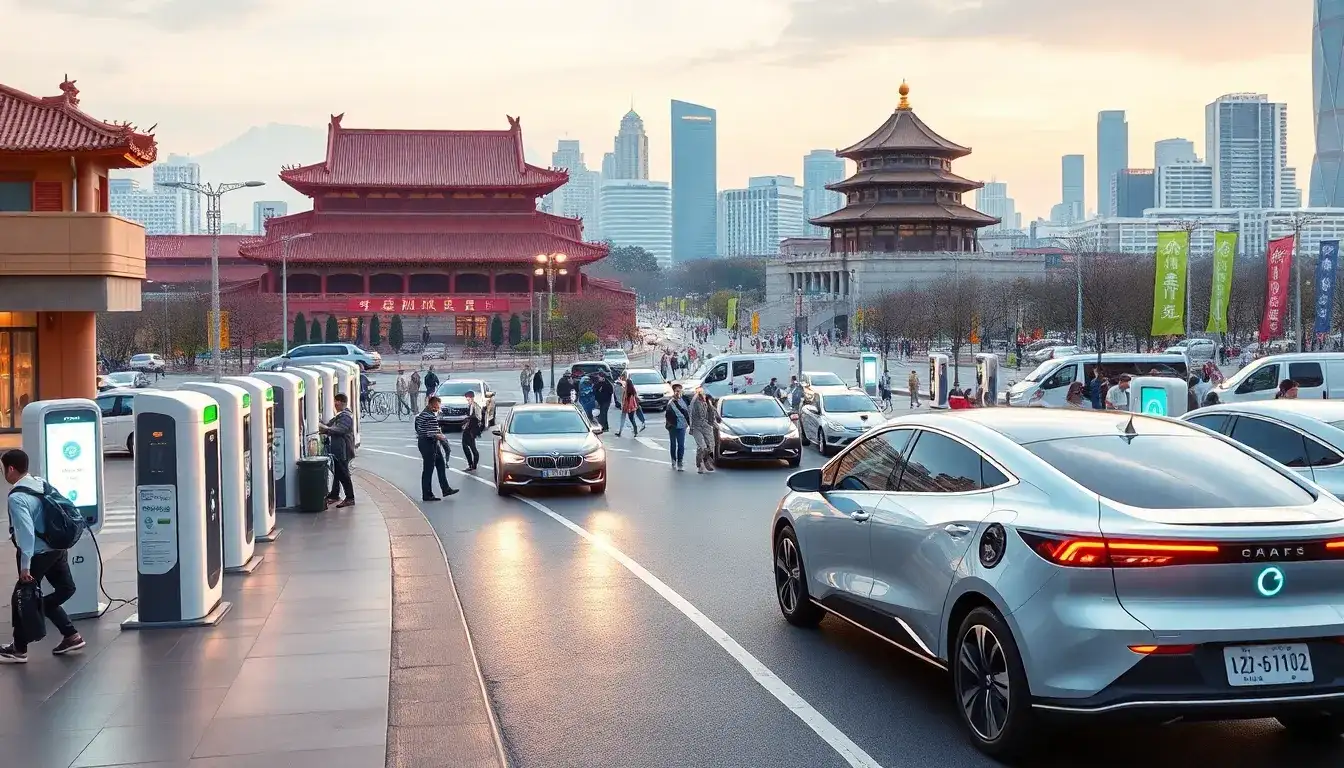
Exploring Intelligent Mobility Together: The Chinese Approach and Industry Future at the 2025 World New Energy Vehicle Conference
On September 28, 2025, from 14:00 to 18:00, the Haikou International Convention and Exhibition Center became the focal point for the global new energy vehicle industry during the “Forward-looking Technology and Integrated Innovation” main forum of the 2025 World New Energy Vehicle Conference. This prestigious event brought together government officials, industry leaders, technical experts, and researchers from around the world. Centered around the theme “Technology Leading the Future, Achieving Better Mobility,” the forum deeply analyzed the integration of automotive technology with AI and next-generation information technology. It discussed the industry’s transformation from mere “transportation tools” to “intelligent mobile spaces, distributed energy storage units, and smart city data nodes,” providing a “Chinese solution” and “global consensus” for the new ecosystem of intelligent mobility.
Policy Guidance: A New Direction for Global Industrial Development
The accelerated iteration of the new energy vehicle industry relies on strategic policy guidance and international cooperation. During the main forum’s speeches, representatives from various governments and industry organizations painted a clear picture of the industry’s development from a global perspective. Miao Hong, Deputy Secretary-General of the Ministry of Science and Technology, emphasized that China has always regarded new energy vehicles as a necessary path to transition from a major automotive nation to a strong one. Since the initiation of key technology breakthroughs in the 15th Five-Year Plan, the Ministry has continuously empowered the industry through five consecutive five-year plans, facilitating the leap from “technological breakthroughs” to “industrial implementation.” Progress includes enhanced energy density and safety of power batteries, successful vehicle installation verification of semi-solid batteries, breakthroughs in key technologies such as automotive operating systems, computing chips, and lidar, large-scale commercialization of L2 level driving assistance, and acceleration of advanced autonomous driving testing. China has also established the largest and most extensive charging infrastructure network globally, leading to the emergence of new business models like integrated “light-storage-charging.” Market data reflects this strength: in 2024, China’s production and sales of new energy vehicles both surpassed 12.8 million units, achieving a penetration rate of over 40%. In the first half of 2025, the market share rose further to 44.3%, with cumulative wholesale sales of domestic new energy passenger vehicles reaching 8.931 million units from January to August, a year-on-year increase of 33.5%. As China’s only free trade port, Hainan has become a fertile ground for innovation in the global new energy vehicle industry due to its unique policy advantages.
Innovative Technologies: Addressing Key Industry Challenges
Over nine innovative technologies were showcased, addressing core areas such as energy replenishment, electric drive, battery safety, and intelligent control, with many results already implemented commercially:
- Huawei Digital Energy presented megawatt charging technology based on full liquid cooling and power pooling architecture, enabling dual-gun 2400A stable current output, which facilitates the use of electric heavy trucks in open applications.
- GAC Group introduced highly efficient, high power density amorphous-carbon fiber electric drive technology, applying amorphous-carbon fiber materials to the powertrain, achieving a motor power density breakthrough of 17.29 kW/kg at 1000 volts, thus helping to reduce overall vehicle energy consumption by 4%.
- BYD unveiled an intelligent all-active body control system (Cloud Lifting X), overcoming challenges in high-pressure sealing and NVH noise suppression, achieving 50 kN of main power output with “0 roll and 0 pitch,” even supporting functions like jumping and leaping.
- NIO introduced a full-vehicle operating system aimed at AI, with a “1+4+N” architecture (1 virtual machine monitor, 4 operating system kernels, N self-developed middleware), achieving cross-domain integration and low-latency communication.
- Infineon showcased AI-oriented high-security, high-performance main control chip technology, improving encryption operation efficiency by 7-21 times through innovations like hardware virtualization and AI acceleration engines, thus fortifying the safety base for intelligent driving.
Future Directions: Groundbreaking Technologies for the Next 3-5 Years
Emerging technologies focus on perception, communication, security, and energy, outlining the direction for industry development:
- Quantum correlation imaging technology provides high-accuracy 3D perception solutions with all-weather and strong anti-interference characteristics, catering to all scenarios of intelligent driving.
- On-board high-bandwidth optical communication technology exceeds 100 gigabits per second bandwidth per fiber, achieving millisecond-level end-to-end latency, likely becoming the optimal solution for the next generation of in-vehicle networks.
- New energy battery AI large model technology addresses the “data island” bottleneck, achieving full-process connectivity from data access to inference.
- Automotive information security technology integrating quantum encryption ensures controllable data throughout its lifecycle with encryption delays within 100 milliseconds.
Market Penetration: Transitioning to a “New Energy Dominated” Era
The rapid rise in penetration rates serves as a clear market signal. Zhu Huarong, Secretary of the Party Committee and Chairman of Changan Automobile, predicts that by 2030, the energy structure of China’s automotive market will have a BEV (battery electric vehicle), XEV (plug-in hybrid + range-extended), and ICE (including hybrids) ratio of 4:4:2, with global new energy vehicle penetration rates increasing from 25% in 2025 to 40%. Wang Xiaoqiu, Chairman of SAIC Group, is even more optimistic, forecasting that by 2030, the penetration rate of new energy vehicles in China will exceed 70%, forming a “433” market structure (40% pure electric, 30% hybrid, 30% fuel).
Technological Evolution: Breakthroughs in Battery and Intelligent Technologies
Battery technology is progressing along a “semi-solid to solid-state” staircase. Currently, companies like NIO and Zhiqi have launched semi-solid battery models (with liquid electrolyte accounting for 5%-10%), which will enter small-scale commercial use between 2025 and 2027. The commercialization roadmap for solid-state batteries is clearer: GAC and Chery plan to implement them by 2026, while BYD and CATL will begin small-scale production in 2027, aiming for large-scale commercialization after 2030, with energy densities potentially exceeding 400 Wh/kg and breakthroughs of 500 Wh/kg anticipated between 2030 and 2035. In the intelligent networking field, the integration of 5G, AI, and the Internet of Things is accelerating, with vehicle-road collaboration and intelligent cockpits becoming competitive focal points, expected to achieve large-scale application in urban traffic management and logistics by 2025.
Ecological Integration: Cars as Key Nodes in Smart Cities
The integration of new energy vehicles with smart cities has entered a phase of deep practice. The industry has reached a consensus that cars are no longer isolated transportation tools but are core hubs connecting energy, transportation, and urban infrastructures. Through real-time interactions between vehicles (V2V), vehicles and infrastructure (V2I), and vehicles and the cloud (V2C), functions such as traffic flow optimization, intelligent scheduling of charging stations, and peak load shaving of the power grid can be realized. The practice of Huawei’s ADS4 system, which has accumulated over 5 billion kilometers of assisted driving mileage, not only enhances individual travel efficiency but also supports traffic management optimization through data feedback.
Globalization: Bilateral Engagement Between Domestic and Foreign Car Manufacturers
Chinese automotive companies are accelerating their “going global” strategies, resonating with the opening of overseas markets. In the ASEAN market, SAIC-GM-Wuling has achieved over 37% market share in Indonesia’s new energy sector through localized production, leading in vehicle ownership; Dongfeng Liuqi has launched new energy heavy trucks tailored to ASEAN logistics needs, completing 20%-80% of energy replenishment in just 60 minutes with an energy consumption of only 1.1 kWh per kilometer. At the same time, international car manufacturers are deepening their engagement in China: Audi, in partnership with Huawei, is developing an ADAS system equipped with dual lidar to optimize for China’s complex traffic scenarios; BMW plans to launch 40 new models globally by 2030, with 50% being new energy vehicles, making the Chinese market a core battleground. This model of “local innovation + global collaboration” is reshaping the global automotive industry landscape.
Thought Exchange: The Collaborative Ecosystem of AI, Cloud, Chips, and Systems
“The automotive industry has entered the ‘smartization’ phase, with AI as the core driving force and ecosystem collaboration as the key to breaking through,” stated Zhang Yaqin, foreign academician of the Chinese Academy of Engineering and Director of Tsinghua University’s Intelligent Industry Research Institute, during a roundtable discussion. This dialogue focused on the integration paths of AI, cloud, chips, and systems, generating many industry consensus points. Zhang noted that the automotive field is the largest “embodied intelligent application scenario” for AI—autonomous driving must meet the standard of “10 times safer than humans,” and AI provides the technological foundation for the transition from “transportation tools” to “intelligent mobile spaces.” Chen Liming, President of Horizon Robotics, added that the industry has entered an era where “AI defines automobiles,” with cloud-edge collaboration becoming critical: the cloud handles large model training and simulation testing, while the edge must support real-time decision-making with efficient computing power, raising higher demands for low latency and high security in chips. “Automotive chips need to compete with mobile chips on the same generation level to meet multi-sensor fusion and AI inference requirements.”
Self-Development and Ecosystem: A Dynamic Balance of Industrial Principles
Regarding the balance between self-development and ecosystem collaboration, Shen Feng, Executive Vice President of NIO, proposed a “core self-research + deep collaboration” strategy. “Manufacturers should focus on user needs and the integration capability of the entire vehicle architecture while maintaining self-research in core algorithms and operating systems, and deeply cooperate with the supply chain through a ‘Tier 0.5’ model, as demonstrated by NIO’s collaboration with Tudatong in developing lidar and with Bosch in co-developing intelligent chassis.” Xu Daqian, Executive President of Bosch (China), cited Tesla as an example, emphasizing the principle of “self-research breakthroughs in the early stages of innovation, followed by ecosystem collaboration”—when technology becomes a “general commodity,” specialization can achieve optimal cost efficiency.
Safety and Data: Core Challenges in Industrial Upgrading
The balance between safety and cost, along with data quality bottlenecks, were central topics during discussions. Zhang Yaqin proposed a solution of “generative AI supplementing real data” to enhance data coverage through a “Real to Sim” closed loop, alleviating testing challenges in “long-tail scenarios”; Chen Liming firmly stated that “safety is 1, everything else is 0,” emphasizing the need for a positive validation system for AI models to address functional safety issues. Participants unanimously agreed that China’s advantages in complex traffic scenario data and industrial chain collaboration efficiency would help it become a global example of intelligent mobility.
Corporate Practices: Differentiated Innovation Paths Among Global Players
In the special speech segment, domestic and international automotive companies and technology firms showcased their “real-world achievements,” demonstrating innovative practices from different dimensions and providing fresh examples for industry development. Akira Matsunaga, Vice President of the Japan Automobile Manufacturers Association, and Masahiro Ochi, Foreign Affairs Manager at Isuzu, jointly released the “JAMA2035 Vision,” proposing to promote the automotive industry’s transition to a “mobile mobility ecosystem” through “decarbonization transformation” and “digital upgrade,” inviting global partners to participate in the “Japan Mobility Exhibition” on October 30 to explore cross-industry collaboration opportunities. Audi (China) CEO, Robin Yinhang, focused on “localized innovation,” highlighting the ADAS system co-developed with Huawei featuring dual lidar, integrating over 30 sensors for 360-degree blind-spot-free perception, equipped with a lidar cleaning system and temperature control module to tackle extreme weather; in the battery sector, they were among the first to meet the new national safety standards set for 2026, ensuring user safety through IP69K protection and 1000-volt insulation technology. The performance of China’s new forces was equally impressive. Deng Chenghao, Chairman of Deep Blue Automotive, shared experiences of “cross-industry integration”: by attracting talents from the ICT sector, co-developing intelligent driving systems with Huawei, and collaborating with CATL to build battery cell factories, they achieved breakthroughs in both “super range extension” and “advanced intelligent driving”; their model L06 incorporates high-end technologies like magnetorheological suspension and 3-nanometer cockpit chips into more affordable models, promoting “intelligent equality.” Jin Yuzhi, CEO of Huawei’s Intelligent Automotive Solutions BU, announced the latest achievements of the ADS4 system, which has assisted in over 5 billion kilometers of driving, avoiding collisions 2.71 million times, with an average user-assisted driving mileage of 727 kilometers in August (accounting for over 70% of monthly driving distance), confirming the user acceptance of the intelligent driving system. Cao Yanfeng, Senior Vice President of Infineon Greater China, revealed that their 28-nanometer millimeter-wave radar chips have been shipped in bulk, with a centralized radar architecture reducing system costs by 30%; Yang Yuxin, CMO of Black Sesame Intelligence, introduced the A2000 chip targeting L3-L4, enhancing computational efficiency through the “Nine-Sheng NPU” architecture, with plans to extend automotive chip technology to robotics and low-altitude economy fields.
Conclusion: Navigating the Stars of Intelligent Mobility Together
From policy collaboration to technological breakthroughs, from trend analysis to corporate practices, every aspect of the “Forward-looking Technology and Integrated Innovation” main forum at the 2025 World New Energy Vehicle Conference conveyed a core message: the competition in the new energy vehicle industry has evolved from a contest of singular technologies and individual companies to a comprehensive contest of global industrial chains, innovation chains, and ecological chains. As Wan Gang, Chairman of the Chinese Association for Science and Technology and Chairman of the World New Energy Vehicle Conference, stated during the award ceremony, “Open cooperation is the only path for industry development; only by using technology as the pen and innovation as the ink can we collectively write a beautiful future for intelligent mobility.” With continuous breakthroughs in solid-state batteries, quantum sensing, and vehicle-road collaboration technologies, new energy vehicles will truly become “key nodes connecting energy, transportation, and cities,” injecting new momentum into the sustainable development of the global economy as the world moves towards a 40% penetration rate by 2030. This gathering in Haikou is not only an industry event but also a shared consensus among global automotive professionals—to set sail towards the stars of intelligent mobility with forward-looking technology as our sail and integrated innovation as our oar.
Original article by NenPower, If reposted, please credit the source: https://nenpower.com/blog/exploring-smart-mobility-chinas-vision-and-future-of-the-global-new-energy-vehicle-industry-at-the-2025-world-conference/

