

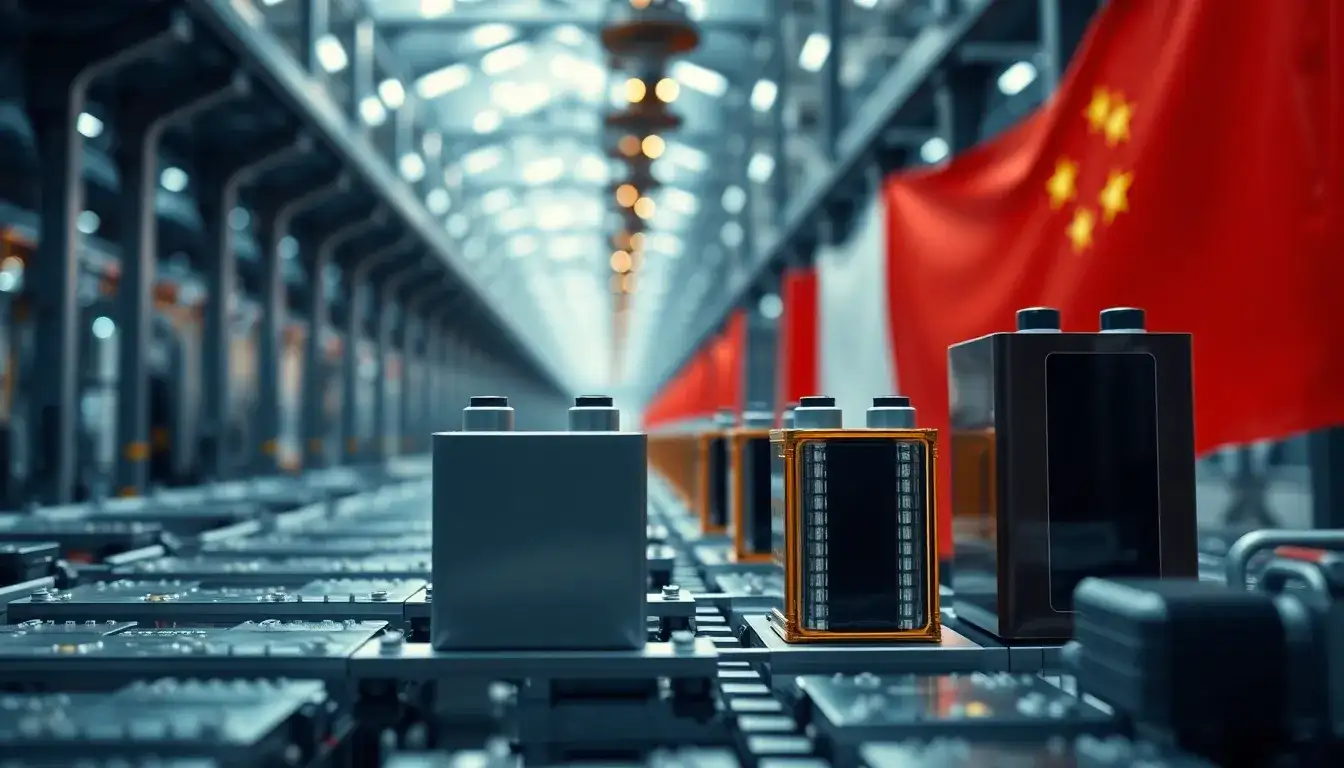
The race for solid-state batteries has taken an intriguing turn recently, as reports suggest that European and American companies may be leading the way. A noteworthy development involved a Mercedes-Benz EQS test vehicle equipped with a solid-state battery, successfully completing a long-distance journey from Stuttgart, Germany, to Malmö, Sweden, covering 1,205 kilometers without interruption. Upon arrival, the vehicle still had a remaining range of 137 kilometers. The Chief Technology Officer of Mercedes stated that this achievement represents a “disruptive breakthrough” in solid-state battery technology. Importantly, the solid-state battery pack used in this experiment boasts a performance of 450Wh/kg, which is a 25% improvement over traditional lithium-ion batteries, while maintaining similar weight and volume to mass-produced battery packs. This news has created a significant buzz in the global new energy sector, prompting discussions about whether Europe and the U.S. are now ahead in solid-state battery technology.
Notably, this is not the first time that overseas car manufacturers have celebrated similar “breakthroughs” in solid-state battery technology. A few years ago, Toyota made headlines by claiming that its solid-state battery technology was “20 years ahead of China,” asserting that once mass production commenced, it would revolutionize the fuel vehicle industry. Historically, Japanese fuel vehicles dominated the market for decades but lost their luster due to missed opportunities in the new energy sector. The rise of Chinese companies such as CATL and BYD has significantly impacted the standing of established Japanese automakers. In 2023, China’s total automotive exports surged by 57.4% year-on-year, surpassing Japan for the first time and marking it as the world’s largest automotive exporter, which has contributed to a growing sense of crisis within the Japanese automotive industry. In 2022, Toyota sold only 24,000 electric vehicles, less than the average monthly sales of BYD.
Faced with this widening gap, Toyota’s Chairman Akio Toyoda publicly criticized electric vehicles as “inferior products” lacking in technological substance. Some Japanese media outlets have even spread rumors about “overstated range” and “flammable batteries” in Chinese electric vehicles. In the realm of solid-state batteries, Japan’s actions have also been inconsistent. A decade ago, Toyota invested 1.5 trillion yen in research and development, securing over 1,300 patents and establishing a leading position in this field. Although there was initial concern regarding this investment, the reality has proven to be disappointing, as Toyota’s plans for mass production of solid-state batteries have been repeatedly delayed, pushing the timeline from an initial target of 2026 to 2030, with no sight of actual production yet.
The commercial viability of solid-state batteries cannot be discussed without considering the advancements made by Chinese companies, who have been quietly making significant progress. While European manufacturers celebrate the testing of solid-state batteries, China is already contemplating how to achieve mass production. Guoxuan Hi-Tech recently announced the completion of its experimental production line and plans to enter the pre-mass production phase, with battery yield rates reaching 90%. Meanwhile, SAIC Motor Corporation has announced that its solid-state battery technology will be ready for mass production by 2026; CATL aims to achieve mass production in two years; and GAC Aion plans to launch its solid-state Haobo model in 2026, with the Zhiji L6 semi-solid state battery already achieving a range of 1,000 kilometers. Overall, Chinese car manufacturers have adopted a dual-track strategy of “semi-solid transition + full solid-state sprint.”
On the policy front, support for domestic solid-state batteries is gaining traction. In April 2025, a document released by the Ministry of Industry and Information Technology outlined plans to promote the establishment of solid-state battery standards. Following this, the Ministry and the State Administration for Market Regulation issued an action plan to support cutting-edge research in solid-state battery technology. Additionally, patent data indicates that China accounts for 36.7% of global solid-state battery patent applications, with an average annual growth rate of 20.8% over the past five years, the fastest rate in the world.
While Mercedes’ recent breakthrough is certainly noteworthy, it is essential to recognize that Chinese companies are also making strides and are not lagging behind. In terms of the pace of industrial implementation, Chinese enterprises appear to be more pragmatic. Crucially, China possesses unmatched advantages in the solid-state battery supply chain, from cathode materials to separators, electrolytes, and battery recycling systems, forming a closed loop. This comprehensive capability is the core support for transitioning solid-state batteries from the laboratory to the market. If European and American companies wish to accelerate the mass production of solid-state batteries, they will likely need to collaborate with Chinese supply chains. Thus, the notion of being “first to the finish line” may reflect more of a temporary technical highlight rather than a definitive industrial advantage.
Original article by NenPower, If reposted, please credit the source: https://nenpower.com/blog/european-and-american-solid-state-batteries-make-major-advances-overtaking-china-by-20-years-saic-plans-mass-production-next-year/

