

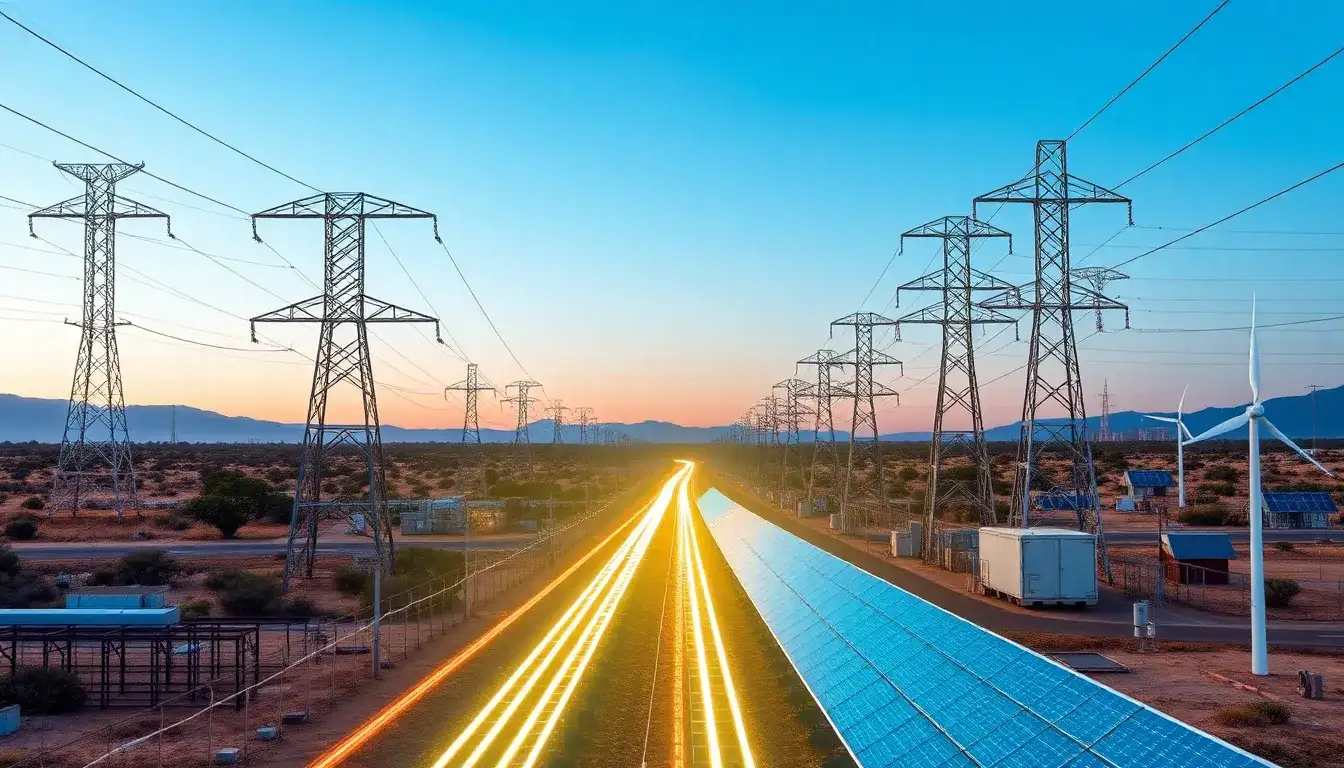
### Adding Stability and Reliability to the Western Australian Grid
By Drew Robb
Tuesday, July 1st, 2025
Large distances are a common aspect of life in Australia. For instance, Perth, located on the west coast, is approximately 2,500 miles away from Brisbane on the east coast. Within Western Australia (WA) itself, the distances are equally vast. The state consists of two distinct, non-integrated grids that serve only portions of the area. The North West Interconnected System (NWIS), situated around 1,000 miles from Perth, services towns like Karratha and Port Hedland and extends inland to support mining operations. In contrast, the South West Interconnected System (SWIS) is centered around Perth and is the state’s largest network, managed by Western Power, which oversees the transmission and distribution infrastructure, while Synergy serves as a significant generator and retailer of electricity. Both entities are government-owned.
Within the SWIS, Kalbarri is located nearly 400 miles north of Perth, Bremer Bay is about 300 miles to the southeast, and the gold mining region surrounding West Kalgoorlie lies roughly 400 miles to the east.
The SWIS comprises nearly 8,000 kilometers (about 5,000 miles) of transmission lines. With the recent surge in renewable energy usage, the SWIS has developed a duck curve similar to California’s. Currently, about one-third of homes connected to the grid have rooftop photovoltaic (PV) systems installed, which can produce twice the electricity of the largest power station during peak summer days. In the evening, however, there is a rapid demand for power from various sources, including coal, natural gas, waste-to-energy, wind, and battery energy storage systems (BESS). Projections indicate that the duck curve will continue to deepen.
The state’s PoweringWA decarbonization initiative has set ambitious goals to reduce carbon emissions by 80% by 2030, relative to 2020 levels, and to achieve net-zero emissions by 2050. Recent developments include the Merredin Solar Farm, located 260 kilometers east of Perth, which features 360,000 solar panels capable of generating 281 GWh of electricity annually. Additionally, more BESS are being integrated into the 100 MW/200 MWh system that Synergy has already implemented in the Perth area. Over the next two decades, around 4,000 kilometers of new transmission lines and 50 GW of new renewable electricity and storage infrastructure are expected to be added to the SWIS.
To address the challenges posed by peak demand periods, Synergy and other local utilities are encouraging consumers to shift their energy consumption to midday when solar energy is abundant. They have established virtual power plants (VPPs) that can adjust dynamically to the needs of the electricity system by better integrating distributed energy resources (DERs). Additionally, the WA government has introduced emergency solar management (ESM) to remotely manage household solar power, temporarily disconnecting it during excess production to prevent outages.
The initial strategy in much of Australia focused on retiring coal and natural gas plants and rapidly transitioning to renewable energy sources. However, this approach has been revised due to challenges like the duck curve in the SWIS and issues with grid stability. As coal and gas plants are taken offline, the critical inertia typically provided by steam and gas turbines is lost. Renewables cannot replicate this inertia, leading to frequency fluctuations, insufficient reactive power, and other problems that could potentially cause blackouts.
Consequently, the PoweringWA initiative now includes investments in pipeline infrastructure and gas generation to provide stability to the energy system, alongside efforts to stabilize the grid. Existing gas plants have received a 10-year exemption from new emission limits. For example, the Pinjar Power Station, which consists of six GE Vernova Frame 6 units and three Frame 9 units, operated by Synergy, has a capacity of 576 MW and can be online within 15 minutes. This swift response capability is essential for the SWIS, especially during evening hours when demand peaks as people return home from work.
However, plants like Pinjar require significant capital investment and incur substantial operating costs. If they operate only intermittently, it may not be financially viable to keep them running. Fortunately, the state now compensates facilities for providing ancillary services. With the influx of wind and solar energy onto the national grids, the Australian Energy Market Operator (AEMO) conducted a thorough analysis and found that wholesale closures of coal plants and gradual phasing out of remaining natural gas plants were leading to system issues across various regions.
Synchronous alternating current generators, such as coal and natural gas plants, have crucial characteristics for secure power system operation and grid support. They provide essential services such as:
– **Inertia:** Large rotating machinery that offers resistance to changes caused by disturbances.
– **System Strength:** These machines generate significant short-circuit fault currents, which are necessary for maintaining consistent power output during voltage drops.
– **Voltage Control:** They absorb and generate reactive power to regulate voltage levels.
– **Frequency Control:** They can automatically adjust rotational speed in response to demand variations.
– **Dispatchability:** They can be brought online or offline as needed within the operational limits of the units.
The AEMO study concluded that continuing on the path of phasing out fossil fuel plants could lead to increased risks of cascading failures, widespread load shedding, and potential blackouts unless proactive measures were taken to implement technologies and regulatory reforms that support renewable generation.
In the SWIS, failure to address stability issues could lead to a more unstable grid, necessitating interventions to limit non-synchronous generation. Consequently, various programs and incentives have been developed to create a more attractive ancillary services framework. The report recommended identifying optimal locations for deploying synchronous condensers or other technologies to ensure system strength and inertia are maintained at required levels. This led to the establishment of AEMO’s Wholesale Electricity Market (WEM) rules, which compensate power producers for services such as load following and spinning reserve.
An AEMO report stated: “Technical standards and regulatory and market structures require carefully designed but urgent changes to implement or incentivize new technologies in the SWIS, such as synchronous compensation, energy storage, and enhanced inverter capabilities.”
At the Pinjar Power Station, several units have been retrofitted with synchronous self-shifting clutches from SSS Gears Ltd. of Sunbury, UK. These clutches enhance system stability and grid support. When the turbine operates faster than the generator, the clutch engages, allowing the turbine to drive the generator. Once the generator synchronizes with the grid, the turbine slows down, and the clutch disconnects, converting the generator into a synchronous condenser.
“In recent years, there has been a focus on the need for synchronous compensating functions worldwide,” noted Jean-Bernard Gross, technical and sales area manager for Australia at Flender-Graffenstaden. “This aligns with the global push for renewable integration and the necessity for increased system inertia and strength.”
This synchronous condensing upgrade brings several benefits to the grid, including voltage support through reactive power and enhanced transmission efficiency, which is critical given the vast distances in WA. As coal plant retirements progress, the demand for system stability will only grow. Synergy’s last two coal power stations are set to close in the coming years, representing nearly 1.2 GW of generation.
To ensure the Pinjar plant can meet its ancillary services requirements, Synergy has ordered a critical spare load gear and SSS clutch. This precaution aims to maintain the system’s ability to provide real and reactive power despite unexpected faults, failures, or routine maintenance.
“There has been an increasing requirement from the grid operator to validate the availability of the synchronizing condenser function, leading to the need for the purchase of the critical spare,” Gross explained. “We received an order for a replacement gearbox at Pinjar with an SSS clutch to serve as a critical spare for the fleet with synchronizing condenser capabilities.”
In conclusion, Western Australia is aggressively pursuing its renewable energy goals while also implementing essential transmission and grid support strategies to ensure a reliable electricity supply for its population.
—Drew Robb, [drew.robb@example.com](mailto:drew.robb@example.com), has been a freelance writer for over 25 years, specializing in engineering and technology.
Original article by NenPower, If reposted, please credit the source: https://nenpower.com/blog/enhancing-stability-and-reliability-in-the-western-australian-power-grid/

